Search This Blog

Friday, 13 May 2016

Tabby's star and other stellar oddities....

Above: An asteroid being transformed into a crude spaceship - by this method a star encircling structure might be built. Image courtesy of NASA.

At least part of the mystery surrounding Tabby’ star – aka KIC 8462852, the star that was accused of having alien mega-structures (or swarms or something) around it – has probably been cleared up: The apparent long-term dimming of the star appears to have been an illusion caused by, ironically, improvements in telescope optics and use over the years. 

So, no, this probably isn't happening*. Sorry guys.

The short term dips in its brightness - dips that last for days and suggest massively wide things passing in front of it at irregular intervals – are definitely real. That leaves a mystery that still makes this star among the strangest we’ve ever seen.

And it's not alone. In fact, strange isn’t that strange out there: As we’ve got better at exploring the universe we’ve encountered many more weird things than are generally known about. For example: There’s a young, Sun like star that rejoices in the name TYC 8241 2652. Like many young stars, it had a ring of warm dust around it - discovered by infra red astronomy in 1983. That ring was a signature of planet growth going on, made from microscopic debris kicked up by two or more colliding protoplanets.
Above: An artist's impression of a stellar dust ring.
 
For twenty five years the ring was pretty much unchanging - that's not surprising: The ring filled the space around the star, out to the distance of the orbit of Mercury around our Sun. That's a lot of dust, trillions of tons of it, spread through a gigantic volume of space. It would take something spectacular to move all of that to somewhere we couldn't see it, and something really spectacular to do so in less than centuries.

Henry, what have you done!?

So it's a bit odd that all the dust just disappeared in 2010. The astronomers at the Gemini observatory, who've been trying to figure this out, thought their observations must be wrong: "The dust disappearance at TYC 8241 2652 was so bizarre, and so quick, initially I figured that our observations must simply be in error in some strange way,"  said Ben Zuckerman of the University of California, who's been studying these kind of dust rings for over twenty years. "It's as if you took a conventional picture of the planet Saturn today, and then came back two years later and found that its rings had disappeared."

So what happened?  To this day we don't know, just like the whatever-it-is at Tabby's star... ...which is brilliant: I love a mystery!
There are other stellar oddities out there....
So don't be too sad that Tabby's star has gotten slightly less mysterious - there're plenty of mysteries still out there....

* In fairness what's shown in that (commonly used for this story) picture wasn't likely to begin with - a solid shell would need materials far stronger than anything we can even theorize about.


Want to get direct links to our sources, and to stories we didn't have time to write about? Then you might like to subscribe to the Ancient Solar System News Round Up...

* indicates required

Wednesday, 11 May 2016

Life on Venus?

One of our major assumptions about any extraterrestrial life we might find is that it will need water - in fact it's one of NASA's main criteria in the search for extra terrestrial life.  
Why water? Because life is an incredibly complex set of chemical reactions. For those reactions to take place the ingredients need to travel to find each other, and have a way of mixing together. Liquid water does both. It’s an ideal choice for this role, especially on Earth: Most of planet is covered in it, you're 75% water, jellyfish are 98% water.... life on Earth means water.  

Above: A jellyfish - literally water with stingers.

But water’s not the only possibility. Next door* to Earth is Venus, a world that could generously be compared to one of the more desolate suburbs of hell. The surface is crushed under 90 atmospheres worth of CO2, and may once have been awash with oceans of liquid CO2. The temperature is pushing 400 degrees Celsius. But the clouds … the clouds of Venus conceal a layer, 70 km up, that is probably the most Earth like in the solar system: Similar temperatures, pressures, and an abundant solvent available as mists and cloud droplets. But not water: Sulphuric acid.

Above: Venus, showing the strange dark markings that cover it's clouds in the UV spectrum.

Even the most acid-adapted terrestrial organisms wouldn't last long there: There are organisms that can survive in very acidic water,  but this is just plain acid. There are organisms that can live up in the clouds, but on Venus they could only live in the clouds – to be pulled into the depths would mean being pressure cookered to death. 

But, for all that, the idea has a remarkable appeal to astrobiologists. Plausible biochemistries that can work in sulphuric acid have been suggested, using chemical bonds that would behave in sulphuric acid the same way terrestrial chemical bonds do in water. For example the carbon – carbon triple covalent bond could replace the carbon-oxygen bond Earth life uses**. Some terrestrial plants do use that bond, in producing fragrant molecules.

Above: Zinnias, which produce smell molecules that are literally Venus proof...

Even if the chemistry could work, what about metabolism, inorganic trace elements, and all those other things life needs? Well, energy is abundant on Venus, both from the Sun at the cloud tops and the brooding heat of the surface far below. Volcanic eruptions can inject rarer molecules into the atmosphere as aerosols. Any cloud living organisms would still struggle not to be pulled into the burning depths. But it looks like at last worth thinking about – if not for Venus than for other acid rich worlds out there. 

So, is there any evidence? Well...there’s something are going on at Venus which we don’t fully understand – and cloud borne life might be an explanation: Probes riding balloons in the Venusian cloud tops have detected tiny particles in the clouds that were roughly the size of bacteria, and not the spherical shape expected of liquid droplets. 

The Venusian atmosphere also contains chemical imbalances, a phenomena thought by many astrobiologists to be an indicator of life: Sulfur dioxide (SO2) and hydrogen sulfide (H2S) are both present, even though they shouldn’t be found together — when in the same place, they react with each other. Something on Venus must be creating them and one thing that could be skewing the atmospheric composition is a simple cloudborne eco system. 

There are actually a lot of chemical mysteries in the Venusian clouds: Carbonyl sulfide is present, which is so difficult to produce inorganically that it has been claimed as an ‘unambiguous indicator of biological activity' ***. The clouds are also full of a mysterious UV absorbing material: One  explanation for that is that microbes may be absorbing the UV, either for energy, or as a naturally occurring sunblock made of sulphur.  

Or it's due to huge cloud monsters....
It's only a theory. But, if it turned out Venus was harbouring exotic life all along... how awesome would that be?


* 38,000,000 km, which is 'next door' by space standards.

**For where I got that information from, and a lot more on potential alternative biochemistries, follow this link to the book 'The Limits of Organic Life In Planetary Systems', which you can download for free. Yes, I read this stuff for fun.

***Probably other astrobiologists disagree, else this piece would be titled ‘the amazing acid drinkers of Venus’ or just ‘ the universe is weird’


Elsewhere in the Universe:

Mercury crosses the Sun


Space X nails a second re-useable rocket landing.

Odds are good the universe has hosted other civilisations.
 

Want to get direct links to our sources, and to stories we didn't have time to write about? Then you might like to subscribe to the Ancient Solar System News Round Up...

* indicates required

Sunday, 8 May 2016

Water carved valleys on Ceres?


Above Top: The latest image of Ceres. Above bottom: The latest image of Ceres with my highlighting of what I think might be one of the dendritic valleys.

A number of pundits looking at the latest image releases from the Dawn mission to Ceres are claiming to be seeing dendritic valleys. Dendrite means that they valleys break into many fingers or channels at one end - a pattern that usually indicates a valley carved by a fluid flow, or even a fluid flow caused by precipitation (rain). As one amateur image buff exclaimed "are we looking at Ceres or Mars?"

Could it have once rained on Ceres?

Er... no.
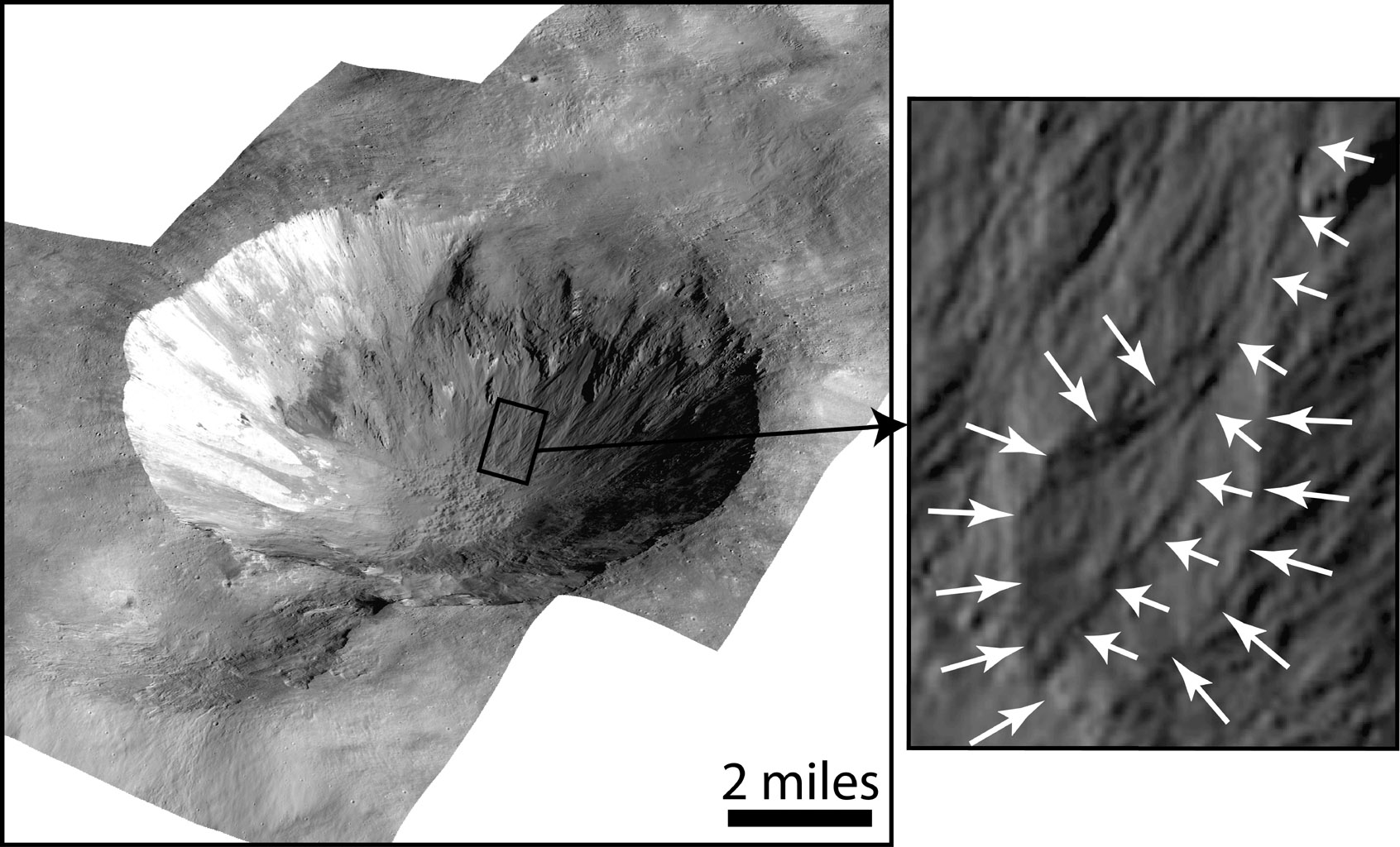
Well, ok, anything's possible*, but right now Ceres has no atmosphere at all, so I'd say rain is unlikely. However the idea that we might find signs of water flow on Ceres isn't so crazy - even though the surface is far less hospitable than Mars, where signs of water floes have been debated for decades. The reason why I say this is because, to the great surprise of many, possible signs of water (or at least water-y sludge) flow were seen on Vesta by Dawn. If it could happen on Vesta then it could happen on Ceres - but there's no official word yet, only Internet scuttlebutt, and a proper analysis of the possibilities for Cerean water will take years. And that's after many more, much higher resolution, images have been taken by Dawn, so don't hold your breath for a quick and definite answer.

Above: Possible water carved features on Vesta. Courtesy of NASA.


It's kind of a recurring theme in space research: Does the path of our solar system through The Milky Way galaxy have any influence on the timing of asteroid/comet strikes, drops in the Suns brightness, and other things that could cause mass extinctions? Impending cosmic doom is a great motivator, and I've read papers arguing one way or the other before, but this is the first time I've read an entire thesis on the subject. The answer it arrives at isn't entirely yes or no, but it definitely rules out a lot of possibilities, based on the data we currently have to hand.


*Yes, even that thing you just thought of. But I said possible, not remotely likely

Thursday, 5 May 2016

Starship drives part 3: Out of the box ideas...


After the recent announcement of the Breakthrough Starshot initiative, a $100,000,000 'feasibility study' to solve the problems of travelling to the nearest star, we were looking at  possible engines for a starship - from those we might build with today's technology (albeit at great expense and difficulty) to those that are only unproven theories.

But let's say we'll always be limited to no more than a few per cent of lightspeed: It would take us decades just to reach the very nearest stars. That's no good for building an interstellar empire. There are, however, ways around the problem...


Make yourself live longer (or even become immortal):

Above: Tick tock, tick tock...
The longest lived humans make it to maybe 120 years. But what if we improve on that? There are creatures, like tortoises, that can easily clock up two centuries. There are simpler organisms, like jellyfish, that can live much longer: One species in particular can return to a larval state and regenerate, effectively living forever.

Above: Jonathan the 184 year old tortoise gets his first ever wash.

What if that's the real key to a race establishing itself in the galaxy - not high power stardrives but just having a long lifespan? Does that make us permanently excluded from the club?
Maybe not. 

It shouldn't come as much of a surprise that life extending technologies are being investigated, with some promising results. We've only got lab only experiments so far, but fruit flies, mice, and other creatures have had their lifespans extended. Some insects have had their lifespan doubled by deliberate genetic mutation.

Above: Turritopsis dohrnii, the tiny immortal jellyfish.
If we could count on a hale and hearty existence into our 230th year, would a wait of 100 years for a slow-boat mission to reach a nearby star system really seem so terrible?
And, if enough life extension to cross the galaxy seems too much to hope for, there're other ways of living to the end of a long mission...


Freeze yourself:

Space travel: A great excuse to get nude with everyone. Until the aliens star jumping out of people's chests...

People have been falling (and getting pushed*) into freezing water since forever, and once in a while they would be found and revived - sometimes after hours. From this the idea of freezing a person and reviving them at a distant future date has become a serious proposition. It's a sci-fi staple and, although in the real word we're still a long way off, simple oreganisms and even early stage human embryos have been
revived and born after over ten years on ice.

Although freezing adult people for space travel is still impossible (don't believe the promises of people who claim they can freeze your body to be revived in  the future - think about that promise for a second), research into it actually has more immediate life-and death applications. In hospitals suspended animation has been used in an attempt 
preventing gunshot/stabbing victims from deteriorating until they can be operated on.
 
Become an A.I.

Yup, we're into Matrix terretory.
This is probably the most extreme of the 'live longer' options: Take the human mind, download it into a computer, and you can crew your ship without having actual bodies. The computerised minds won't age, and can run the spacecraft for centuries if needs be.

As bizarre and terrifying as this sounds, it is being investigated. 'Uploading' a human is a real goal for
Ray Kurzweil, director of engineering at Google, who claims people will be able to "upload" their entire brains to computers by 2045. IF that were to happen then worries about lifespans on a space mission would be irrelevant: The uploaded people would be effectively immortal.

Although that immortality does have a weak spot.

Although uploading a full human mind is still far away (if it should be done at all) there are glimmers that it could eventually be done: The 'Openworm project' succeeded in copying the nerve patterns of a nematode worm (it's 'mind' as far as it has one) into an artificial body last year. 


Move Earth:


Yep, this has seriously been looked at and found, if not practical today, not impossible either. And, if you want to travel from Earth to a planet in another solar system quickly, why not move Earth closer?
Well, OK, the obvious answer is because that's freaking insane. Except.... maybe it's not: There have been
serious suggestions on how it might be possible to move the Earth - such as building a huge sail (a lightsail, which have been test flown by several space agencies, here and here), and towing Earth using gravity. Another involves slingshotting asteroids around Earth, gradually altering its orbit.

Although these ideas show that moving a planet isn't as impossible as it sounds, it would take a huge amount of time to Move Earth far. Even if you waited for a close pass by another star - as happened 70,000 years ago - you'd need a far more efficient method of propulsion to transplant Earth into another solar system. That said... it might be possible to engineer such a close encounter - and it might be desirable to do so, since one day our Sun will die.

Extreme as it is, in many way's it's more plausible than things like warp drives or wormholes- they need large amounts of negative energy, and precise control of black holes to be made to work - this would just need patience.
And it's not the most audacious plan to improve interstellar commuting. Not by a long shot....


Move the solar system


If you're looking for an insane idea that would make any James Bond villain wet themselves in awe, look no further than the Shkadov thruster: A plan to turn the Sun into a gigantic engine and steer this entire solar system through the galaxy like... well I can't think of anything it'd be like. Well done Leonid Shkadov, you've broken my ability to metaphor.

To do this you'd have to take the planet Mercury, and spin it out into thin, reflective sheets. Then wrap half the Sun in a gigantic structure called a Shkadov sail, made from those sheets. The pressure of sunlight would hold the sail up against gravity, much like today's solar sails, and the Sun's light and particle emissions would be diverted in one direction, generating a thrust.

Although such a drive would take millions of years to work, it would eventually allow a patient race to park their star system in easy commuting distance of any other star they liked the looks of - or several races together could park their stars into a miniature cluster. In combination with the planet moving ideas mentioned above, that might allow them to make their homeworld immortal, hopping from solar system to solar system for ever.


But there may be a simpler way... 


Move to a star cluster...

Above: A globular cluster.

If your race have the patience to consider Skadov's ultimate engine then you'll know there's a natural alternative: Around the edges of our galaxy lie collections of stars called Globular clusters'. Although they sound like something you spit up when you've got a bad cold, they're actually huge complexes of long lived stars, all living within fractions of a lightyear.
Havard scientist Rosanne DiStefano has pointed out that, for the advanced alien who likes company, worlds inside such a cluster
would be a prime location - species could live within easy travelling distance of each other, making something like Star Treks Federation (Or Star Wars' Galactic Empire) practical, even with sublight drives.

Before anyone points out that at least three of those ideas are, well, insane.... yes I realise they are. But they make a great leaping off point for thinking and talking about our place in the universe, and just how big and grandiose engineering might get for a star faring race.

And, it's worth remembering too: None of them is physically impossible - and if there's anything history on Earth has taught us, it's that as long as something is possible it's not question of if it will ever be done.... just when...

* It's not suspicious I made that distinction. Shhhhhh.


Want to get direct links to our sources, and to stories we didn't have time to write about? Then you might like to subscribe to the Ancient Solar System News Round Up...

* indicates required

Sunday, 1 May 2016

SpaceX's Dragon 2 - opening up the solar system?


Elon Musk, founder of SpaceX, announced recently that he plans to launch aprivate (unmanned) mission to Mars. The core of the mission will be SpaceX's Dragon Two capsule, an upgrade on the Dragon One model currently flying missions to and from the ISS. Dragon Two - which is currently undergoing testing - will be capable of ferrying up to seven crew to ISS.
That's cool enough, but the design isn't limited to ISS flights: It's designed to land on any world with a solid or liquid surface.

Above: A mock up of dragon two, on display at a SpaceX facility.

In conjunction with SpaceX's planned Falcon Heavy rocket it could put four tonnes of equipment on Mars, land on the Moon, or even put a payload onto one of the Moons of Jupiter.

Above: SpaceX's recent landing of it's Falcon re-usable booster.

Musk, it seems, isn’t content with less than the whole inner solar system - and he aims to make Dragon Two the standard interplanetary delivery vehicle.

Above: Dragon Two tests it's propulsive landing engines.

In September we'll find out more details of the planned Mars mission. The internet is already alight with speculation on it, so instead I thought I’d try looking at some of the ideas being raised for using Dragon Two to explore the rest of the solar system.

First, some caveats: Putting humans onto another world -possible excepting the Moon or a small asteroid - with just a Dragon Two isn't really an option because many months in a capsule the size of a big shower cubicle isn't great for astronaut psychology.
Plus Dragon 2 is designed to land on these worlds, not take off again... which is also bad for astronaut psychology*.


The Moon:

Above: An Apollo astronaut . Will humans return to the Moon any time soon?

If you can do a rocket powered landing on the Martian surface you can certainly manage one on the Moon. Dragon Two could land large loads of sensors and instrumentation, heavy duty  rovers, multiple small rover, supplies and equipment for a lunar base, or robots to build one. There's a lot still that we don't understand about the Moon, and scientists are very eager to get exploring:


  • ISRU (In-Situ Resource Utilisation): This is one of the big enabling technologies we'll need to develop if dreams, like Elon Musk’s, of expanding into the solar system are ever to be realised. Experiments with using lunar resources for construction and science are also high on peoples list: It would take far less energy to build and launch a vessel from the Moon than it does from Earth.

Above: The strange 'Ina' formation, which seems to have erupted in the last million years.

Although Musk himself is focussed on Mars, a lot of folks who'd like to begin exploring the Moon again are paying close attention to the Dragon two.

Near Earth asteroid:

Above: An artists impression of an asteroid being transformed by 3D prinitng. Courtesy of NASA.

Dropping a major payload onto a near Earth asteroid with Dragon two would be even easier than landing it on the Moon. With missions like NEAR, Philae, and Hayabusa, we've learned a lot about landing on such teeny objects, and there’s lots of reasons to do so: The possibility of extracting resources from them, studying their geology (which would tell us about how the solar system formed), and even sending a manned expedition are all on the cards – not to mention learning how to move a dangerous one.

But one possibility being bought up  is that we could use a Dragon two to kidnap one: It's been known for a while that small space rock s - only a meter or less wide - can and do get caught in Earth's gravitational field, becoming 'quasi moons'. A heavily modified Dragon two capsule could track one of the smaller ones down and bring it back to Earth intact. Only tiny amounts of guaranteed uncontaminated  asteroid material have been returned to earth to face the full battery of scientific investigation.

Mars:

Above: Marathon valley, Mars.

You could write a book on the science that scientist want to do on Mars - and plenty of people have. Amongst the most exciting things a Dragon two could land on the Martian surface are :
  • Landing equipment and supplies for a manned mission: Any future 'boots on Mars' effort will have to include a long stay on the Martian surface - partly to make the time and money well spent, and partly because orbital mechanics dictate that there are better an d worse times to make the crossing. So dropping supplies onto the surface with Dragon 2, ahead of the main event, would make the whole thing more do-able.

  • An unmanned sample return mission: The large payload mass that Dragon 2 could put on the Martian surface means it might be able to deliver the mission that, in many space geek’s eyes, is the next best thing to a manned landing: A mission where carefully selected Martian rock and/or soil is collected by a rover, returned to the capsule, and then launched back to Earth. It's a huge technical challenge, but having a proven system that can land enough equipment on the Martian surface would clear the first big hurdle

  • Send a greenhouse: Dreams of terraforming Mars rest on the idea that, with some do-able modifications, the Martian environment could support plant life from earth. One mission being floated around the 'net is landing an inflatable greenhouse, and experimenting with growing living things on Martian soil. That might also give any manned missions the handy knowledge of how to grow their own supper while on the red planet.

  • ISRU experiments: Much like on the Moon, this means learning to use native resources of another world, such as ground ice, minerals in the soil and rock, and even the gasses in the air, to build, maintain, and power human activities.

Venus:

Above: the surface of Venus, as seen by a short lived Russian lander.

If you can go to Mars you can get to Venus - but the morning star planet has the most challenges of any world Dragon two could reach: The surface pressure is over ninety atmospheres, and the temperature is four hundred degrees Celsius plus. Probes have made it to the surface before, but haven't lasted long. However there's a lot of interesting science to be done at Venus, as Europe’sVenus Express spacecraft showed, and which Japan's Akatsuki is now following up on:


  • The atmosphere is a complex mystery of interacting chemical processes.

  • The atmosphere also contains a layer, at 70km altitude, which is actually the most Earth like environment in our solar system, and might one day be suitable for a manned visit by a balloon bourns space craft.

As well as the possibility of landing some kind of hardened probe on the Venusian surface, Dragon 2 could be used to drop a serious balloon mission into the atmosphere. Venus air is less like earth's atmosphere, and in many ways more like our oceans - there are plenty of mysteries, and even speculation of airborne bacteria, that could be explored without needing to go near the hellish surface.

The moons of Jupiter:

Above: An artists impression of Jupiter, seen below the plane of its moons.

In general outline Jupiter's system of moons resembles its own miniature solar system - and each of the four main moons (Io, Europa, Calisto, and Ganymede) has its own unique character. A Dragon two mission to any of them would be able to carry less than a Mars mission, and would need radiation shielding... but there’s a lot to do there:

Io:
The most volcanic world in the solar system, Io's surface is a complex and ever changing smorgasbord of lava lakes, gigantic volcanoes, and complexsulphur based chemistry. A lander mission to Io would open up a window onto one of the most fascinating and alien environments in the solar system, not to mention being an enormous technical achievement.

Europa:
The other world in Dragon 2's range which could easily have a whole book written on it, Europa has had astrobiologists practically drooling ever since it became clear that there's an ocean beneath the icy crust. Kept liquid by the heat from Io-like volcanoes, how far below the ice the ocean lies is upfor debate. Jumbled regions of ice called chaos terrain suggests that there are areas where it can break through to the surface. More evidence of the ocean reaching the surface emerged last year, when a plume of water vapour was seenshooting up above the surface by Hubble. A lander mission in then right spot could give us a chance to sample ice that was once water in the ocean - and if that ocean supports life the evidence for it could be right there to be picked up.

Callisto:
Although it doesn't receive the same amount of tidal heating as Europa, Callisto may well have its own internal ocean, albeit at over 150 km depth. it's surface is ancient, and something of a mystery - it's not clear exactly how old it is, or if it ever interacted with the internal liquid layers. Organic compounds have been detected on the surface, suggesting that there's scope for life-like chemistry to have gotten started if the surface did have contact with the ocean.

Ganymede:
Yet another world with an internal ocean, Ganymede is the largest Moon in the solar system, and like Io and Europa, has a hot core capable of driving geologic activity. The cores churning gives the moon a planet like, magnetic field, and it even has its own faint aurora's. Ganymede’s surface is broken into brighter and darker areas, possibly indicating that some areas were changed by cryovolcanism - which would mean that a lander on Ganymede might have a large selection of material from the internal ocean to study.

Above: An artists impression of the surface of Io, near a lava lake.

Being a jack of all trades will undoubtedly give the Dragon two capsule some disadvantages compared to a probe customised for a particular destination, but Musk's ambitions overall seem to be driving down the cost of space travel via standardisation and re-usability. And, if it works, it might help open a new age of exploration....

*Although, in all seriousness, a one-way manned mission has been suggested.