Blogging about the exploration of space seems to be a bit like smoking - even when you know you should quit, you can't. So, very, very quickly: Weird crystals from the Russian mountains:
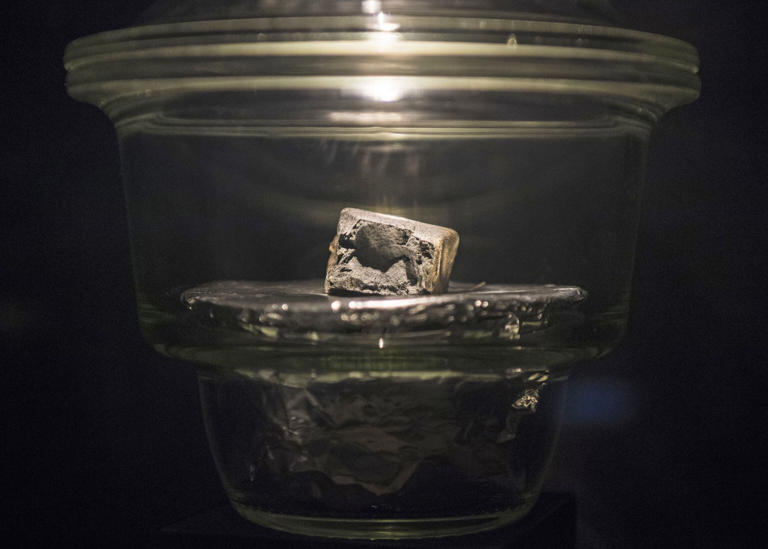
Quasicrystal is a form of matter with crystal structure that can only be fully expressed in higher dimensional space. This strange class of material - that started a minor revolution in materials science when it was discovered - has been confirmed to come from the site of an ancient meteorite impact in the Russian Koryak Mountains. A massive expedition there has found more natural quasicrystals, and further results are on their way. Even more interesting, it seems to be present in carbonaceous chondrite meteorites, which date from the solar systems birth.
"What does nature know that we don't? How did the
quasicrystal form so perfectly inside a complex meteorite when we
normally have to work hard in the laboratory to get anything as perfect?
What other new phases can we find in this meteorite, and what can they
tell us about the early solar system?" Said Paul Steinhardt of Princeton University, who was part of the expedition.
Image above: A piece of lab made quasicrystal. Image courtesy of Stanford University.
Fastest solar storm ever:
The fastest Coronal Mass Ejection ever observed has been seen by NASA's STEREO spacecraft. It was clocked at one percent of lightspeed. If you could ride the front of this blast of particles and radiation it would get you to Pluto's orbit in a little over five weeks.
Video above: A huge, high speed, CME tearing through space. No fart jokes, please. Video courtesy of NASA. Mars has Earth-like geology.
And Mars have a primitive form of plate tectonics, consisting of just two moving plates, that formed the titanic Valles Marineris. The result comes from a paper by An Yin, a UCLA professor, and shows that Mars may resemble a primitive version of Earth geologically.
Image above: The Valles Marineris fault line. Image courtesy of UCLA.
Lastly:
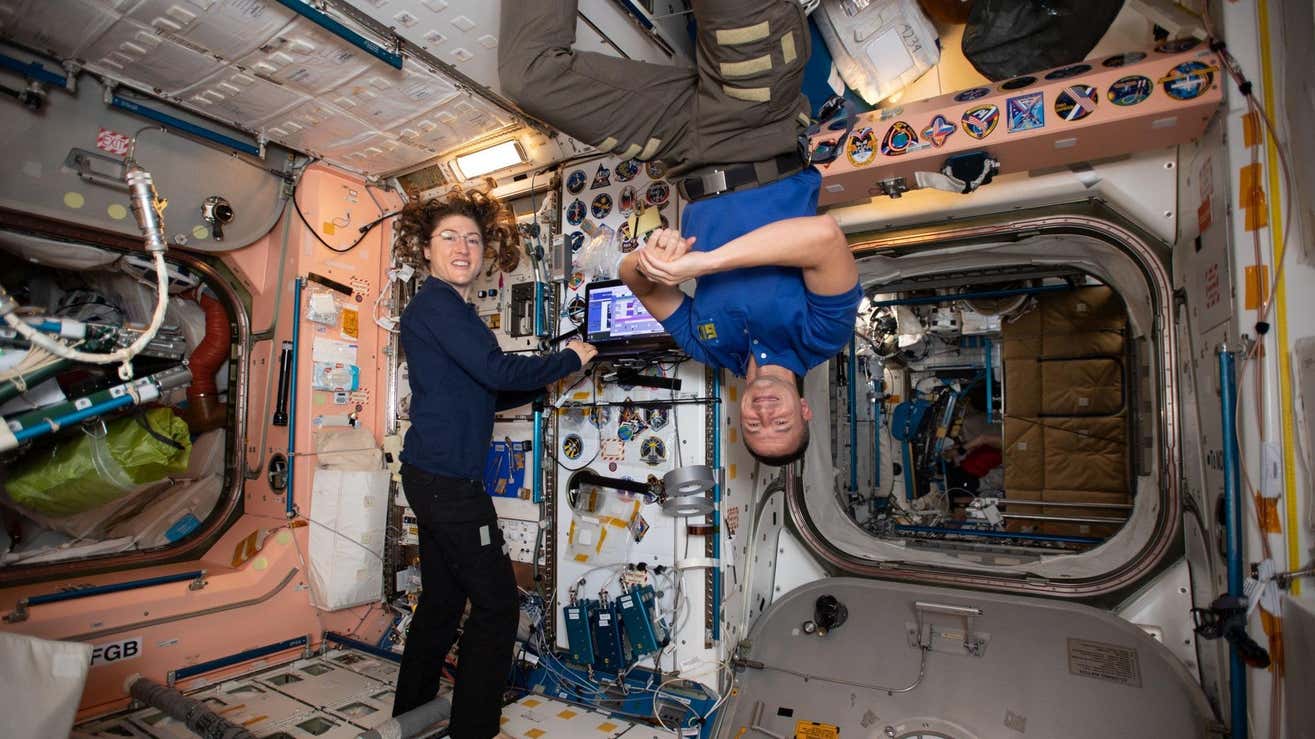
Sunita Williams, an astronaut stationed on the International Space Station, is training to compete in the Nautica Malibu Triathlon in September. She'll still be on the station as she does so, so she will compete using various equipment in the stations gym. Yes, the ISS has gym, in fact it's vital for the astronauts health, but that's another story....
Image above: Sunita, training in the ISS gym. The eighties hair is entirely an artefact of zero gravity, NASA officials say. Image courtesy of NASA tv.
...real life has caught up with me. I'm going to be very short on time for a couple of weeks at least, but I promise I'll be back with something special (not that it isn't all special) as soon as possible! Until then, keep looking at the world, and thinking about it - ultimately that's what people do best...
How's my blogging? Leave some feedback, I get better at this, you get a more interesting read! Or at least fewer spelling mistakes.
Edit: Here's some additional material[0], from the press briefing for the RBSP mission.
It’s tempting to think that the space between the Earth and
the Moon is fairly empty. But a complete map of cis-lunar space would actually be pretty complicated.
There are the satellites in low Earth orbit, medium Earth orbit, high orbit, and
polar orbits. There's the magnetic field of Earth[1] protecting us, the
lucrative geostationary satellite ring[2], thevarious small temporary moons[3] and quasimoons[4] that come and go with time, near earth asteroids that zip past on a
regular basis, the L4 and L5 Lagrange points[5], the geocorona[6]…. It's busy up there - a realm in it's own right.
Image above: A visualisation of the inner and outer Van Allen belts, countless high speed particles caged in the magnetic field of Earth. Enough radiation to kill just about anything, hanging over your head right now. Image courtesy of NASA.
The
belts are made of high energy charged
particles, from the solar wind[8], funnelled into two huge doughnuts by the
magnetic field of Earth:
The inner belt stretches from sixty miles above the surface
(touching the atmosphere over the South Atlantic Anomaly[9]) out to six thousand miles. It's composed of high speed electrons, protons, and smaller numbers of other particle like alpha particles[10] and oxygen ions.
The outer belt stretches from eight thousand four hundred miles out to thirty six
thousand, and is mainly made of electrons. When a solar storm[11] hits it the outer belt inflates with protons from the Sun, that seep down into the inner belt over a day or so. It's a bit like filling a ballot with air, then slowly releasing it, except the balloon is a huge magnetic field, the air is high speed DNA smashing protons[12]... OK, it's not very like filling a balloon with air. But I did only say a bit....
Video above: The Van Allen belts, shown here in cross section, twitching like crazy as a solar storm runs over and through them. The forces at work here are titanic. Yet I can't get past how much it looks like a pair of huge ears flapping about..... Video courtesy of NASA/Goddard.
These belts surround Earth like reefs: They can damage or disable[13] spacecraft that pass through
them when they're active, and many spacecraft do. But they are also an important part of the interplay between Earth, solar storms,
and interplanetary space.
It's worth knowing about them for other reasons to: Most of the universe is made of electrically charged particles[14] (called plasma), funnelled by magnetic fields, just like the belts. These plasmas can even form strange crystals[15], and it's been proposed they might hold life like patterns[16].
Video above: A quick low down on the radiation belts around Earth, and the RBSP twin space craft being sent to explore them. Although it isn't really a low down, these are spaceships, so it's a high up.... ....I'll get my coat. Video courtesy of NASA/Goddard.
Our radiation belts belts are a huge natural plasma lab, and
NASA is taking a closer look: On August the twenty third, the
two octahedral Radiation Belt Storm Probes[17] are being sent into these badlands, to study them up
close. Other missions have done this, but this is the first to use two probes
to get a comprehensive real time view of how the belts act, and using one of
the best suites of sensors ever flown to them.
Image above: One of the RBSP spaceships. A made up image, I assume, unless NASA is employing Dr Who as a photographer now. Image courtesy of NASA.
The RBSP mission will answer questions
like: What mechanism accelerates the particles in the belts to such high speeds? How to they react to coronal mass ejections, and why? What
role do they play in geomagnetic storms and aurora? We have some ideas already, but the RBSP mission will give us a much, much, clearer picture.
And when you're sharing your part of the solar system with two massive, unpredictable, belts of ionising radiation[18] - and you are - a clear picture is a good idea...
Lastly, just because, here's a stunning video of the Earth from space:
Video above: The Earth, as seen from the International Space Station. Just because it's beautiful, and because this is what space missions, like RBSP, are helping us to understand and protect. Video courtesy of NASA.
How's my blogging? Leave some feedback, I get better at this, you get a better read!
While Curiosity is undergoing post landing tests, it appears that the rover may already be in a brilliant spot for learning about the history of water on Mars: The mini sized rover has come down near the edge of an alluvial fan[1] - a spread of debris left by water running down the side of Gale crater.
Based on the MARDI[2] images, the team has put the rovers co-ordinates at 4.5895 S, 137.4417 E. The alluvial fan material is a lag deposit - it was deposited in ancient times, and the weather has blown away the fine grained material, leaving behind a spread of similarly sized pebbles.
This is a nice, simple, patch to understand geologically speaking. Also, it's apparently water related - all of which makes for a nice start to what will, hopefully, be a long mission. Nearby there is an even more interesting spot: A three way junction, between three distinctly different looking kinds of terrain - such unusual locations are often big clues to conditions on a world, millions or billions of years ago.
Image above: An image from the MRO orbiter [3], showing the location of Curiosity, and the various spent parts of its landing system. Centre right, you can see the triple junction of different terrains. Image courtesy of NASA.
But, while the robot is designed to rove across the plains of Mars, this spot is potentially full of good science. Or, to quote John Grotzinger, the mission's lead scientist: "This place is awesome. We really don't want to blow out of there."
Image above: The alluvial fan that Curiosity has landed on, with Mount Sharp in the background. From where the rover is at the moment it's a five and a half kilometre trek to the top, which I'd find quite intimidateing. But then, I won't even mow the lawn until I loose sight of the shed. Image courtsey of NASA/JPL.
All of the robots systems have apparently made it through the landing intact, and on the way down the MARDI camera captured this series of images, from the moment the protective backshell was jettisoned, until the rovers wheels hit the dirt:
Video above: The recording from the MARDI camera, of the last minutes of landing. the impact was about on par with the speed of something falling an inch to the ground (on Earth). You can see the dust blown up by the skycranes jets, and it seems that Curiosity is already covered in Martian dust. Never mind, who's going to see? Video courtesy of NASA/JPL.
Lastly, if you've ever wondered if scientists and engineers get a rush out of their work:
Image above: The Curiosity team find out that the lunch van has arrive... I mean, that Curiosity has made it safely to the surface of Mars. Image courtesy of the US government.
How's my blogging? Leave a comment, I get better at this, you get a better read.
Curiosity[3] has landed in Gale crater, within sight of Mount Sharp. Pictures are already coming down, and the talk about the skycrane[1] landing method has changes from " Um... are we really gonna do this?" to "Well, of course it worked, never had any doubts".
Image above: A first light image from Curiosity. Courtesy of JPL/NASA.
But there is one image I feel like I have to post* - I'm going to refrain from a major post until the Curiosity team have got their bearings, and maybe given a preliminary geologic assesment of the area they're in - but:
Image above: Curiosity, inside it's protective shell, parachuting onto the Martian surface. Image courtesy of JPL.
This shot was taken by the orbiting MRO spaceship[2], as Curiosity parachuted to the surface. Bear in mind, there's no real time, adjust it as you go, controlling of a robot ship near Mars: This was all pre-programmed in, and then the team crossed their fingers and went "!" .
*Yes, I've posted two.
List of links: [1]http://www.space.com/16878-mars-rover-landing-sky-crane-guide.html [2]http://mars.jpl.nasa.gov/mro/ [3]http://mars.jpl.nasa.gov/msl/