Hows my Blogging? Feel free to leave a comment! I get constructive critisicm, I get better at this, you get a more interesting read!
Video above: A van sized chunk of primordial space rock rips into our atmosphere on April the 22nd. Courtesy of Júlio Cézar Soares.
A couple of weeks ago a 70 ton meteoroid - about the size of a minivan - blew up spectacularly in Earths atmosphere. Packed quite a punch in fact, around 5 kilotons. Meteorite tracking networks [1] (More on them soon!) used infrasonic sensors to pin point the rough location of the blast at 37.6N, 120.5W.
Image right: Fragments of the Sutters Mill Meteorite. Image courtesy of Greg Hupe.
It's being called the Sutter’s Mill Meteorite. Meteorite hunters have been able to recover fragments of it, and we now know that it was a CM class carbonaceous chondrite [2]. That's one of the really rare and groovy types that contain ancient material, show signs of having been altered by liquid water on their worlds of origin, and contain bio-molecules like amino acids.
NASA and SETI are looking for bits of it using a zeppelin! Follow this link [3] for news report.
The really strange thing is that things this size hit Earth on a regular basis, but often come in over unpopulated areas and don't get seen. Earlier this year 2012 BX34 [4], a lorry sized asteroid, 'near missed' Earth - it was too small to have done any world ending if it hit, and in any case 'near miss' in this case means about ten times the distance from the Earth to the moon.
These events highlight a very interesting point: Fragments of lost worlds buzz by Earth all the time!
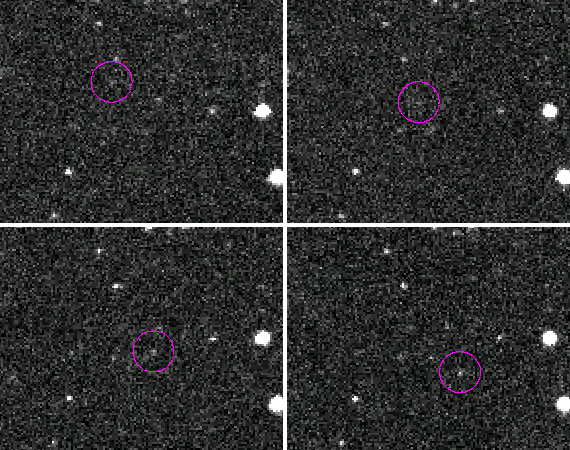
Image left: 2012 BX34 seen in January. Image courtesy of Alex Gibbs, Catalina Sky Survey/University of Arizona
The chart below, courtesy of the brilliant space weather.com [5], has bought home to me just how freaking often some piece of space debris passes by Earth. This is just the encounters for the last half of January! Only one was big enough to be scary, and it passed us by a loooong way off. But it just goes to show that there are a lot of objects out there. Bear in mind I'm convinced we can find clues to the big questions of the universe in even the tiniest bit of space debris.....
Recent Earth-asteroid encounters:
Asteroid 'name'
Date(UT)
Miss Distance
Size
2012 BZ13
Jan 18
9.1 LD
29 m
2012 BL14
Jan 20
1.2 LD
10 m
2012 BV1
Jan 20
0.8 LD
3 m
2012 BS1
Jan 23
3.1 LD
10 m
2012 BY1
Jan 24
2 LD
31 m
1991 VK
Jan 25
25.3 LD
1.9 km
2012 BW13
Jan 26
1.7 LD
16 m
2012 BD14
Jan 30
5.8 LD
19 m
Notes: LD means "Lunar Distance." 1 LD = 384,401 km, the distance between Earth and the Moon. 1 LD also equals 0.00256 AU.
Image above: The simulated path of a mini-moon, following a temporary, chaotic orbit about Earth. Inset: A larger asteroid, showcasing the rough surface of small objects. The simulations suggest mini-moons could be a common occurrence, and these little critters could orbit Earth for a year or more. Image courtesy of K.Teramura.
In fact, things have recently been suggested to get even closer to home than that. We've known for some time that asteroids like 3751 Cruithne [6] can become co-orbital with Earth, making them 'quasi moons'. Now a joint study from the University of Helsinki [7], the University of Hawaii [8], and the Paris Observatory [9], suggests that small space rocks, meters to tens of meters across, frequently become mini-moons of Earth.
They are only weakly bound, and follow chaotic, temporary, orbits, but the simulations the teams have run show that there will be at least one object a meter across or bigger orbiting Earth at any one time.
Now for an asteroid hugger like me that is absolutely amazing: A sample return mission to such an asteroid could be done for next to nothing in space exploration terms.
OK, house sized bits of rock whizzing over our heads on an almost daily basis isn't any thing to get excited about......
......um actually, at the very least, I'd rate it a 6.5 on my list of things that make go 'huh?'. Seriously - house sized rocks are flying over my head right now, and this happens every day?
A lot of the time when space science gets into the mainstream media it is due to a mission to somewhere in space. But a big chunk of our knowledge, much bigger than many people imagine, is down to the universe coming to us. So here's my ode to the universe coming to us (certainly no offence meant to the 'boldly going' approach), and a few bits and pieces of news on the end: Oh, but first: Some suitably epic music for this subject: Composers: Two Steps From Hell Studios, -Thomas J. Bergensen & Nick Pheonix Fusing Boldness and Cunning: Going and getting the Universe, and getting the Universe to come to us. There are two ways of exploring the cosmos: 1: Go out to it (or: ‘To Boldly Go’), and 2: Have it come to you (or: ‘To Cunningly Wait’). It is little realised that 2 is in many ways easier than 1, though with its own weaknesses as well, because it happens naturally all the time.
Image above: The view from Earth: Image courtesy of Marylandweather.com
Look up at that huge, black and twinkle studded, expanse over your head on a clear night - the light reaching your eyes is a wealth of information about the universe, falling onto us for free. Over time we've learned to make the most of that light: At first by careful observation with our own eyes, then using telescopes, and eventually across the whole of the electromagnetic spectrum [1]. We have learned to use the information carried by particles, and fields as well: Projects like Ice Cube (studying neutrinos)[2], Compton (gamma rays)[3], and Cluster (magnetic fields)[4] have allowed us to sense realms of information from space that our unaided bodies cannot.
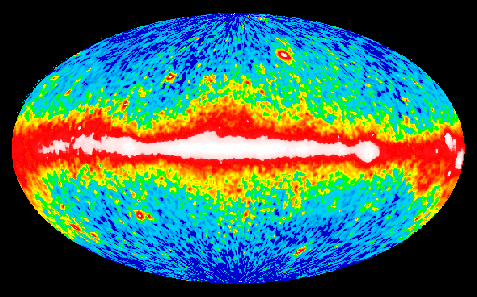
Image above: Sky seen in Gamma rays by the Compton Gamma Ray observatory. The bright bar across the middle is our Milky Way Galaxy. Image courtesy of APOD NASA.
The cool thing is this shows that science, and the universe it studies, are all one piece: the existence of neutrinos [5]was first inferred [6] from theories that plumbed into the subatomic realm. How ironic then that those theories about the smallest scales opened a new view onto cosmology, the largest. Many of the instruments we use to sense the torrent of information streaming down on us are undersold by the word telescope : Just take the European Southern Observatory [7], a battery of scientific instruments, some bigger than a small house, high atop various mountaintops, to give us a window into a universe we could scarcely imagine. And we have many observatories like this - the hull of spaceship Earth is studded with sensors [8], and surrounded by a swarm of high tech eyes and ears piecing the deeps of space.
Image above: The European Southern Observatories Atacama Facility of frankly gigantic telescopes. Image Courtesy of ESO.
Other things than radiation carry their knowledge to Earth; pieces of matter, more familiar to us than hyper exotic neutrinos, come here every second of every day: Meteorites and space dust carry geologic information to us from all across the solar system, on worlds often long dead or totally destroyed. Some pieces of material we have recovered may even be from the black gaps between the stars, or remnants of the pre-solar nebula [9]that birthed our star system. This to we have got better at exploiting; Meteor tracking networks [10] have been set up, and we know the best hunting grounds for well preserved space rocks – places like the Atacama desert, or the ice fields of Antarctica. And NASA has for a long time run high altitude flights to collect in falling space [11] dust. Once these pieces of matter are here their advantages quickly come to light: We can do things with them that we can't do to a sample being examined by a small space craft millions of miles away:
We can subject them to the best possible tests using the most advanced and powerful equipment on the planet.
We can use multiple approaches and methods to get the most possible information from each micro gram.
Technologies like Secondary Ion Mass Spectrometry (SIMS [12]), Transmission Electron Microscopy (TEM [13]), and Gas Chromatography – Mass Spectrometry (GC-MS [14]), Atomic Force Microscopy (AFM [15]) can be bought into play with far greater ease than we could send these things into space (although we can, and do [16] if the pay-off in knowledge gained looks to be big enough).
Image above: Mars, showing off its biggest mountains and swirls of water ice clouds. Courtesy of NASA.
A staggering example of this is Mars exploration: Some of our best geological evidence for conditions on ancient Mars comes from actual samples of its crust – yet a sample return mission [17] is at best decades away still. These samples were shot into deep space by the shock waves from asteroids striking Mars. They wandered – preserved by the cold and vacuum of interplanetary space – until the landed here on Earth. As well as giving us evidence of warm and wet conditions on ancient Mars [18] these samples provide possible (highly controversial) indicators of microbial life [19] there – some of which have been largely debunked, and some of which still have a question mark over them. The scientific process occasionally takes a detour down a blind alley but without these naturally travelling samples of the red planet we would not have even reached that junction yet! And, just to add to the mysteries, there have recently been more meteorites shown to have come from Mars [20].
Image left: The new visitor from Mars, which landed here on Earth in July 2011. Another example is the giant asteroid Vesta [21]. Although the first space craft to visit it – the gob-smacking Dawn mission [22] – only arrived in 2010 we have had samples of it [23] to ponder for many years, courtesy of the giant impact that, thanks to Dawn we now know, tore apart the entire Vestan south pole. A great example of how approach 1 and approach 2 can compliment each other! There are other scientifically profitable meetings between approach 1 and approach 2. One such approach is sending observatories a short way into space, where see more clearly above our atmospheres distortions, or in wavelengths that our atmosphere attenuates. These are instruments like the Compton observatory (mentioned above), the Planck observatory [24], or the venerable Hubble. Image left: The Pillars Of Creation, one of the most famous images from the Hubble. To get anything like this view with the naked eye we would have to travel around a thousand light years. By travelling only a few hundred miles into space we can explore for countless thousands of light-years. Even more, we can look back into the younger ages of our cosmos, even back to the first galaxies, and (completing the circle begun with the discovery of neutrinos) we can use what we see to learn about the most fundamental properties of matter. Black holes and neutron stars are great examples of this [25]: by studying these examples of matter under such improbably extreme conditions [26] we can infer things about its fundamental, sub atomic, make up.
Video above: The Crab nebula, seen an multiple wavelengths. Courtesy of NASA.
A new fusion of approach 1 and approach 2 may be in the offing: A team led by Mikael Granvik has shown [27] via computer simulation that many small asteroids – ranging from 10 cm to 1 meter across – may become temporary satellites of Earth [28]. These are too small and dim to be easily spotted, although a few suspicious examples may have been caught [29]. These objects, if we can pin down their paths and identify one that will wait a few years, could be a great resource: A space mission to study, and perhaps even retrieve, one of these visitors would be far easier and cheaper than travelling clear across the solar system to reach similar objects. Such a mission would need to travel less far, less fast and could carry more weight. It could bring back a significant portion of one of these objects (or just bring it intact back to home, period, and) combine the perfect preservation of deep space with the facilities available on Earth. None of this is to say that we could do away with the ‘boldly going to look at things first hand’ approach: Without Viking we would not know our Mars samples we actually from Mars, without Dawn the geologic context of the rocks from Vesta would still be obscure, not to mention all the wonders that these missions have shown us that could not even be guessed from samples of rock, however well preserved (Vestas gigantic landslides and grooves, Mars buried glaciers and dust devils). But the best results come from finding ways to have ‘Boldly going’ and ‘Patiently waiting’ compliment each other, and the more we learn from both methods, the better at combining them we will undoubtedly become............ In other news: Quasi crystals: I will try to post a more detailed report on this soon, but a bizarre from of matter known as ‘quasicrystal’ has been found in rock believed to have come from space [30]. Quasi crystal crystal has regular but non-repeating molecular structure, and to date this is the only natural example of it.
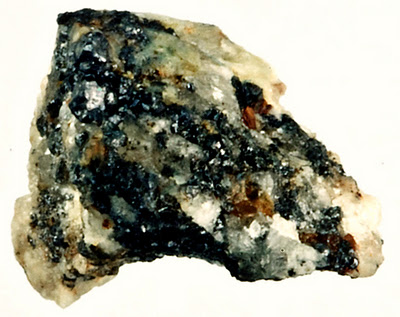
Image right: A piece of rock, believed to be extraterrestrial, containing quasi crystal. Courtesy of Princeton University. There are three lines of thought supporting its origin: Oxygen isotope ratios found in the rock show it to be from the early solar system, the composition of the rock is similar to carbonaceous chondrite meteorites, and the conditions for quasi crystal formation are more likely in space. At first the very notion of such a material was far to outre for scientists, and fierce scientific battles were fought for years to have the notion accepted. Until recently it was thought to be created in the controlled conditions of the laboratory only. Now it seems it may rain from the sky...... Finally: Please spare a thought for everyone who worked so hard, and persevered so much,on the Phobos-Grunt mission to the Martian moon Phobos, and the Yinghuo-1 orbiter to Mars itself. These two probes were launched in November of last year. The launch craft suffered some form of internal malfunction, which stopped it putting the probes on course to the red planet, despite making it into Earth orbit. There was a brief ray of hope late last year when some communications were temporarily restored, and early indications that the craft had some power and was holding its orientation with its own attitude thrusters. But attempts to reach and revive the mission failed, and it burned up over the Indian Ocean. Rest In Peace Phobos Grunt and Yinghuo-1, and my sympathies to everyone who worked on them and was hoping for data from them.
Firstly: If you are reading this page you probably have at least a passing general interest in space, and if you do and follow any of the major space news pages at all you have probably have already seen this:
Video above :Comet Lovejoy seen from the ISS. Courtesy of NASA.
But I wouldn't be Human if I didn't put a copy here. It's comet Lovejoy, which recently made a breakneck death plunge into the sun and came out the other side (see last weeks post) ....And now, as if to rub ol' Sols nose in it, it is putting on a truly spectacular display. The video is made of time lapse footage from the international space station, an what better place to watch a comet from?
Thirdly: NASA has long been hankering after returning a sample of comet to a well equipped lab beneath Earths blue skies. However landing on such a fragile object is problematic at best. So a team at Goddard space centre, led by Joe Nuth, is working on a 'comet harpoon' [5] to spear the icy beasts and bring back subsurface samples without needing to land. It sounds kind of wacky, so NASA have put together a video explaining the concept:
Video above: The 'Comet Harpoon' concept. Video courtesy of NASA/Goddard.
Today is Christmas, a holiday and a time of reflection, so rather than focus on any specific topic I've decided to post some of the thoughts that make asteroid, comet, hell even space dust, science so fascinating for me:
As I’ve written about before, the study of meteorites has opened up a picture of the kinds of worlds that made up our solar system in the years after its birth. The major planets, especially the terrestrial ones, were still growing. This left a lot of smaller bodies ranging in size from chips of rock to things the size of Mars, roaming about the solar system in chaotic orbits. Given the current state of Mars [6] – a hyper arid, bitterly cold desert where even on a good day the hardiest organisms would struggle on the surface – you’d expect these small worlds to be at least as inhospitable. In fact you’d expect most of them to be like our Moon: Totally unsuitable for the kind of chemical processes involved in or leading to life.
Image above: Modern Mars, an environment that challenges the outer bounds of what even ultra hardy extremophiles may be capable of surviving.But was it always this way? Image courtesy of JPL.
But this is where we have to remember that the rules were different [7] in the early solar system. Many bodies, it is now apparent [8], had enough internal heat form liquid water in the cracks and pores beneath their surfaces. The chief culprits for these heat sources are impacts from smaller bodies, which were many many times more frequent than today, and relatively short lived radioactive isotopes. Internal heat in the Earth and other terrestrial planets today comes, at least in part [9], from the decay of radioactive materials. Back in the day, in fact back before there were days and nights, many radioactive materials that have now decayed away completely (for example Aluminium 26) were still present. This meant that even places as small as Lutetia [10] could have maintained a molten – or at least semi molten – core. There are other lines of evidence supporting this: Meteorite fragments that show signs of having come from parent bodies with Earth like crusts [11], fragments that have signs pointing to liquid water percolating through them, ones that show signs of coming from differentiated bodies, and the giant asteroid Vesta which is covered in frozen basaltic lava, a dead giveaway of a geologically active history.
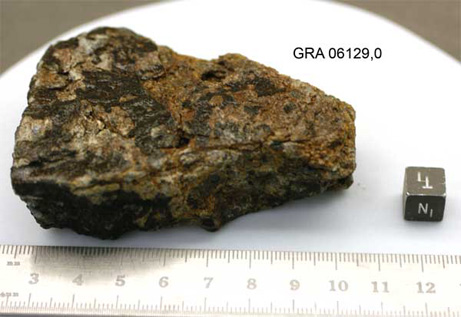
Image right: Meteorite GRA 06129, composed of material similar to Earths continental crust. Image courtesy of the Antarctic Search for Meteorites.
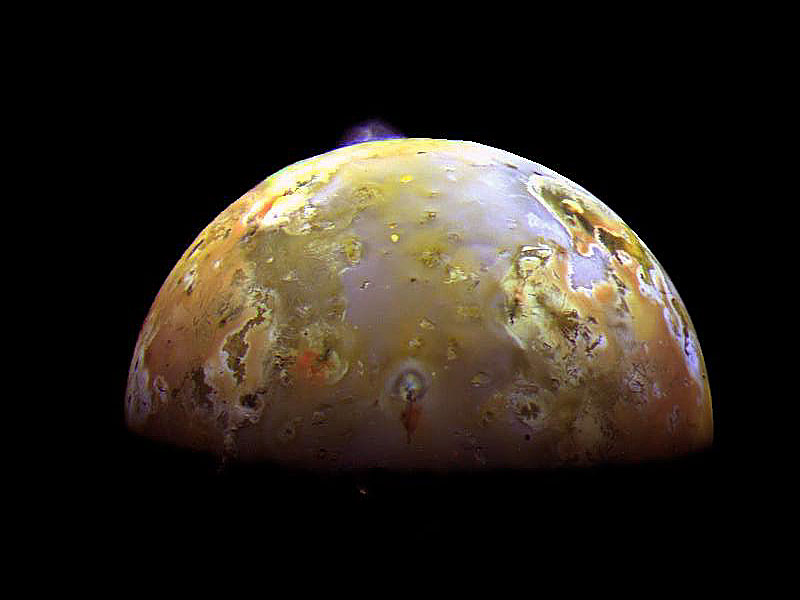
Ok – so these little planetary pre-cursors were warm (in fact some of them were probably as hot and active as Jupiters mon Io [12]for a while). So..... fascinating for geologists, who get to study the geology of worlds hundreds, even tens of thousands, of times smaller than Earth with consummately lower gravity. It makes a fascinating comparison to the Earth itself, tells them something about how the larger rules that govern its geology work, and what materials it was built from. But who else would be interested?
Image above: Io. Only marginally relevant to what I'm talking about but it's just to spectacular to not put an image of up. The volcano blowing its lid in this picture is called Prometheus. Courtesy of NASA/JPL.
Astrobiologists for a start. You see; these little worlds inherited a legacy or two from the primordial cloud that span up to become our solar system: An abundance of water [13] (one of the most abundant compound in the cloud), and organic chemistry [14]. Some of them were so hot these things were baked out of them, but many were merely warm. Some members of the carbonaceous chondrite [15] meteorite family were never heated above 50 degrees Celsius for example.
Now we have the three big things that astrobiologists wet themselves about all together, on not just one small world but many: Water, carbon based (which is referred to as ‘organic’ by chemists) chemistry, and enough heat to melt the water and allow the carbon chemistry to actually do something.
In fact, as the latest evidence[16] from studies of carbonaceous chondrite meteorites shows, these reactions had got quite a way down the road before their host worlds were either destroyed or froze:
In August this year researchers from the University of California published results[17] showing that nucelobases (basic building blocks from which DNA and RNA are made), and similar molecules referred to a nucleobase analoges, were present inside certain carbanceous chondrites.
Now in a way this isn't all that Earth shaking: Fairly complex carbon compounds, includeing amino acids and nucleobases, have been found in meteorites before. But the discovery, in more than one meteorite, of nucleobase anlouges adds credebility to the idea that these molecules are not contamination from terrestrial biology: Terrestrial biology would have left the nucleobases themselves, not the similar-yet-different anolgues. Further evidence comes from the studies the team did to see if any of these compounds were present in the ice or soil near where the meteorite landed - they weren't. Lastly the team did a series of lab experiments involving liquid water, ammonia and hydrogen cyanide. These experiments were aimed to re-create the chemical environment present beneath the surface of the long dead protoplanet that these meteorites came from. These lab tests produced the same mix of nucleobases and their anogues, in the same proportions.
It seems as though these asteroids, long before Earth as we know it existed, were producing the basic chemical building blocks of life. Watch these tiny specks of matter - they may have even bigger surprises in store for us......
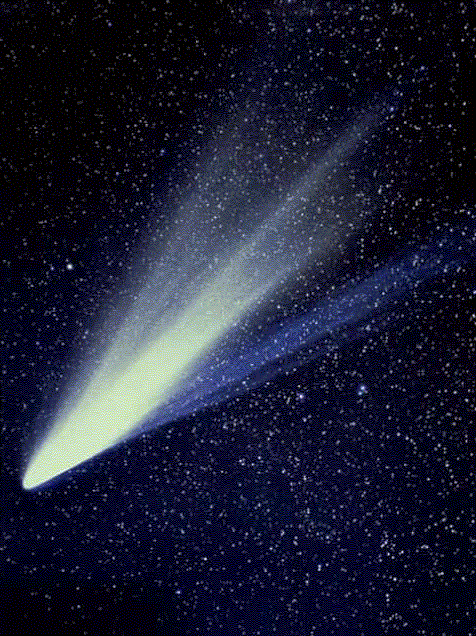
Image left: The brilliant twin tails, one of dust the other of ions, of comet west. Image courtesy of John Laborde.
Comets[1], wandering escapees from the protoplanetary disk that formed our solar system almost 5 billion years ago, usually lead a solitary existence: They move silent and almost invisible out beyond the ice giant Uranus and Neptune [2]. Only occasionally does one break ranks with its fellows and come hurtling into the inner solar system. It does not do this willingly, it must be pushed or pulled by the gravity of some other body. When that happens the comets frozen surface boils away into space, subsurface pockets of more volatile material explode through its skin as jets, and the comet briefly develops a tenuous atmosphere of gasses, called a coma [3]. This coma is shed and renewed as the black (comets are usually covered in a crust of pitch black hydrocarbons) ice ball hurtles inwards, leaving behind tails of dust and gas that catch the sunlight and can be a spectacular display if Earth is in the right position.
Image right: despite their brilliant tails the cores of comets are actually grey to black in colour, as demonstrated by comet Halley here. Image courtesy of ESA.
And sometimes a comet does not just hurtle sun wards. Sometimes, as if it has lost its way from the safe cool depths, a comet flings itself into the solar systems central inferno [9]. This is what astronomers thought would happen to comet Lovejoy this week. It has been tracked by the Solar Dynamics Observatory (SDO [10]), a spacecraft who's main mission is to study the sun itself. But this was too juicy to miss, so they got the doomed comet in one corner of the spacecrafts eye and are posted updated photos as they got them. They even ran those images together into a time lapse movie of what we all expected to be comet Lovejoys final moments.... enjoy:
Video above: Comet Lovejoy approaches the sun with its tail rippling in the solar winds. Courtesy of JPL/NASA.
You can see the comets tail twitching and kinking in the blasts of plasma from the Suns surface! But it turns out the snowball thrown into hell did have a chance after all......
Video above: Comet Lovejoy takes a seemingly fatal plunge into the sun, only to emerge from the other side hours later! Courtesy of JPL/NASA.
Despite passing just 120,000km from the suns surface, and despite the solar behemoth tearing off part of its tail, the enigmatic comet has proved to be made of stern stuff; tearing past the surface of the sun at incredible speeds and back out the other side. At the size of two football fields it is hardly an obvious challenger to the Suns 3 light second wide majesty, yet this underdog has at least survived to tell the tale. Others have not been so lucky: Another comet met a truly spectacular demise at the suns hands in may of this year:
Video above: A comet dies spectacularly as it careens into the Sun. Image courtesy of JPL/NASA.
Now Lovejoys (presumably) melted and altered surface will take a story of peril and fire surmounted back into to cool of deep space....and perhaps one day we will catch up with it to read that story in greater detail.
A double post this time: One of the big small body events from the past year and a plan from NASA that is right up my street!
Rosetta at asteroid Lutetia:
Deep into the darkness that no human and few machines have ever penetrated you wouldn't expect to run across a literal piece of home. But you'd be wrong.
Image to the right: the enigmatic contours of Lutetia catch the distant sunlight. Courtesy of NASA/JPL.
In July 2010 the ESA space craft Rosetta [1] tore past the asteroid Lutetia at a distance of around 3000 km - a long way for a human but nothing for a space faring robot. As it did so it took images and spectra of this enigmatic 120km long boulder. Even its changes in speed as it passed by gave us information on this little worlds mass and density - Lutetia is denser than an ordinary stony chondrite meteorite [2], meaning it almost certainly is metal rich. Now scientist have had the chance to study the data beamed back and draw some conclusions: Lutetia may be a left over building block of the four terrestrial planets, Mercury, Venus Earth and Mars.
The Rosetta spacecraft observed the asteroid, which, when combined with telescopic observations from European Southern Observatory [3] New Technology Telescope gives us the most complete surface spectrum of an asteroid ever. The spectrum - the wavelengths of sunlight reflected and absorbed by the surface - gives us an idea of what an object is made of. Luetetias spectrum is very similar to a type of meteorite called estatic chondrites - these are thought to have formed close to the sun, making up the earliest Lego's from which planets like ours were born Hence Lutetia may have been grown in the same place - a piece of Earths own ancient history, stranded out of deep time [4].
Another revelation about Lutetia is that it may have once had enough internal heat - from internal radioactivity or left over accretion heat - to have had a warm core smouldering sullenly behind its rocky face. An incredible thing for a place so small its gravity cannot even squeeze it into a rough sphere.
Image above: The geological regions of Asteroid Lutetia. Image Courtesy of ESA.
The surface of Lutetia has been mapped into seven areas: Baetica, Achaia, Etruria, Narbonensis, Noricum, Pannonia, and Raetia. Achaia and Noricum are truly ancient places; based on crater counting Achaia is nearly 4 billion years old.
Image right: A set of grooves on the Lutetian surface. Grooves like these are seen on many asteroids, but their exact origins are still a matter of debate.
The surface is studded by immense, monolithic blocks of impact ejects, blankets of solidified lava up to 600 meters thick, grooves [5] a hundred meters deep, and landslides creeping down crater walls under the low low gravity. Finding such an active geological history on a world so small is a treasure trove for planetary geologists.
Image left: A huge landslide has slithered down onto the bottom of this crater in the Baetica region of Lutetia. Massive boulders on the overlooking slopes cast black shadows that are reduced to pinpricks by distance.
Why wasn't this massive rock incorporated into one of the main planets? Luck, and gravity. Lutetia probably had a gravitational slingshot [6] type close encounter with at least one major planet as they were growing, and ended up in the asteroid belt instead. Only 2% of asteroids in the belt are from the inner solar system, so scientists will be keeping Lutetia in their thoughts- a mission dedicated to Lutetia itself (Rosetta is on its way to meet comet Churyumov-Gerasimenko in 2014) could help shed light on the origin and earliest, most hidden, years of Earths existence.
Vesta go BOOM!
Speaking of things that happened when Earth was still young: Check out this computer model of the titanic impact that pulverised the south pole of Vesta:
Video above: A computer model of a 50km wide asteroid smashing apart Vestas south pole. Courtesy of Martin Jutzi. First seen on The Planetary Society blog [7]. No protoplanets were harmed in the making of this video.
The big sphere is a primordial Vesta, and the little one is a 50 km wide impactor. However even the simulations authors admit they are a way from having an accurate handle on the impact yet. Eric Asphaug and Martin Jutzi who authored the model suggested there might be several reasons for this: the impact speed could have been lower than in the model, Vesta may have been harder, or there might have been effects that did not kick in until some time after the explosion that had more influence over the final shape.
Vesta it seems is proving difficult to interpret - it's uniqueness as a world surviving from the deep past and its unusual history makes it difficult to interpret. However a few tentative conclusions are being drawn: Vesta is differentiated like a planet for starters. For more on this follow the link above for the planetary society report, or go to the website for the 2011 American Geophysical Union meeting [8].
Well a year in fact. But that said a helluva lot has happened since I last got a chance to blog. I've deliberately left it until I've begun to have enough free time to make a decent commitment to it. I've had a thesis to write, small people shouting things like 'dada, come!' before jumping in muddy puddles, things like that. So, to get back into the groove, I'll start with a series of posts devoted to the biggest and most stunning ancient solar system developments of the last Earth orbit. As always a list of links is provided at the bottom of the post.
First up:
Dawn arrives at Vesta.
I wish, really wish, that I could get someone to play something suitably jaw dropping every time I hear that. Actually there are lots of jaw dropping bits of music out there, so here's a good one [1] - just imagine the music starts as Dawn leaves Earth orbit, then the Sun rises over Vesta's monumental impact scars as the string section really kicks in....On the July 16th of this year the ion engine [10]powered Dawn spacecraft [2] pulled into a survey orbit around the immense 400km bulk of asteroid Vesta. Alone with this devastate majesty it moved into a high altitude mapping orbit (HAMO), and recently moved into a low altitude mapping orbit (LAMO). As soon as it arrived at this tortured and primordial place this sophisticated space faring machine began collecting images, scans, and data of all kinds [3] on its surface, its composition.... and its cataclysmic history.
Video above: An introduction to the Dawn probe. Courtesy of NASA/JPL.
This is a neat little video released shortly before Dawn pulled into orbit about its first lonely port of call, and it serves as a nice introduction to the mission. The next video snippet shows Vesta as Dawn closed with it: it's immediately an illustration of why Vestan history gets the description 'cataclysmic':
Video above: Dawn closes with the first target: Vesta. Courtesy of NASA/JPL.
The evolution of the images from fuzzy blob to (still fuzzy) monstrous space rock highlights one of Vestas main, primeaval, features: From this video we can see that the bottom 1/4 of the protoplanet [4] has been obliterated by a gigantic impact.
In fact it gets worse for Vesta:
Left: A false colour relief map of the south polar region of Vesta. Blue is lower, yellow/red is higher. Image courtesy of NASA.
Look at the two arcs of thrown up mountains making the rim - there are two distinct arcs. Each arc is the right size and shape to have been thrown up by a giant impact, which tells us that the Vestan south pole got blasted not once, but twice by smash ups with its brethren space rocks. These blasts made the Asteroid hit implicated in the dinosaur extinction [5] look seriously puny: Vesta had its entire south pole blasted apart and replaced with these giant basins and their mountains.
However this is a good explanation for one other mystery: How pieces of Vesta got launched into space and eventually arrived on Earth as meteorites! These are known as Howardite–Eucrite–Diogenite (HED) meteorites [6] and have long been suspected to be portions of Vesta's crust.
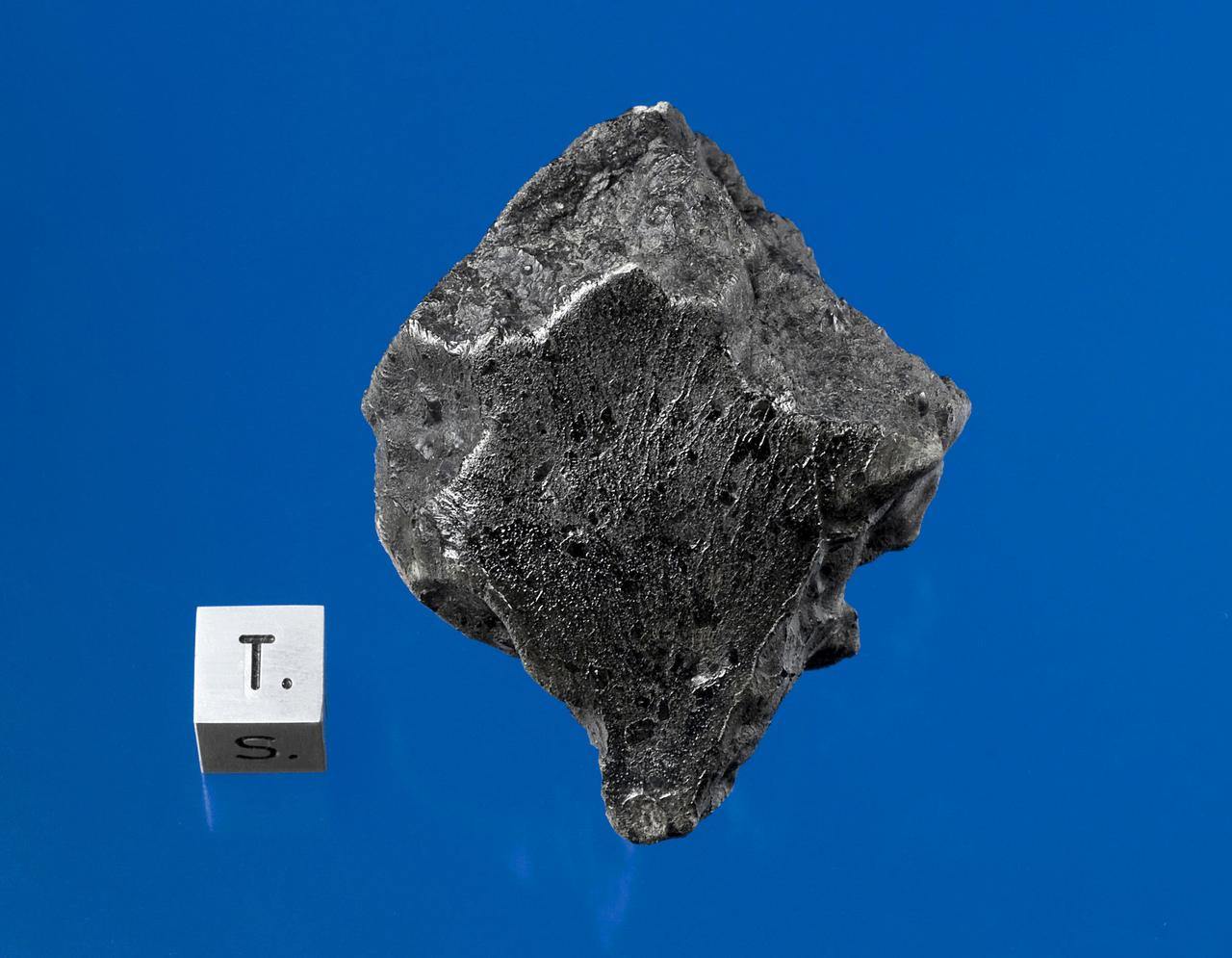
Image above: A fragment of the monomict eucrite Millbillillie which fell in October 1960 near Jundee Station, Wiluna district, Western Australia. Today scientists agree that the source of the known eucrites is Asteroid 4 Vesta and its smaller companions, the Vestoids. Image courtesy of www.niger-meteorite-recon.de/en/meteorite_eucrite.htm
Dawn provides more evidence for these vast calamities from long before humankind looked to the sky, with pictures like these:
Image above: A view from Dawn of the face of Vesta, showing the destruction of its south pole and how the whole asteroid was forced into a new shape.
The above image shows, on the lower right, the crushed depression where Vesta should have a south pole. It also shows, on the lower left most visibly, grooves, steep walled, flat bottomed, that encircle the dead world like a grim garland.
There are two sets of grooves, one older, the other younger, and guess what? Their epicentres line up almost with the epicentres of the two giant impacts. These two titan events made the basaltic rock of Vesta ripple like waves on a pond and then settled into these strange new shapes.
The newest of these giant crater has been named Rheasilvia. But the discovery doesn't stop with the obvious Vestan wounds. Mysteries abound here:
Right: A close up shot of the Vestan surface. Notice how some craters show ejecta that is both light and dark -as though the impacts have broken into different layers of material.
The surface is splotchy in places, with odd light and inky dark patches that show little relief, as you would expect if they were related to craters or hills. And even amongst those that clearly are related to craters the mix of light an dark material is confusing - we'd have expected Vesta to be fairly homogeneous beneath the surface, but some craters that seem to have had landslides of light and dark material, as if Vesta were layered inside like a gobstopper.
Image above: A beautiful shot of a crater on the plains of Vesta, within which streams of light and dark rubble can be seen.
And going back to the abyss that was once the south pole: In its centre lies the giant central peak of the crater. Measuring tens of kilometres from base to peak it is one of the biggest mountains in the solar system:
Image above: A profile of the remains of the Vestan south pole. Courtesy of NASA/JPL.
There's so much in these pictures we don't understand. Some of these oddities are almost like a Vestan signature, unique to this giant amongst asteroids: Craters cut in half:
Image above: A Vestan crater that has been partly erased. Courtesy of NASA/JPL.
A varied surface composition (false colour image).
Image above: A false colour image of Vesta. Very subtle colour variations have been enhanced here to make variations in surface composition stand out. Courtesy of NASA/JPL.
It goes on and on.... You'd think Dawn would have its own blog wouldn't you? Well it does[7]! And to round off this frankly inadequate introduction to Dawn and Vesta here is a conference presenting the finding from the team themselves... enjoy!
Video above: Science briefing by the Dawn team.Courtesy of JPL/NASA.
And this is not the end of Dawn and her teams mission into the deep mysteries of the asteroid belt: Dawn will be the first spacecraft to visit the dwarf planet Ceres [8], a world suggested to have once had a subsurface ocean [9], and hints of activity over its south pole. That will be a whole new voyage in to the unknown.........
Happy 2011 everyone, I hope you've had a great Christmas. Shortly I'll be putting up a post on this years exciting Juno mission to Jupiter.
However before I do I have to tell you that the Juno post will be my last here until the end of March - pesky real life matters I'm afraid, specifically writing up my PhD thesis. I'm a single dad, so as you can imagine my time is quite limited, and I'm afraid it's just not practical to maintain this blog at a decent level and write a thesis on the subject of plasmas and hard wearing coatings. So I'll see you all in the spring, hopefully with a PhD to my name and enough free time to explore the jaw dropping wonders of 4 bllion years ago with you once again.