Real life - and the demands of other projects that I've committed to - have caught up with me. I always said I'd try running this blog for a year, and it's been an education, as well as a ton of fun. Sadly I just can't find the time to do it properly anymore, so this will be the last post here for a good long while. I hope you've enjoyed reading as much as I've enjoyed writing it!
All the best,
John Freeman
Friday, 18 December 2015

Monday, 14 December 2015
Factory-in-space prototype gets the go ahead, storm on a teeny star, rare shot of Antarctca from space....
Hi all, I'm away for a couple of days after this, so see you the end of the week!
Space Systems Loral asked by NASA's Tipping Point program to develop in-space satellite factory
NASA is getting serious about the idea of satellite factories in space, and has tapped Space Systems Loral to develop a ground based proof of concept for the idea. This will be part of NASA's Tipping Point program, and builds on SSL's DARPA funded Dragonfly study, which established the theoretical feasibility of the idea.
"NASA's Tipping Point program enables SSL to qualify new technologies for the commercial market while at the same time providing advances for future NASA missions," said John Celli, president of SSL. "Satellites assembled on-orbit using our integrated robotics capability will be capable of higher performance than satellites that can be launched today. An added benefit will be antennas that can be moved and changed during a satellite's mission life for flexibility and to accommodate changing market requirements."
SSL has experience building robotics for the Space Shuttle, the International Space Station and the Mars landers and rovers.
Student experiment discovers vast ring of dust filling our solar system
The Student Dust Experiment is a unique take on the idea of a student experiment - unique because it's currently bolted to the 'front' of NASA's New Horizons space probe, quite an achievement for a student run experiment. It's an impact detector, meaning that it picks up dust by registering when it smashes into the detector. As of late 2010, when it passed a distance of 18 AU (1.7 billion miles or 2.7 billion kilometers), SDC became the farthest reaching dust impact detector in history! As SDC plunges through our dust disk, they’ve been able to measure and characterise the dust density distribution from Earth to Pluto, and beyond. The majority of the particles are thought to be from Kuiper belt object. With this information, not only can we better understand our solar system, but also help unravel the mysteries of countless other solar systems throughout the observable universe.
Teeny star has Jupiter-like storm
"The star is the size of Jupiter, and its storm is the size of Jupiter's Great Red Spot," said John Gizis of the University of Delaware, Newark. "We know this newfound storm has lasted at least two years, and probably longer." Gizis is the lead author of a new study appearing in The Astrophysical Journal, which describes how the tiny L-dwarf has been found to have the storm near one pole.
Above: An animation of the storm. Courtesy of University of Delaware.

Space Systems Loral asked by NASA's Tipping Point program to develop in-space satellite factory
NASA is getting serious about the idea of satellite factories in space, and has tapped Space Systems Loral to develop a ground based proof of concept for the idea. This will be part of NASA's Tipping Point program, and builds on SSL's DARPA funded Dragonfly study, which established the theoretical feasibility of the idea.
"NASA's Tipping Point program enables SSL to qualify new technologies for the commercial market while at the same time providing advances for future NASA missions," said John Celli, president of SSL. "Satellites assembled on-orbit using our integrated robotics capability will be capable of higher performance than satellites that can be launched today. An added benefit will be antennas that can be moved and changed during a satellite's mission life for flexibility and to accommodate changing market requirements."
SSL has experience building robotics for the Space Shuttle, the International Space Station and the Mars landers and rovers.
 |
| Above: An artists impression of a communications satellite in orbit. courtesy of ... |
Student experiment discovers vast ring of dust filling our solar system
The Student Dust Experiment is a unique take on the idea of a student experiment - unique because it's currently bolted to the 'front' of NASA's New Horizons space probe, quite an achievement for a student run experiment. It's an impact detector, meaning that it picks up dust by registering when it smashes into the detector. As of late 2010, when it passed a distance of 18 AU (1.7 billion miles or 2.7 billion kilometers), SDC became the farthest reaching dust impact detector in history! As SDC plunges through our dust disk, they’ve been able to measure and characterise the dust density distribution from Earth to Pluto, and beyond. The majority of the particles are thought to be from Kuiper belt object. With this information, not only can we better understand our solar system, but also help unravel the mysteries of countless other solar systems throughout the observable universe.
 |
| Above: A simulation of the Solar Systems dust disk, based on the SDC results. |
Teeny star has Jupiter-like storm
"The star is the size of Jupiter, and its storm is the size of Jupiter's Great Red Spot," said John Gizis of the University of Delaware, Newark. "We know this newfound storm has lasted at least two years, and probably longer." Gizis is the lead author of a new study appearing in The Astrophysical Journal, which describes how the tiny L-dwarf has been found to have the storm near one pole.
Above: An animation of the storm. Courtesy of University of Delaware.
This, and other images (follow the link) have been released in poster size to support International Polar Year. Based on data from the AMSR-E satellite, and courtesy of NASA/Goddard Space Flight Center Scientific Visualization Studio, it's worth having a look on zoom, trust me!

Saturday, 12 December 2015
NASA goes to the Sun, pictures from around the solar system, and how Akatsuki got to Venus.....
NASA's mission to the Sun passes critical design review
There's been a lot of amazing science done by space platforms observing the Sun from a safe distance. But at some point you have to get stuck in there - and NASA agrees which is why they're sending the Solar Probe Plus mission to get closer to the Sun than any spacecraft before.
How Akatsuki's engineers used an 'inspired hack' to get it into Venus orbit
The spirit of McGyver and Scotty must have been hanging about with JAXA engineers over the last year, because after their Akatsuki probe had an engine breakdown they used some audacious space navigation and engine hacks to get their ship where it wanted to go anyway. My fellow space geek and pro blogger Emily Lakdewalla explains how.
BBC has a good breakdown of future missions to Enceladus
This tiny moon has stunned the science community by turning out to hold a potentially habitable ocean beneath its icy crust. As the Cassini mission bids fare thee well to Enceladus for the last time the BBC science team take a look at what might be the next steps in exploring this icy moon...
Ancient star cluster reveals secrets of our galaxy's past
An incredibly ancient cluster of stars may hold clues to our galaxy's birth. As well as being incredibly ancient, and in the last days of its existence, the cluster is distorted into an odd rhomboidal shape by the gravity of surrounding stars.
Lastly, some very brain melting pictures from across the solar system:
There's been a lot of amazing science done by space platforms observing the Sun from a safe distance. But at some point you have to get stuck in there - and NASA agrees which is why they're sending the Solar Probe Plus mission to get closer to the Sun than any spacecraft before.
 |
| Above: The Sun. Here's why we don't give too much AI to space probes: NASA "Hey, why don't you fly into that?" Over AI'd space probe: "No." End of mission to the Sun. |
How Akatsuki's engineers used an 'inspired hack' to get it into Venus orbit
The spirit of McGyver and Scotty must have been hanging about with JAXA engineers over the last year, because after their Akatsuki probe had an engine breakdown they used some audacious space navigation and engine hacks to get their ship where it wanted to go anyway. My fellow space geek and pro blogger Emily Lakdewalla explains how.
 |
| Above: He cannae change the laws of physics... unless, y'know, there might be a pay rise in it captain? |
BBC has a good breakdown of future missions to Enceladus
This tiny moon has stunned the science community by turning out to hold a potentially habitable ocean beneath its icy crust. As the Cassini mission bids fare thee well to Enceladus for the last time the BBC science team take a look at what might be the next steps in exploring this icy moon...
 |
| Above: Enceladus, courtesy of JPL/NASA |
Ancient star cluster reveals secrets of our galaxy's past
An incredibly ancient cluster of stars may hold clues to our galaxy's birth. As well as being incredibly ancient, and in the last days of its existence, the cluster is distorted into an odd rhomboidal shape by the gravity of surrounding stars.
 |
| Above: The incredibly ancienmt, dying, E3 star cluster. |
Lastly, some very brain melting pictures from across the solar system:
 |
| The dunes and hills of Mars, courtesy of JPL/NASA/Thoma Appere |
 |
| Akatsuki's first UV image of Venus, courtesy of JAXA. |
 |
| The twisted landscape of comet 67-P, as of December 7th, courtesy of ESA. |
 |
| The weird little moon Prometheus, set against Saturn's F ring, courtesy of JPL/NASA. |
Friday, 11 December 2015
A new planet? Whoa there.....
ALMA array finds new member of our solar system?
This is the big news hitting the web today: The ALMA array may have detected something big - an Earth sized planet big or bigger sort of big - on the edge of our solar system....but I really need to put the emphasis on 'may' and 'something':
Mists and fogs on Ceres?
For years now astronomers have been puzzled by the mysterious bright areas on the surface of Ceres. At first they were just some slightly brighter patches visible to Hubble. The the dawn mission arrived, and revealed some irregularly shaped patches of the surface that seemed to have incredibly bright white surfaces.... and that's where our knowledge stopped: These patches were unlike anything we'd ever seen. They mystified us. To be frank they still do.
Just recently Dawn has been able to send back some new clues: We now know these patches are probably not ice, but a paper published this week seems to show evidence that at certain times of the Cerean day these bright patches are emitting vapours and fogs of some kind. That's deepened the mystery still further as the most likely material to evaporate and cause fogs - probably clouds of vapour crystals rather than clouds of water droplets - is ice, which has been ruled out as a cause of the bright patches. All we can do is keep gathering data, and wait for the right clues to solve the puzzle....
Vapour farming experiment approved for testing on Mars
Salt has a lot to answer for on Mars: Especially a particular group of salts that suck moisture out of the thin Martian air until they self-dissolve into tiny water droplets. This phenomena, called deliquescence, is suspect number 1 for how the seeps that are thought to cause recurring slope linea form, and earlier this year Javier Martin-Torres and his colleagues reported results from NASA’s Curiosity rover suggesting that liquid water pools just beneath the surface of Mars at night before evaporating during the day.
To test the idea in a more controlled way, the ESA ExoMars rover will carry an experiment called HABIT, which will use salts to absorb 5 millilitres of water from the atmosphere a day, and it can hold up to 25 millilitres in total. The motivation isn't pure curiosity: If the process works, it can easily be scaled up to provide water for future crewed missions to Mars. "HABIT can be easily adapted to ‘water-farms’ for in-situ resource production,” Torres told New Scientist Magazine. “We will produce Martian liquid water on Mars, that could be used in the future exploration of Mars for astronauts and greenhouses.”
Deal struck to build Jupiter Icy Moons Explorer mission
This is the big news hitting the web today: The ALMA array may have detected something big - an Earth sized planet big or bigger sort of big - on the edge of our solar system....but I really need to put the emphasis on 'may' and 'something':
- Firstly, a lot of people are pointing out that it's a huge coincidence for ALMA, which has a tiny field of view, to have detected this object by pure chance....so either ALMA has been very lucky,or there are a lot of these things, or it's not real - some kind of illusion caused by a problem with the array.
- Second, as the authors of the paper make clear themselves, it's not at all clear what this thing is, or even how big it is. It's literally just a point on a couple of their scans.
- Lastly, the paper is a preprint - that means it's a rough draft and hasn't been peer reviewed or accepted for publication by anyone. In other words no-one has independently fact checked it, and that's a HUGE part of good science. Scientific American has good write up on this aspect of it.
 |
| Above: The ALMA array. |
Mists and fogs on Ceres?
For years now astronomers have been puzzled by the mysterious bright areas on the surface of Ceres. At first they were just some slightly brighter patches visible to Hubble. The the dawn mission arrived, and revealed some irregularly shaped patches of the surface that seemed to have incredibly bright white surfaces.... and that's where our knowledge stopped: These patches were unlike anything we'd ever seen. They mystified us. To be frank they still do.
Just recently Dawn has been able to send back some new clues: We now know these patches are probably not ice, but a paper published this week seems to show evidence that at certain times of the Cerean day these bright patches are emitting vapours and fogs of some kind. That's deepened the mystery still further as the most likely material to evaporate and cause fogs - probably clouds of vapour crystals rather than clouds of water droplets - is ice, which has been ruled out as a cause of the bright patches. All we can do is keep gathering data, and wait for the right clues to solve the puzzle....
 |
| Above: Images and caption from the paper, showing the purported mists: Occator contains the brightest spot on Ceres. This is a pit covered by bright material, and the surrounding area shows a specific diurnal brightness rhythm, which becomes detectable at oblique views. a, Oblique view at noon reveals a diffuse near-surface haze (white) that fills the floor of its host crater. This haze disappears completely at dusk (b). The low column density of the haze is indicated by the very oblique limb views at noon (c and d), and the haze does not extend above the elevated southwestern part of the crater floor (left in c). There is a lapse of 450 s between the taking of the images shown in c and d |
Vapour farming experiment approved for testing on Mars
Salt has a lot to answer for on Mars: Especially a particular group of salts that suck moisture out of the thin Martian air until they self-dissolve into tiny water droplets. This phenomena, called deliquescence, is suspect number 1 for how the seeps that are thought to cause recurring slope linea form, and earlier this year Javier Martin-Torres and his colleagues reported results from NASA’s Curiosity rover suggesting that liquid water pools just beneath the surface of Mars at night before evaporating during the day.
To test the idea in a more controlled way, the ESA ExoMars rover will carry an experiment called HABIT, which will use salts to absorb 5 millilitres of water from the atmosphere a day, and it can hold up to 25 millilitres in total. The motivation isn't pure curiosity: If the process works, it can easily be scaled up to provide water for future crewed missions to Mars. "HABIT can be easily adapted to ‘water-farms’ for in-situ resource production,” Torres told New Scientist Magazine. “We will produce Martian liquid water on Mars, that could be used in the future exploration of Mars for astronauts and greenhouses.”
 |
| Above: The 'recurring slope linea' that form on some Martian slopes and are thought to be due to liquid water. Courtesy of NASA. |
Deal struck to build Jupiter Icy Moons Explorer mission
Airbus and the European Space Agency
have signed the contract that will lead to the construction of a space probe known as JUICE (JUpiter ICy moon Explrer - the things people will do for a good acronym) to study Jupiter and its icy moons.
The probe will launch in 2022 and arrive at the giant planet 7.5 years later. The 5.5-tonne probe is being built in Toulouse in France, however components will be sourced from across Europe, America, and Japan. The full price for the JUICE is expected to exceed
one billion euros, one of ESA's biggest missions to date, and as well as other goals it will help us understand the potential habitability of Jupiter's icy moons.. |
| Above: Ganymede, one of Jupiter's potentially ocean bearing moons. |
Wednesday, 9 December 2015
Superflares, ESA sets sights on the Moon, Exploring exoplanetary atmospheres....
Devastating solar superflare?
Our Sun is a pretty impressive thing - a naturally formed nuclear fusion reactor, so huge its gravity measurably distorts space and time.. When it throws a wobbly - like an x class flare - it can cause radio blackouts, damage power grids and knock out satellites.
But evidence is emerging that the Sun can sometimes put out a flare that is less a tantrum, and more a full on rage: It seems our Sun might be capable of sending out a superflare a thousand times stronger than anything in recorded history - a flare that would devastate today's technology dependant civilisation.
ESA explains the importance of sea level in climate change
Climate change is almost always in the news these days, either because of people trying to stop it or trying to pretend it isn't happening. But lets be honest, most of us don't know much about what the detailed mechanisms behind climate change are. In this video ESA explains the role of sea level, and why it's one of the things they monitor.
British mission to measure exoplanet atmospheres
Twinkle is a low-cost mission, built be the University of Central Lancashire and Surrey Satellite Technology, that will use spectroscopy to decode the light from hundreds of extrasolar planets. Twinkle will be able to reveal, for the first time, the chemical composition, weather and history of worlds orbiting distant stars - not quite as good as the starship Enterprise, but it's a step along the road. The Twinkle satellite will be built in the UK and launched into a low-Earth orbit.
ESA's lunar symposium - what's next for our Moon?
Our Sun is a pretty impressive thing - a naturally formed nuclear fusion reactor, so huge its gravity measurably distorts space and time.. When it throws a wobbly - like an x class flare - it can cause radio blackouts, damage power grids and knock out satellites.
But evidence is emerging that the Sun can sometimes put out a flare that is less a tantrum, and more a full on rage: It seems our Sun might be capable of sending out a superflare a thousand times stronger than anything in recorded history - a flare that would devastate today's technology dependant civilisation.
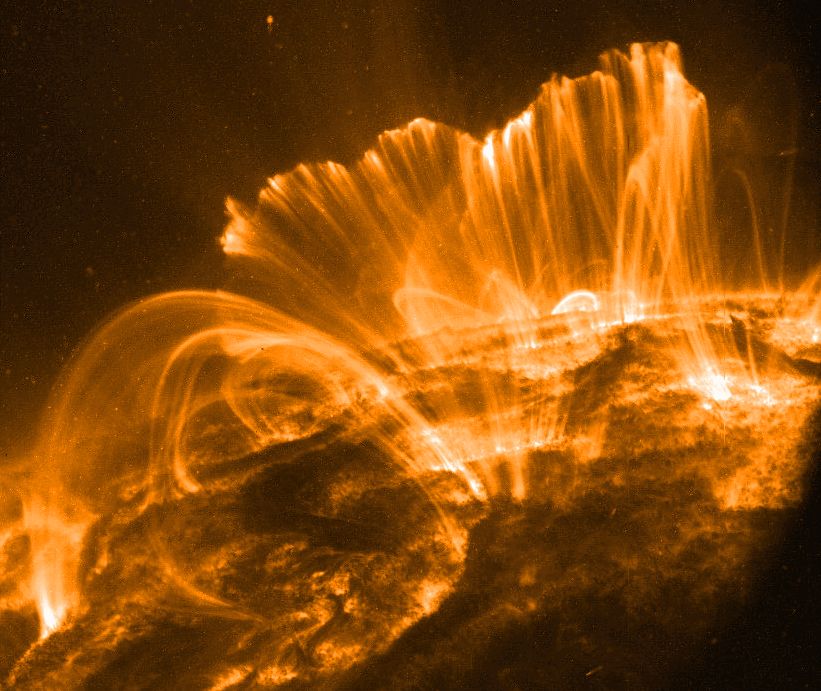 |
| Above: Areas of twisted magnetic field on the Sun, a precursor to a flare or coronal mass ejection. Courtesy of NASA. |
ESA explains the importance of sea level in climate change
Climate change is almost always in the news these days, either because of people trying to stop it or trying to pretend it isn't happening. But lets be honest, most of us don't know much about what the detailed mechanisms behind climate change are. In this video ESA explains the role of sea level, and why it's one of the things they monitor.
British mission to measure exoplanet atmospheres
Twinkle is a low-cost mission, built be the University of Central Lancashire and Surrey Satellite Technology, that will use spectroscopy to decode the light from hundreds of extrasolar planets. Twinkle will be able to reveal, for the first time, the chemical composition, weather and history of worlds orbiting distant stars - not quite as good as the starship Enterprise, but it's a step along the road. The Twinkle satellite will be built in the UK and launched into a low-Earth orbit.
 |
| Above: The Twinkle spacecraft - looking very un-twinkly and slightly death-ray like if you ask me. |
ESA's lunar symposium - what's next for our Moon?
The ESA space exploration strategy and the ISECG Global
Exploration Roadmap underline the strategic significance of the Moon in a
global space exploration endeavour.
The international vision for lunar exploration calls for a
new era of coordinated human and robotic missions enabled by broad
international cooperation.
The ISS programme has demonstrated the importance of a
robust international partnership for ISS development, assembly,
operations and effective utilisation.
Now is the time to build on this partnership and open it to
new partners to continue the journey beyond low Earth orbit.
The symposium "Moon 2020-2030" will be a key step in
advancing the international approach for lunar exploration together with
key players from agencies, academia, and industry.
I personally look forward to the innovative ideas and
mission that will be discussed and the feedback from the stakeholders.
Thomas Reiter
ESA Director of Human Spaceflight and Operations
 |
| Above: ESA's pan for a lunar transport architecture. |
Tuesday, 8 December 2015
Factory in space, dark matter stars.....
Prototype in-space factory built
A company called Magna Parva has produced a prototype of an in-space factory that should be able to produce gigantic structures in space without the need to launch them off the Earth. This could open the door to building things in space too big or too fragile to be launched on a rocket. It's called COPMA, which stands for ‘Consolidated Off Planet Manufacturing and Assembly System for Large Space Structures’. Want to see huge-ass spaceships built? Then this is the technology to keep an eye on...
Dark matter stars
Dark matter- that mysterious stuff that seems to interact with the rest of the universe only by gravity - may clump together in 1000 kilometre sized packets with strange properties. The 'dark stars' ( Which they aren't really since they wouldn't give off energy, but hey, it's a cool name and why be pedantic?) would be naturally forming Bose-Einstein condensates, where all the atoms inside acted as one. Here's the original paper, although it's pay per view.
Fraser Cain takes a look at wormholes:
Fraser Cain is editor of Universe Today, and pretty much one of the biggest space buffs around. Here he's taking a look at wormholes: In science fiction, wormholes are a method often used to travel great distances across space. First proposed by Einstein (amongst others) there's always ben a question mark in the theories about whether they could be built in real life, and exactly what they'd really do....
A company called Magna Parva has produced a prototype of an in-space factory that should be able to produce gigantic structures in space without the need to launch them off the Earth. This could open the door to building things in space too big or too fragile to be launched on a rocket. It's called COPMA, which stands for ‘Consolidated Off Planet Manufacturing and Assembly System for Large Space Structures’. Want to see huge-ass spaceships built? Then this is the technology to keep an eye on...
 |
| Above: I promise, that thing didn't get launched into space on a piddly little rocket like we use today.... Courtesy of Disney. |
Dark matter stars
Dark matter- that mysterious stuff that seems to interact with the rest of the universe only by gravity - may clump together in 1000 kilometre sized packets with strange properties. The 'dark stars' ( Which they aren't really since they wouldn't give off energy, but hey, it's a cool name and why be pedantic?) would be naturally forming Bose-Einstein condensates, where all the atoms inside acted as one. Here's the original paper, although it's pay per view.
 |
| Above: Ceres, a dwarf planet that would be about the same size as the dark matter 'stars'. Courtesy of JPL. |
Fraser Cain takes a look at wormholes:
Fraser Cain is editor of Universe Today, and pretty much one of the biggest space buffs around. Here he's taking a look at wormholes: In science fiction, wormholes are a method often used to travel great distances across space. First proposed by Einstein (amongst others) there's always ben a question mark in the theories about whether they could be built in real life, and exactly what they'd really do....
Sunday, 6 December 2015
Earth sized telescope sees galactic black hole, Akatsuki arriveas at Venus........
Event Horizon telescope 'sees' back hole magnetic fields
The Event Horizon Telescope (EHT) is still under construction, but when it's fully built it will be a global network of radio telescopes that link together to function as one giant, Earth-sized telescope. It will be able to spot an orange on the surface of the Moon ( A radio transmitting orange at least*). But even now, half built, EHT has resolved features at the horizon of our galaxy's central black hole 26,000 light-years away from Earth. Specifically it has used the polarisation of the light coming from hot matter right up close to the hole to learn about the magnetic fields around it.
"Because of technical advances with the EHT, we can now detect this polarization information. And because the emission near Sgr A* is synchrotron radiation, the direction of linear polarization traces the magnetic fields. So that's how we can go from measuring polarization at the telescope to understanding magnetic fields near the black hole," says EHT researcher Michael Johnson. They also found that the magnetic fields fluctuated on short time scales of only 15 minutes or so.
"Once again, the galactic center is proving to be a more dynamic place than we might have guessed," says Johnson. "Those magnetic fields are dancing all over the place."
'Lost in space' Akatsuki probe finally makes it to Venus!
A Japanese space probe that was trapped in an orbit around the Sun after an engine broke down as it tried to enter orbit around Venus, has finally made it to the hellish planet, after engineers used its manoeuvring thrusters to make a second attempt - although the orbit has not yet been independently confirmed.
“It is in orbit!!” reported Sanjay Limaye of the University of Wisconsin-Madison, who is working with the science team in Sagamihara, Japan.“We had a perfect operation!” says project manager Masato Nakamura
Elsewhere in the universe:
Suborbital X-ray telescope
Mini spacecraft factory
Russia's crumbling economy cuts ROSCOSMOS budget
* I know of no plans to send radio transmitting oranges to the Moon. Although I'm sure I've just inspired at least one reader to draw a picture of one.
The Event Horizon Telescope (EHT) is still under construction, but when it's fully built it will be a global network of radio telescopes that link together to function as one giant, Earth-sized telescope. It will be able to spot an orange on the surface of the Moon ( A radio transmitting orange at least*). But even now, half built, EHT has resolved features at the horizon of our galaxy's central black hole 26,000 light-years away from Earth. Specifically it has used the polarisation of the light coming from hot matter right up close to the hole to learn about the magnetic fields around it.
"Because of technical advances with the EHT, we can now detect this polarization information. And because the emission near Sgr A* is synchrotron radiation, the direction of linear polarization traces the magnetic fields. So that's how we can go from measuring polarization at the telescope to understanding magnetic fields near the black hole," says EHT researcher Michael Johnson. They also found that the magnetic fields fluctuated on short time scales of only 15 minutes or so.
"Once again, the galactic center is proving to be a more dynamic place than we might have guessed," says Johnson. "Those magnetic fields are dancing all over the place."
 |
| Above: An artist impression of Saggitarius A*, our galaxy's central black hole. |
'Lost in space' Akatsuki probe finally makes it to Venus!
A Japanese space probe that was trapped in an orbit around the Sun after an engine broke down as it tried to enter orbit around Venus, has finally made it to the hellish planet, after engineers used its manoeuvring thrusters to make a second attempt - although the orbit has not yet been independently confirmed.
“It is in orbit!!” reported Sanjay Limaye of the University of Wisconsin-Madison, who is working with the science team in Sagamihara, Japan.“We had a perfect operation!” says project manager Masato Nakamura
Elsewhere in the universe:
Suborbital X-ray telescope
Mini spacecraft factory
Russia's crumbling economy cuts ROSCOSMOS budget
* I know of no plans to send radio transmitting oranges to the Moon. Although I'm sure I've just inspired at least one reader to draw a picture of one.
Subscribe to:
Posts (Atom)