Search This Blog

Saturday, 16 June 2012

Worlds beyond the edge of knowledge: The Steppenwolf.

How's my blogging? Leave some feedback, I get better at this, you get a better read!

Today's post combines something I've wanted to talk about for a while with some latest news, so it's a bit longer than usual. If you want to skip straight to the bit about there being billions of rouge planets in the galaxy, and some of them travelling at enormous speeds into intergalactic space, skip to where it says 'Steppenwolf'.

But you'll miss all the cool giant telescope, simulated Earth, and asteroid flyby stuff, so don't unless you're feeling really impatient...
....oh, they've gone.

Never mind:

On Thursday I asked: What's this then?
Odd looking, I'd say. But, more accurately: It's the inside of a very small planet!


Video above: Some of the latest data from the Geoflow 2 experiment, on the International Space Station. Courtesy of NASA/ESA.

This shifting pattern is data from an experiment on the International Space Station [1], called Geoflow 2 [2]. It is literally a re-creation of the mantle of an Earth sized planet, only possible in microgravity conditions.

The experiment consists of two spinning spheres, one inside the other. The inner one represents the core, and the outer the crust. In between them is a fluid that stands in for the mantle. The whole thing has simulated gravity, via a strong electric field.


Image right: The ISS.Yep, they really do do things up there besides float around! Although, floating is cool enough to have some mileage in it. Image courtesy of NASA/JPL.

Doing something like this wouldn't work on Earth, because real gravity would pull everything in one direction. And this is just one of the many brilliant experiments going on on the ISS. There are investigations into the physics of fire [3], fluid flow [4], testing new technologies and materials for space satellites, studying the Earths atmosphere, studying particles from deep space [5]...... Follow the links, and find out just how much good science is actually being done there.

Or did you think they just waited for the Space Olympics [6] to come around?


Video above: A droplet of fuel burns in a way never seen on Earth, under microgravity conditions, in an ISS experiment. Video courtesy of Space.com.


The biggest telescope ever:

Image above: An artists impression of ESO's massive planned telescope. Image courtesy of ESO.

The European Southern Observatory [7] is building a monstrous telescope, with a main mirror forty meters across. Aptly named the European Extremely Large Telescope, the mirrors will have the latest adaptive optics [8] system. This bit of wizardry changes the mirrors shape thousands of times a second, cancelling out distortion from the Earths atmosphere, giving clarity of image almost as good as a space telescope.
Far bigger than anything we're likely to field in space (for the foreseeable future), it will collect more light, and be able to resolve smaller, fainter, further objects..

What's the point of a telescope as wide as a 737 jet is long? Well, if you're a James Bond villain then you could point it at the Sun and turn it into a solar death ray machine:

Image above:The solar powered 'Icarus' death ray from James Bond. But the bad guy didn't actually laugh maniacally as he fired it. I would have.... Image courtesy of Pinewood Studios.

But for those of us.... ahem, technically that's 'all of you'..... who don't wake up going 'Mwhahahahahah':
This beast will be able to take a picture of an Earth sized planet going around another star. It will be able to see the first stars ever to shine in the universe. Point it at a Bok globule [9], or Proplyd [10], and you might actually catch the signs of worlds growing  before your eyes. Or at least your ultra sensitive CCD imaging device.

The E-ELT will cost something like a thousand million euros, will be ready in the early twenty twenties, and be based near the already existing Paranal observatory in Chile.

I've just gone into my shed and looked at my 7 inch refractor. Suddenly I'm feeling insecure....telescope envy, anyone?

2012 LZ1 struts her stuff:

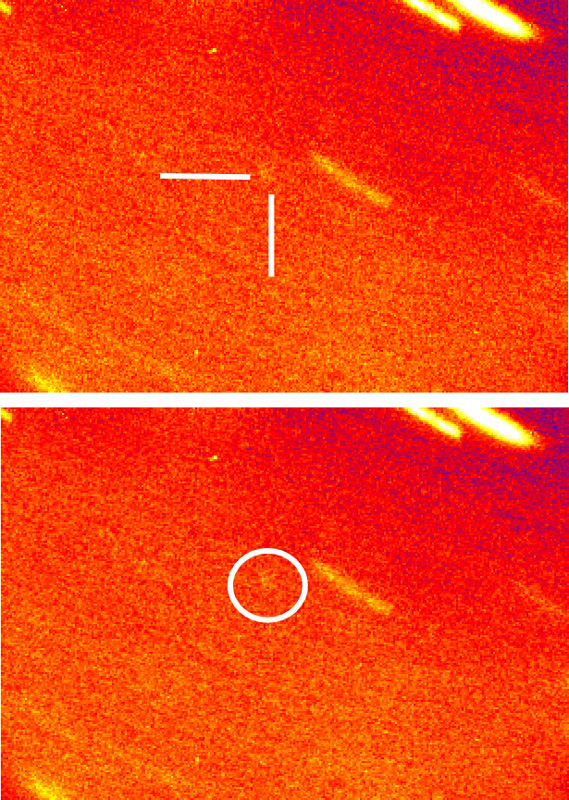
The Italian Remanzacco Observatory [11] has recorded the close approach to Earth of asteroid 2012 LZ1, and made the footage available online:


Video above: 2012 LZ1 near its closest approach. Video courtesy of the Remanzacco Observatory.

The unusually bright space rock only came as close as five and a bit million kilometers, although it still gets the designation 'Potentially Hazardous Asteroid'. However, as far as we can tell, 2012 LZ1 has no plans to come crashing through your kitchen ceiling at 25 kilometres per second. Although it has declined to be interviewed on the subject........
For an overview of what we know about the visitor, head over to the Minor Planets Center [12].

Steppenwolf:
I've been meaning to write about this for a while:
A theoretical study [13] by the Kavli Institute for Particle Astrophysics and Cosmology suggests an upper limit of a hundred thousand wandering planets, sometimes called Steppenwolf planets [14],  for every star in our galaxy.
This isn't just theory though. Astronomers have found evidence [25], using 'microlensing [15]', for a few wandering planets already. The rouges so far found are giant planets, lying between Earth and the centre of our galaxy, but the idea of Earth sized worlds being out there is also gaining credibility from the findings.   .
Image above: A graphic of the way that wandering planets can distort the light from a distant star. Image courtesy of NASA Astrobiology magazine.

Which leads to the question: What kind of worlds might be out in the dark, and how did they get  there?

The answer to the first part is, obviously, 'Cold'. Without a nearby star to warm them these worlds will only have whatever heat they kept from their birth, and whatever the decay of radioactive isotopes [16] in their cores doles out.

But therein lies a get-out clause!

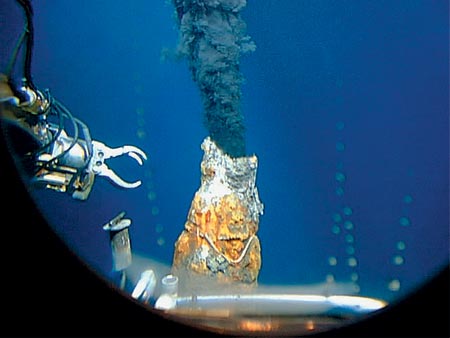
Image right: The Alvin submarine approaches a deep sea volcanic vent - a black smoker - around which weird life forms cluster, living without sunlight. Could a similar 'hotspot' sustain simple life on a Steppenwolf world? Image courtesy of Woods Hole Oceanographic Institution.

The surface of Earth is mostly Sun warmed. Yet in places it's intensely hot due to internal heat - those pleasant spots called 'volcanoes'.  So, might a wandering rocky planet have volcanic oasis beneath the ice that probably covers most of its surface?
We know of microbes, and even worms [17], that live absurdly deep beneath surface of Earth. And even that might be a conservative way to get habitable conditions: A paper published in Nature [18] has calculated that a hugely thick hydrogen atmosphere could hold enough heat to keep water liquid at a planets surface, even without a sun.
Wandering Jupiter sized worlds would probably be be a lot like the giant planets in our solar system. After all, Jupiter puts out as much heat as it receives from the Sun, and then some; The core of Jupiter is thought to be up to thirty five thousand degrees Celsius. So, since Jupiter has a powerful internal heat source, a Jovian Steppenwolf might stay toasty warm inside for billions of years.

How warm these wanderers could be is up for grabs. But it's a good bet: These worlds wouldn't be  frozen chunks of dead ice.


Image above: The Hubble Space Telescopes view of Pluto, and it's three largest moons. The ex-planet has been suggested to retain enough heat for a liquid water layer near its core. Could Pluto be a model for low mass wandering planets? Image courtesy of ESA/NASA.

OK, so they might not be totally dead places. But how did they get so far into the dark in the first place?

Jupiter sized and fatter planets could have formed as loners, in a similar fashion to a star, from a scrap of molecular cloud. The existence of Brown Dwarfs [19] -  objects part way between star and gas giant planet - gives this idea some weight, but the micro lensing studies I mentioned earlier found too many to be easily accounted for this way. 

However a starless planet doesn't need to have formed on its lonesome.
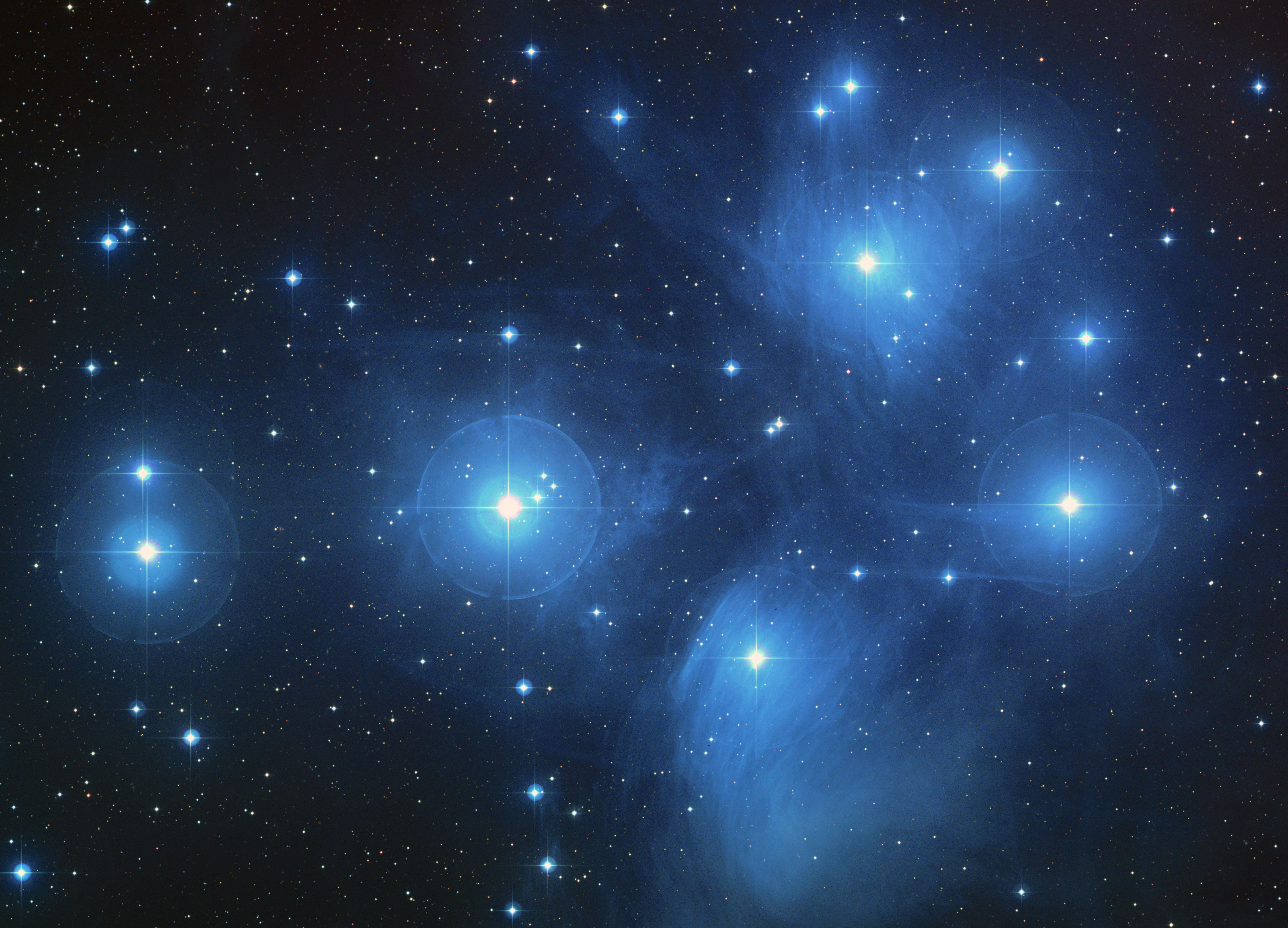
Image above: The Pleiades open cluster, a collection of close packed young stars still clinging to the remnants of the gas clouds that birthed them. In such a cluster close encounters between stars, and so planet stealing , are probably common. Ever seen two year olds fight over a toy? Image courtesy of NASA/ESA/AURA/Caltech

The other method to get a wandering planet is for it to lose a gravitational argument with something, and be thrown out of its home star system. This idea isn't as far fetched as it sounds. In fact it's thought to have happened in our own solar system [20]. The physics of this are akin to a gravitational slingshot manoeuvre [21], which you may have heard about (or not, I am very nerdy), but with bigger participants.

Generally, there are two main directions for a planet to be 'thrown' - towards its sun, or towards interstellar space. If the planet goes interstellar, then it's just going to get very, very, cold. But if the the planet goes into its sun..... 

It's not an either/or thing: A planet could get thrown into any number of strange orbits. But undoubtedly some worlds do go to their suns fire, or the icy deeps of space.

Video above: This is what happen to a comet when it hits the Sun. So multiply that by about a million for a planet hitting its star. Video courtesy of NASA/JPL

So, to answer 'how did they get there':  
Some of the worlds floating around out there are natives of the interstellar dark, but many are probably exiles, born into a planetary family that rejected them.

Awww!

But why let them just float!? Bring a big black hole into the mix -  which appeals to my inner supervillian - and your wandering planet can become a charging one!

When a double star system wanders too close to the monster black hole [22] in our galaxies centre, one star can be captured, and the other thrown into space with a huge speed. These are the hypervelocity stars [23].
And, if you run the calculations, it turns out that the same thing can happen to the stars planets! Their encounter with the black hole leaves them tearing through the Milky Way, like huge cannonballs, at up to thirty million miles an hour. Faster than any other planet [24] - than anything natural that's bigger than a proton - they would see the whole disk of the galaxy, core to outer rim, in under two million years.

Video above: A journey towards the Milky ways titanic central black hole, showing the stars that rip around it in tight, high speed, orbits. Video courtesy of the European Southern Observatory. The guys with the thing for gigantic telescopes.

And then... it's goodbye to the Milky Way.....and on into the void between galaxies....

List of links:. 
[1]http://www.nasa.gov/mission_pages/station/research/index.html
[2]http://blogs.esa.int/promisse/2012/05/09/geoflow-ii-experiment-campaign-complete/
[3]http://issresearchproject.grc.nasa.gov/Investigations/F/LEX-2
[4]http://www.nasa.gov/mission_pages/station/research/experiments/FSL.html
[5]http://www.nasa.gov/mission_pages/station/research/experiments/AMS-02.html
[6]http://www.nasa.gov/mission_pages/station/research/experiments/AMS-02.html
[7]http://www.eso.org/public/news/eso1225/
[8]http://cfao.ucolick.org/ao/
[9]http://www.cfa.harvard.edu/news/2010/su201023.html
[10]http://campus.pari.edu/mwc/html/proplyds.html
[11]http://remanzacco.blogspot.co.uk/
[12]http://www.minorplanetcenter.net/iau/MPEph/MPEph.html
[13]http://news.stanford.edu/news/2012/february/slac-nomad-planets-022312.html
[14]http://geosci.uchicago.edu/%7Eabbot/PAPERS/abbot-switzer-11.pdf
[15]http://www.physics.fsu.edu/Courses/spring98/AST3033/Micro/lensing.htm
[16]http://en.wikipedia.org/wiki/Geothermal_gradient
[17]http://www.nature.com/nature/journal/v474/n7349/full/nature09974.html
[18]http://www.nature.com/nature/journal/v400/n6739/full/400032a0.html#a1
[19]http://www.technologyreview.com/view/418350/lone-jupiter-discovered-wandering-nine-light/
[20]http://www.astrophysicsspectator.com/topics/planets/GiantIcePlanets.html
[21]http://www.astrophysicsspectator.com/topics/planets/GiantIcePlanets.html
[22]http://en.wikipedia.org/wiki/Sagittarius_A*
[23]http://hubblesite.org/newscenter/archive/releases/2010/19/full/ [24]http://www.sciencedaily.com/releases/2012/03/120322113604.htm [25]http://www.jpl.nasa.gov/news/news.cfm?release=2011-147

Thursday, 14 June 2012

Passing space rock to become internet star!

How's my blogging? Leave some feedback, I get better at this, and you get a more interesting read!

Asteroids whizz past Earth all the time. Asteroid 2012 LZ1 is no different really.
It's brighter than most. It's a relatively svelte 500 meters wide, and it will miss Earth by 14 times the distance to the Moon. It would also make a real mess of your country if it crashed into it, but there's no danger of it doing so, although it does come close enough to earn the title 'Potentially Hazardous Asteroid'. And 2012 LZ1 will be at its 14 lunar distances closest to Earth late tonight.

Just one thing before I go on: This tiny fragment of world was discovered on Sunday, which is a bit short notice for me. I mean, yes, it's going to miss but if it had been one of the rare ones that hit Earth... well three days isn't long to do much. More funding, for the detection of huge space rocks heading for us at 22,000 kph, might be nice.

Just a thought.

But 2012 LZ1 has that special, indefinable thing: Star quality. The proof? The Slooh space camera team are planning to make 2012 LZ1 the star of a live webcast [1]!


2012 LZ1 Animation - June 13, 2012, by N. Howes, E. Guido & G. Sosterohttp://remanzacco.blogspot.it/
Video right: Asteroid 2012LZ1 (the bright white flying jellybean thing) as seen last night through a 2 meter telescope. Image courtesy of the Remanzacco Observatory [2].

The webcast will start at 00:00 UTC tonight, and the asteroids closest approach is about 23.10 UTC. The International Astronomical Union Minor Planets Centre has all the detail needed [3] to track the big little fella, if you want to have a go yourself!

I'm guessing from its unusual brightness that this is a metallic or  stony, rather than carbon rich, asteroid, but we'll have to wait to find out!

By the way, if you watch the webcast, try something for me? Instead of thinking of this ancient rock as 'up there', try thinking of it as 'over there'.
'Up there' sounds....kind of inaccessible, separate from us, not a part of our world-view. But 'over there'.......something that's 'over there' is something we could travel to, something that we could affect, and which could affect us.
OK, I'm wittering, but my laboured point is: Space surrounds us in all directions. Earth was born in it, from things like 2012 LZ1. And as today shows, there are still lots of them about. Space is an 'over there' thing.

No, I'm not on drugs. Apart from hayfever tablets. I'm always like this! Imagine what my daughter has to put up with. Well, she's two, so she hasn't grasped what Daddy is like, yet..... But really, try it, you might find that that little speck, somehow looks, a lot closer.

Now, on a totally different note: I have a game for you (if that sounded creepy then you've watched too many 'Saw' movies, it was perfectly innocent*):

Can you guess what this is?

I'll tell you on Saturday!

*That sounds even creepier doesn't it? D'oh, don't run away, I'm nice, really!

List of links:

[1]http://events.slooh.com/
[2]http://remanzacco.blogspot.co.uk/
[3]http://www.minorplanetcenter.net/mpec/K12/K12L30.html

Wednesday, 13 June 2012

Nu-STAR awaaaay.........

How's my blogging? Leave some feedback, I get better at this, you get a more interesting read!

A space addict cannot go to bed without posting something on the launch of  a small, but groundbreaking, spaceship: So here's a video of the Pegasus rocket carrying the Nu-STAR X-ray space telescope [1] into orbit: 


Video above: The launch of the groundbreaking Nu-STAR space telescope, good luck to her team for the next stage of this groundbreaking mission! This video follows the craft all the way into orbit  - there's not actually much to see beyond the initial launch, but watching the whole thing gives you a feeling of just how complex, just how much effort, goes into even a small space launch like this one. Video courtesy of NASA.

What you're seeing here is the small Pegasus rocket [2] being launched from beneath the aircraft carrying it, with Nu-STAR in it's nose. Pegasus launches done this way for a few reasons:
1: It makes the launch position, and therefore the final orbit, of the spacecraft is easy to control.
2: The rocket saves fuel by being carried above much of the Earths atmosphere (imagine the headwind you'd feel at 11,400 miles per hour!).
3: You can just fly the rocket out to an unpopulated area to launch, so there's no risk if clobbering someone if the cutting edge rocket decides to just fall out of the sky. In this case the plane flew out over the Pacific ocean to perform the launch.

OK, the video above doesn't give you much visually on the launch. So here's a computer simulation of Pegasus going into space. There's a bit more to see, some music, and  lots of cool whooshing whirring, and 'bang' noises. I don't think the noises are accurate, especially the satellite going 'whirrr' at the end, but I watched Star Trek last night and that has whooshing noises in the vacuum of space, so I can't grumble too much.


Video above: A simulation of Pegasus rocket launch. Video courtesy of misterp0p0 on youtube. Nice animation misterp0p0!

The last word on Nu-Star was that it had achieved orbit, and all systems were nominal. The next big hurdle is the unfurling of the ten meter long boom, with the X-ray optic on the end.

So good luck to the Nu-STAR team, and well done on their success so far!

List of links:
[1]http://www.nustar.caltech.edu/
[2]http://en.wikipedia.org/wiki/Pegasus_(rocket)

Tuesday, 12 June 2012

Opening an X-ray eye....

How's my blogging? Leave some feedback, I get better at this, you get a more interesting read!

EDIT: I'm a numpty, yet again, the press conference begins at 11.30 eastern daylight time . D'oh.
A quick note, on a small but very interesting space mission:

Nu-STAR ready to take to space!


Image above: The Nu-STAR spacecraft, with its unfoldable boom and X-ray optics deployed. Artists impression, courtesy of NASA/JPL/Caltech.

X-rays astronomy [1] has always been a bit of a bugger to do, as X-rays from space don't go through Earths atmosphere very well  - yes, I know that seems odd, since we use them to look inside ourselves. We use them for that because they will go through some kinds of biological tissue (muscle) and won't go through others (bone for example). However a hundred kilometres of air, like the hundred kilometres of air sitting on top of you right now, stops them rather nicely. Which is good because lots of X-rays would be bad for us, in the sense that they would kill us all.
The other problem with X-ray astronomy is that focusing X-rays isn't easy [2]: Most materials that they don't go straight through absorb them, instead of reflecting them. The highest energy X-rays, which would let us observe some of the most powerful events in the sky, are especially hard to handle. But it can be done [3], using technologies like the Wolter telescope [4]. Getting one of these into space could open up a whole new universe for us!

Image Left: The Pegasus rocket, with Nu-STAR aboard. It's one of those microsat launchers that launches from beneath the belly of a big aeroplane, which means the Nu-STAR is actually quite dinky when it's all folded up. Image courtesy of NASA/JPL/Caltech.

So NASA has built the Nu-STAR [5] (Nuclear Spectroscopic Telescope Array) spacecraft, based on the Wolter telescope, and which is being launched tomorrow on an Orbital Sciences [6] Pegasus rocket.
Once in space it will deploy a ten meter long boom, with a set of X-ray optics on the end. The long boom is needed because the X-ray optics have a long focal length [7], so the optics need to be held away from the X-ray detectors.
The satellite should totally change the field of X-ray astronomy, allowing us to do things like mapping the newly forged heavy elements in the debris of supernova. Since all the elements heavier than iron formed that way [8], learning more about how the gigantic supernova explosions distribute them across space helps us understand our solar systems birth. Nu-STAR will also be a very sharp eyed black hole hunter. Which isn't ancient solar system related, but just about anything to do with black holes is cool in my book.
Image above: To show how much Nu-STAR will improve X-ray astronomy, here's a comparison between an image taken by ESA's INTEGRAL spacecraft (Top left), and the kind of image expected from the Nu guy (bottom right). See what I did there? Make you laugh? Groan? Throw something at the screen? Well, at least that's a reaction. Image courtesy of NASA/JPL/Caltech.

The Nu-STAR team will have a news conference tomorrow, at 11.30 British time, with the following panelists:

-- Omar Baez, NASA launch director, Kennedy Space Center, Fla.

-- Fiona Harrison, NuSTAR principal investigator, California Institute of Technology, Pasadena, Calif.

-- William Craig, NuSTAR instrument manager, University of California at Berkeley (UC Berkeley)

-- Grace Baird, NuSTAR bus chief engineer, Orbital Sciences Corporation, Dulles, Va.

And you can get a live audio stream of it here [9].
I'll be at work then, cussing at the machines. That's not how I usually work, it's just missing the launch. Ahem.

List of links:
[1]http://www-xray.ast.cam.ac.uk/xray_introduction/
[2]http://imagine.gsfc.nasa.gov/docs/science/how_l2/xtelescopes_systems.html
[3]http://www.astro.umd.edu/~richard/ASTR680/Aschenback_mirrors.pdf
[4]http://en.wikipedia.org/wiki/Wolter_telescope
[5]http://www.nustar.caltech.edu/about-nustar
[6]http://www.orbital.com/
[7]http://hyperphysics.phy-astr.gsu.edu/hbase/geoopt/mirray.html
[8]http://hyperphysics.phy-astr.gsu.edu/hbase/astro/nucsyn.html
[9]http://www.nasa.gov/news/media/newsaudio/index.html

Monday, 11 June 2012

Absent Dwarves, and a big black rock....

How's my blogging? Leave some feedback, I get better at this, and you get a more interesting read!

Just a couple of quick bits of news, because it's late, and because the 'a' on my keyboard is playing up which makes typing a lot like hard work:

The Dwarfs aren't out there:
NASA has released results [1] from the infra-red WISE [2] space telescope, and they have a surprise: Theories predict that there should be one Brown Dwarf [3] - an object partway between a Jupiter like planet and a small star - for every regular star. But there aren't! The number is more like one for every six regular stars.


Image above: Our local bit of the Milky way, with the positions of newly found brown dwarfs circled in red. basically, there should be more of them. The image is a view from about 30 light years away. Presumably a simulated view. If it's an actual view then my mission to keep you up do date with space related news has suffered something of a ......hiccup.
Image courtesy of NASA/JPL

Brown dwarfs are thought to form by the same process as regular stars [4] -  the collapse of a huge, sparse cloud of gas. That there are fewer in our local neighbourhood may be telling us something about the history of our corner of the Galaxy, or pointing to a gap in our theories of star formation.
But WISE is still looking, and there may be further surprises. Brown dwarfs are hard to spot: They're too small to sustain hydrogen fusion [5]. Instead they briefly fuse deuterium [6], and then slowly fade and cool-  in fact the coldest one found by WISE is only 25 degrees Celsius at it's surface, a record breaking cold 'star'.

Son of the Falcon to visit black rock:

JAXA [7] is looking to visit asteroid 1999 JU3 [8].... and their ship is already under construction.

Image Above: The asteroid 1999 JU3. Um. Ok, you've got me, that asteroid's Itokawa, the target of Hayabusa 1. But it's still a spectacular chunk of space rock! Go on give it chance...... fine, it looks like a 500 meter long potato. Or worse. But 1999 JU3 itself is pitch black, due to its high carbon content - the 'lead' in a pencil is actually made of carbon -which makes it very difficult to image from Earth. But while most asteroids look like huge potatoes, they make up for it by holding clues to how planet Earth, and life here, started. Image courtesy of JAXA.

Their Hyabusa 2 space ship is, according to the Japanese Asahi Shimbun newspaper, already under construction. It's based on the ion drive [10] propelled Hayabusa (which means 'peregrin falcon') probe, that had a 'very eventful' mission to the asteroid Itokawa.

Which is science speak for: Things went wrong. A lot of things.

But to be fair, it was a totally new design of spaceship. The JAXA engineers are inventive, determined, and they bought the little bird home with its cargo of asteroid samples. The probe -  aside from the sample return capsule, which landed safely - was then incinerated in Earths atmosphere which was a pity, but always part of the plan.

Although the probe itself might have objected to that plan

The story of triumph over adversity [11] has gone down well in Japan, probably as it shows just how much engineering talent and tenacity JAXA have. So JAXA are doing a sequel, although in cash strapped times they've had to fight for the money


Video above: Hayabusa slams into Earths upper atmosphere at very, very, high speed. The shower of huge sparks is the main probe breaking up, the little spark on the lower right is the sample return capsule, which made it back to Earth with it's cargo of asteroid bits intact. Video courtesy of NASA.

The new probe is intended to visit asteroid 1999 JU3 in mid 2018, and stay in orbit for a year and a half, It will spend it's time studying the asteroid, collecting samples for return to Earth, and possibly deploying a small lander. 1999 JU3 is getting this attention because it holds carbon chemistry, and shows signs of being altered by liquid water [12], presumably while part of a larger body like a protoplanet. Ground based observations also suggest that there may be two types of material on its surface, so perhaps we have a rubble pile of two asteroids, smooshed into one by a collision.

After all the things we've found in carbon rich meteorites [13] that relate to the origins of life - nucleobases, nucleobase analogues, amino acids -  this kilometre long piece of black rock could provide us with some important clues as to how we all came to be.

List of links:
[1]http://www.jpl.nasa.gov/news/news.cfm?release=2012-164&cid=release_2012-164&msource=12164
[2]http://www.nasa.gov/mission_pages/WISE/main/index.html
[3]http://astro.berkeley.edu/~basri/bdwarfs/SciAm-book.pdf
[4]http://www.cfa.harvard.edu/news/2008/pr200824.html
[5]http://www.astrophysicsspectator.com/topics/stars/FusionHydrogen.html
[6]http://www.astrophysicsspectator.com/topics/degeneracy/BrownDwarfStructure.html
[7]http://www.jaxa.jp/index_e.html [8]http://en.wikipedia.org/wiki/(162173)_1999_JU3
[10]http://www.jaxa.jp/article/special/hayabusa/kuninaka_e.html
[11]http://www.bbc.co.uk/news/10285973
[12]http://iopscience.iop.org/1538-3881/135/4/1101/
[13]http://www.pnas.org/content/early/2011/08/10/1106493108

Thursday, 7 June 2012

Venus (an extreme world) and Vesta (an extremely battered world):

Hows my blogging? Leave some feedback, I get better at this, you get a better read!

The transit of Venus was as spectacular as promised, although not from my house, as we've had our allocated five sunny days of summer here in Manchester What's up with that? [1]

However, other parts of the world were luckier, and spacecraft don't suffer from such things, so here are some truly amazing snaps from:

The NASA/JAXA Hinode [2] spacecraft....


Image above: The planet Venus begins its passage across the face of the Sun. Image courtesy of NASA/JAXA.

....the Arctic island of Spitsbergen....


Image above: The transit of Venus from the Arctic. Where the weather was, apparently, better for it than in England. Image courtesy of Michel Breitfellner and Miguel Perez Ayucar/ESAC.

 ....Canberra, Australia....


The Venus transit as seen from down-under. Please forgive this pom for calling it that, I realise it is in fact on the top of all the world. Don't make me play Australian rules football, please. I wouldn't survive. Image courtesy of Michel Breitfellner and Miguel Perez Ayucar/ESAC

As well as videos from ESA's Proba 2 micro-satellite [3]...


Video above:  The transit of Venus, as seen from the ESA Proba 2 spacecraft. The wobble is due to the satellite wobbling, not Venus. Venus does enough strange stuff already. Video courtesy of ESA.

...and NASA's Solar Dynamics Observatory [4].


Video above: The transit of Venus, as seen from the Solar Dynamics Observatory spacecraft. The roiling plasma on the surface of the Sun is complex and beautiful enough for me to watch by itself. And then it's got Venus in there to! Courtesy of NASA/JPL.

Image left: NASA has built the Extreme Environment Chamber. It's a beast, like a pressure cooker designed to dissolve, incinerate and pulverise the food in a split second. They plan to build machines that can live in it for a week. Image courtesy of NASA/Glenn.

In other Venus related news: NASA's Glenn research centre have built an Extreme Environment Chamber [5], to recreate the brutal conditions of the Venusian surface. The chamber is much too serious a machine for me to do something silly, like call it an Xtreme Environment Chamber.
Ooops. Anyway, each bolt to hold the lid in place weighs 45 kg, or as much as a... well I can't think of anything that weighs exactly that much. But that's a lot for one bolt. The engineering has to be that hardcore: Having a simulated Venus inside makes the chamber a huge explosion, waiting to happen.

The main purpose of all this is to work out how to build electronics, machinery, and sensors, that will operate under the crushing  Venusian pressure and heat [6]. Initially the aim is to build something that would last for five days there. For example: The Glenn team are developing a seismometer that would provide insights into Venus' extreme geological processes [7]. Others are working on measuring how sound, light, and the Venusian soil would behave under those conditions.

The applications for the chamber go beyond testing for Venus. According to Rodger Dyson, the principle investigator for the project, if you can work on the surface of Venus you can work anywhere in the solar system - except the depths of the atmosphere of Jupiter, which has all of Venus' charm with massive radiation levels added on top.

Geoffry Landis, who works as an aerospace engineer at Glenn, has been involved in several proposed robotic missions to Venus [8]: "Venus is the planet that is closest to the Earth, both in distance and in composition," Landis has said. "It's very much Earth's twin, but in some ways it's Earth's evil twin."

Elsewhere in the solar system:

The Dawn [9] team have published a 3D map of Vesta [10], in both real and enhanced colour, to bring out the differences in the composition of its surface areas.


Video above: A 3D map of Vesta, made using the thousands of hours of data the Dawn spacecraft has collected. Video courtesy of NASA/JPL.

Two things about this make me swoon with space nerdyness: You can see how nearly spherical Vesta is, how it might well have been planet shaped in the past. And we can see how hugely varied the surface composition is, showing just how complex and tumultuous Vestan geological history was. For example: Iron abundance is shown in green in this image, and we can see how iron has been bought to the surface, in patches, inside the huge gap where the south pole of this protoplanet used to be.

Image right: The best guess we have to date on he internal structure of Ceres, based on its mass, signs of materials that have interacted with water on is surface, how warm we think it might have gotten, and computer models. It's not been ruled out that there might be a tiny hint of geological activity, and perhaps a little liquid water, deep down near its core. Image courtesy of NASA.

Dawn is currently moving from its low altitude mapping orbit to its final science orbit, averaging 420 km above the Vestan surface. Then, in August, Dawn will break orbit of Vesta and head out to it's next target: The enigmatic and (probably) ice laden dwarf planet Ceres [11]. The ion drive powered spacecraft will reach the king of the asteroid belt in Febuary 2015, spending longer at Vesta than planned because the mission has so far gone almost flawlessly. As it departs Dawn will still be taking images and readings of Vesta, particularly its north pole, which has been in winter darkness for much of its visit so far.
Image above: The Hubble Space Telescopes best shot of Ceres. Can't think of a good comparison for it, but it looks tantalising. Image courtesy of NASA/JPL.

List of links:
[1]http://uk.answers.yahoo.com/question/index?qid=20091017061019AAhtlye
[2]http://solarb.msfc.nasa.gov/
[3]http://www.esa.int/esaMI/Proba/SEMJJ5ZVNUF_0.html
[4]http://sdo.gsfc.nasa.gov/
[5]http://www.nasa.gov/centers/glenn/technology/venus_chamber.html
[6]http://www.grc.nasa.gov/WWW/TECB/extreme.htm
[7]http://www.lpi.usra.edu/meetings/lpsc2012/pdf/1961.pdf
[8]http://www.lpi.usra.edu/vexag/may2008/presentations/18Landis.pdf
[9]http://dawn.jpl.nasa.gov/
[10]http://en.wikipedia.org/wiki/4_Vesta
[11]http://en.wikipedia.org/wiki/Ceres_(dwarf_planet

Tuesday, 5 June 2012

In which I'm a numpty....

I hang my head in shame: The transit of Venus is tomorrow from the UK, at about 5am [1], and I should be taken outside and slowly minced, feet first, for having the date settings on my computer wrong.

I'm very sorry.

Everything else I said about it still applies though.

OK, less embarrassing, and more interesting stuff:

A quick video of Venus starting to align with the sun to produce the coming transit, as seen from the SOHO spacecraft [2]:


Video above: Venus approaching the Sun, as seen by SOHO. Video courtesy of NASA Goddard space centre.


What I really love about this: You can see Mercury as well, giving a nice sense of looking into a spinning inner solar system.
The sun itself is blanked out, as the usual purpose of the LASCO C3 coronograph, the instrument taking this picture, is to observe the Suns corona (outer atmosphere), which is much fainter than the solar surface. The instrument is so sensitive that both Mercury and Venus are bright enough to overpower the pixels on the coronographs detector - causing the huge death-ray-spikes of light on either side of them.

Image above: A stunning image of Venus as it approaches the transit, showing the ring of scattered sunlight from high altitude particles in its atmosphere. Image courtesy of Lorenzo Comolli, and spaceweather.com.

Remember in my last, erroneous, blog post I pointed out that the suns light refracts about Venus, producing a 'ring of fire' around it, even before it has fully entered the Suns disk?
No?
OK, I only mentioned it briefly. But it turns out that this is important, because it allows astronomers here on Earth to probe the venusian atmosphere [3]. And the Venusian atmosphere is a dozen mysteries, wrapped in a conundrum, and hidden beneath sulphuric acid clouds.....

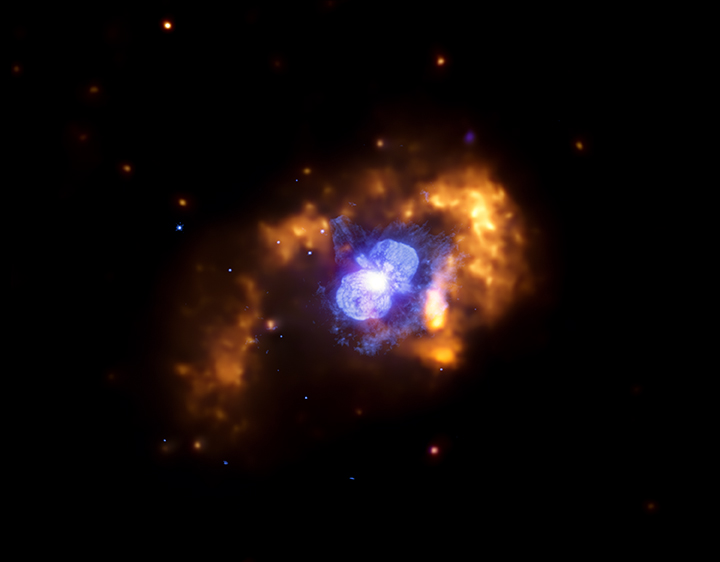
Image left: A combined X-Ray and optical image of the Homunculus nebula, home to the Eta-Carinae double star. The X-ray segment was taken by the Chandra space telescope, the optical part by the Hubble Space Telescope [4].The outer horseshoe shaped cloud is about two light years across, only visible in x-rays, and is evidence of a massive stellar tantrum about a thousand years ago. Image courtesy of NASA/JPL

ESA's Herschel space telescope [5] has produced another stunning picture, this time of the Carina nebula, which is home to several open clusters of young stars, star spawning regions of filaments and Bok globules [6], and the monstrous Eta Carinae double star. One of the stars in the system is thought to be a wolf rayet star [7], the other a huge ultra heavy luminous blue variable [8], weighing in at over a hundred times our suns mass. The pair are so unstable that they blast the bizarre Homunculus Nebula into the space around them.
Eta Carina has, at times, been almost as bright as Sirius [9] (itself a fascinating double star). Considering that Sirius is about eight and a half light-years away, and Eta Carinae is over seven thousand, the unstable double star must have been putting out a titanic amount of power at the time. And it spat our two lobes of super hot material, each weighing as much as our Sun or more, travelling at seven hundred km per second, making the Homunculus Nebula [10] we see today.
As Dr. Kris Davidson, from the University of Minnesota puts it: "If Eta Carina becomes a Supernova next Thursday, we shouldn't be surprised."


Image above: The massive Carina nebula, home to almost every kind of stellar beast you could imagine. It's even bigger and brighter than the Orion Nebula, but less well known because it's only visible in the southern hemisphere. Which seems a bit unfair to me, but never mind. We can see the voids carved into the nebula by the stellar winds of new born stars. The is picture was taken in the infra red by the ESA Herschel spacecraft. Image courtesy of ESA.

We get three fairly close NEO flybys in June: 2002 AC [11] and 1999 BJ8 [12] on June 16th, both passing by 60 to 70 times as far away as the Moon, both just over kilometre big. The third, on June 21st, is 2005 GO21  [13], which will be observed [14] by the Goldstone [15] and Arecibo [16] deep space radars. Arecibo expect to resolve the object to within a thousand pixels, and get a measurement of it's rate of rotation.

Finally: This week sees the Scorpid and Aretid meteor showers peak, with expected fall rates of twenty per hour and thirty per hour respectively. Watch out for the Scorpids Tuesday night, and the Aretids just after sundown Thursday.

The weather here in Manchester doesn't look promising for tomorrow. Still I'm going to go to bed with at least the hope that the sun might break through before I head for work. For long enough, perhaps, for me to use my telescope as a projector and catch a tiny piece of this never to be seen again (unless I wind up as a Futurama style head in a jar) event.
Tom Hanks. In a jar. Image courtesy of Matt Groening.

Cup of tea and then bed methinks.....

List of links:
[1]http://sunearthday.nasa.gov/2012/transit/viewing_locations.php
[2]http://sohowww.nascom.nasa.gov/
[3]http://science.nasa.gov/science-news/science-at-nasa/2012/04jun_arcofvenus/
[4]http://hubblesite.org/
[5]http://herschel.esac.esa.int/
[6]http://www.universetoday.com/24499/journey-inside-a-bok-globule/
[7]http://imagine.gsfc.nasa.gov/docs/ask_astro/answers/980603a.html
[8]https://www.cfa.harvard.edu/~pberlind/atlas/htmls/lbvstars.html
[9]http://en.wikipedia.org/wiki/Sirius
[10]http://en.wikipedia.org/wiki/Homunculus_Nebula
[11]http://ssd.jpl.nasa.gov/sbdb.cgi?sstr=2002 AC&orb=1
[12]http://ssd.jpl.nasa.gov/sbdb.cgi?sstr=1999 BJ8&orb=1
[13]http://ssd.jpl.nasa.gov/sbdb.cgi?sstr=2005 GO21&orb=1
[14]http://ssd.jpl.nasa.gov/sbdb.cgi?sstr=2005 GO21&orb=1
[15]http://deepspace.jpl.nasa.gov/technology/TMOT_News/FEB97/gldstone.html
[16]http://www.naic.edu/