This morning ESA's ExoMars mission set off from Baikonur spaceport, riding a Proton rocket on the first leg of its journey to Mars - here's an ESA video of the launch:
The launch was bang on time (well.. not literally BANG, else this would be a different kind of article) and it's completed all but one of the post launch manoeuvres needed to put itself on a course for Mars.
Whats the deal with sending another spacecraft to Mars?
It seems like we get quite a few launches to Mars, and that's because we do. But space agencies aren't just obsessed with red sad: Although Mars is a frigid desert, with air as thin as you'd find on a 20km high terrestrial mountain, there's a lot of evidence that in the deep past it was a lot more habitable. Ithad deep lakes, and perhaps even an ocean.
Above: A CG shot of Mars' hypothetical ancient ocean. Courtesy of ESA
That makes it a fascinating comparison with Earth, and raises the distinct possibility that some form of simple life might have taken hold there - a perhaps left behind chemical or fossil traces we could detect. Even today some tiny traces of liquid water survive in the shallow subsurface - and that trace of water means a slim chance of life surviving today in some friendlier-than-average Martian niche. Add that Mars has a surface we can reach with robots relatively easily, and that they can work on quite safely, and you get a very promising target for exploration.
That's the general idea with Mars exploration, but ExoMars itself is something slightly new: Although it is one mission, it is actually three droids sent to Mars to investigate signs of life, past or present. The family consists of:
Above: The TGO undergoing antenna tests. Courtesy of ESA.
TGO was launched today, and will be looking for tiny amounts of gasses that might be indicators of life or present day geological activity. A good example of these might be the 'burps' of methane gas detected by the Curiosity rover, one explanation for which could be Martian life of some kind. Whatever the answer, the TGO's instruments will make a comprehensive survey of the tracer gasses in the Martian atmosphere. TGO will also map subsurface hydrogen, which can beused to trace the presence of water ice - and near surface water ice could have important implications for Martian climate changes, and the presence of habitable environments.
Above: An artists impression of the lander. Courtesy of ESA.
The TGO will send the Schiaparelli lander to the Martian surface. It's mainly a technology demonstrator - a test of the techniques and technologies needed for ESA to land on the surface of Mars, which they've never done before. But it also carries a small science package, called DREAMS, which will mainly study the Martian weather and atmosphere.
ExoMars Rover: The last droid of the group is a Mars rover, and will launch towards Mars in 2018. This will be the first robot to land on the Martian surface with the specific intention of looking for signs of life. It will drill into likely spots, bringing up samples from up to 2 meters underground, which it will then grind up and subject to a battery of chemical and physical analysis. Here's a quick videoon it, courtesy of ESA.
Will the ExoMars family uncover evidence of Martian life? It's unlikely one mission could settle the question, but at the very least they will give us a good idea of where to look next....
Imagine that you're an engineer who worked on America's nuclear weapons program. You'd like to look for a more constructive use for you work. Why not turn the mind breaking energy of nuclear bombs to making the kind of absurdly huge spaceships Galactic Empires favour a reality?
This kind of size. Although less pointy. Image courtesy of ComicVine
In the 1950's a bunch of the engineers, who worked on American nukes, developed project Orion. Orion was a plan for .... frankly, quite insanely huge.... spaceships. Spaceships propelled by, essentially, throwing nukes out the back one at a time and setting them off.
"Satellite"
Orion
"Midrange"
Orion
"Super"
Orion
Ship diameter
17–20 m
40 m
400 m
Ship mass
300 t
1000–2000 t
8,000,000 t
Number of bombs
540
1080
1080
Individual bomb mass
0.22 t
0.37–0.75 t
3000 t
Above: A table I've shamelessly cribbed from wikipedia, showing the sizes of three different classes of Orion space ship. Note the number of zeros - that's not a typo. You could carry a small town into space with one of these things.
And, as far as we can tell, it probably would have worked. Two things closed the project down: The nuclear test ban treaty, and one important piece of technology never happening - a fallout free nuke. Without that even starting these bad boys up in orbit would have increased cancers worldwide. There're still people interested in the general idea today - as I said, it's very possible it could have been made to work. The original engineers even built a miniature Orion that used high explosive instead of nukes:
For bit more detail, here's the son of one of the engineers that worked on it:
Above: An artists impression of the inside of an O'Neill colony.
We'll never know for sure - our future seems to be heading in the direction of spacecraft miniaturisation- but it's now 2016.... I wonder where that alternative future would have gotten to by now.
Above: An artists impression of an Asteroid city, by JustV23
Well... the internet is a huge and weird place, so I can't promise that putting 'armchair explorers' into Google will return only PG esults. But for space geeks like meit's a nickname for a quite revolution that has taken place in space exploration (and science generally) over the last fifteen years.
Above: This image was one of the results. Obscene, isn't it? I mean, what kind of lunatic keeps their living room that clean? From this you can form a mental image of my front room. A disgusting one.
NASA, ESA, JAXA, and other space agenciesonly have fairly small number of planetary scientists to study their data - so, to cover more ground, they outsource.... to us space fans!
Mostly it involves going through images of other worlds, (which is my favourite, using the Cosmos Quest website) or of deep space (like the GalaxyZoo project), and indentifying craters, boulders, crevasses, alien landing ships**, and tagging the occasionalunknown object. That might not sound like a task of world shaking importance, but it identifies landing sites, areas of interest for future missions, and mysteries for the NASA guys to follow up on. It works: With just tiny bit of training teams of amateurs can cover a lot more ground/sky, and have had hands in some major projects...
There are more serious brands of armchair explorer: unmannedspaceflight.com is something of an on-line mecca for the more high end folks. These guys are often self taught imaging wizards, and use the website to talk with people at NASA, ESA, etc - it's from folk like these that we get astounding views and analysis of parts of Pluto's surface, like these:
Above: An image of Pluto's surface, colour enhanced and magnified by Gladstoner from unmannnedspacefloght.com, and a snippet of the analysis going on there.
In real life these guys have jobs ranging from care workers to NASA engineers, but they come together to help explore the universe. If you've seen a cool space image there's a good chance it's been cleaned up, or assembled from smaller parts, by these guys.
Above: A 3D image of the Martian desert. To see it you need a bit of technique, which is explained here - but it's worth the effort!
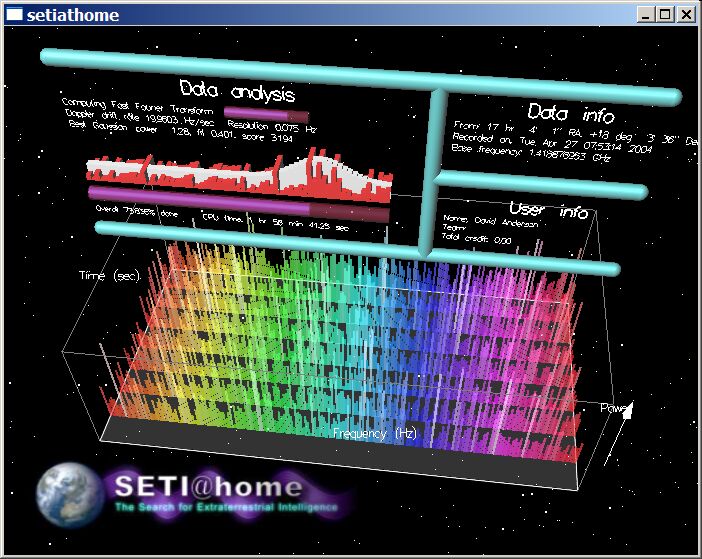
They've even been credited on scientific papers, or asked to help with mission planning (like they did for the New Horizons fly-by of Jupiter). Some folk go the other way, toward minimum effort, and simply donate some of their computers run-time to space exploration every day. A good example of these would be SETI@home, where people donated their computers down time to analysing signals from deep space for signs of intelligence.
Above: The SETI@home program running. Yes, I'm part of this one too.
It's not a hobby that's going to result in great glory or riches, but it lets us ordinary people be a part of space exploration, and gives us a chance to find new and strange things out there.... Elsewhere in the universe: Blue Origin aims to put a human in space by 2017 Vegetables grown on simulated Moon and Mars soils * I'm not an armchair explorer: I have a couch. But Couch explorers and armchair explorers are broadly of the same type.
** Not a joke! I once ran across the site of an Apollo mission, and since humans on the Moon are technically aliens there....
Above These dark markings are (as far as we can tell) caused by water. Very, very bad water. Don't drink it Matt Damon!
But there is a lot of ice. A helluva lot, and the way it's arranged (plus all the fossilised river valleys) suggests water was a lot cleaner and more abundant billions of years ago. But exactly how much has been debated for a very long time: Were there a few substantial oasis in the Martian desert, or are we talking major oceans here?
Which is where a new paper from this years Lunar and Planetary Science Conference comes in (link to the PDF here): It deals with data collected on 'McLaughlin crater' by the Mars Reconnaissance Orbiter. Data which suggests the crater held a groundwater fed lake with a volume of 12,000 cubic kilometres, and a depth of over 400 meters - which is deeper than Earth's Dead sea, and a hundred times the volume. Mclaughlin crater lake dates from the time time in the solar systems history when life was just taking hold on Earth. So, as well as being evidence that some parts of Mars were more than just a little damp, it's sediments could give us an insight into what the solar systems chemistry was like at the time... and who knows, the lake looks like it was pretty life friendly..... There'rea lot of interesting papers coming out of LPSC 2016, so keep an eye on this site and other space news sites for the latest discoveries! Elsewhere in the Universe: Trailer for J.J. Abrhams new docu-movie, Moonshot:
J.J. Abrams is more known for huge budget sci-fi movies like the Star Trek reboot, and little tiny film called Star Wars: The Force Awakens. But this is different: This is a documentary on the Google Lunar X-prize, and race between private companies to land a robot on the Moon. And I can't wait to see what he's made of it....
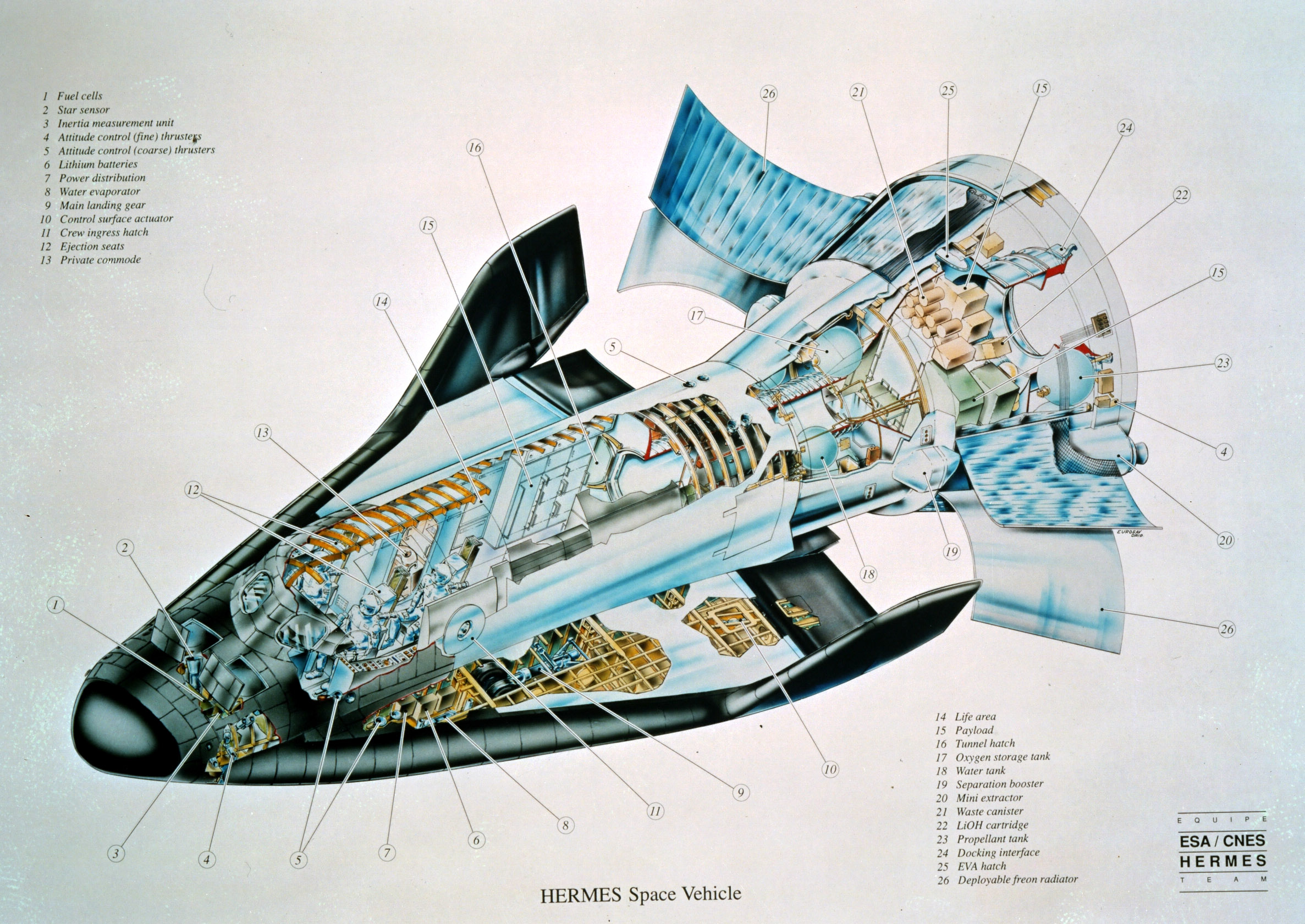
Above: A schematic of the defunct HERMES spaceplane. Courtesy of ESA.
ESA, the European Space Agency, has been looking to develop a re-useable spacecraft for a long time - when I was younger they talked about a miniature shuttle called Hermes, but that didn't work out, partly due to funding troubles. Since then they've mainly concentrated in their incredibly successful unmanned missions, although they've sent astronauts to the International Space Station on Russian spacecraft.
But last year ESA tested the 'Intermediate Experimental Vehicle' (IXV), a sort of prototype for a reusable space vehicle...
Above: A rundown on the IXV test craft, which flew into space for the first time last year. Courtesy of ESA
...and they've also invested 30 million dollars in the Dreamchaser mini-shuttle, expressing an interest in launching them on top of ESA.s Ariane 5 rocket. Sierra Nevada systems have even redesigned the Dreamchaser so it will work with the Ariane.
Above: A rundown on the unmanned, folding wing, version of the Dreamchaser spacecraft.
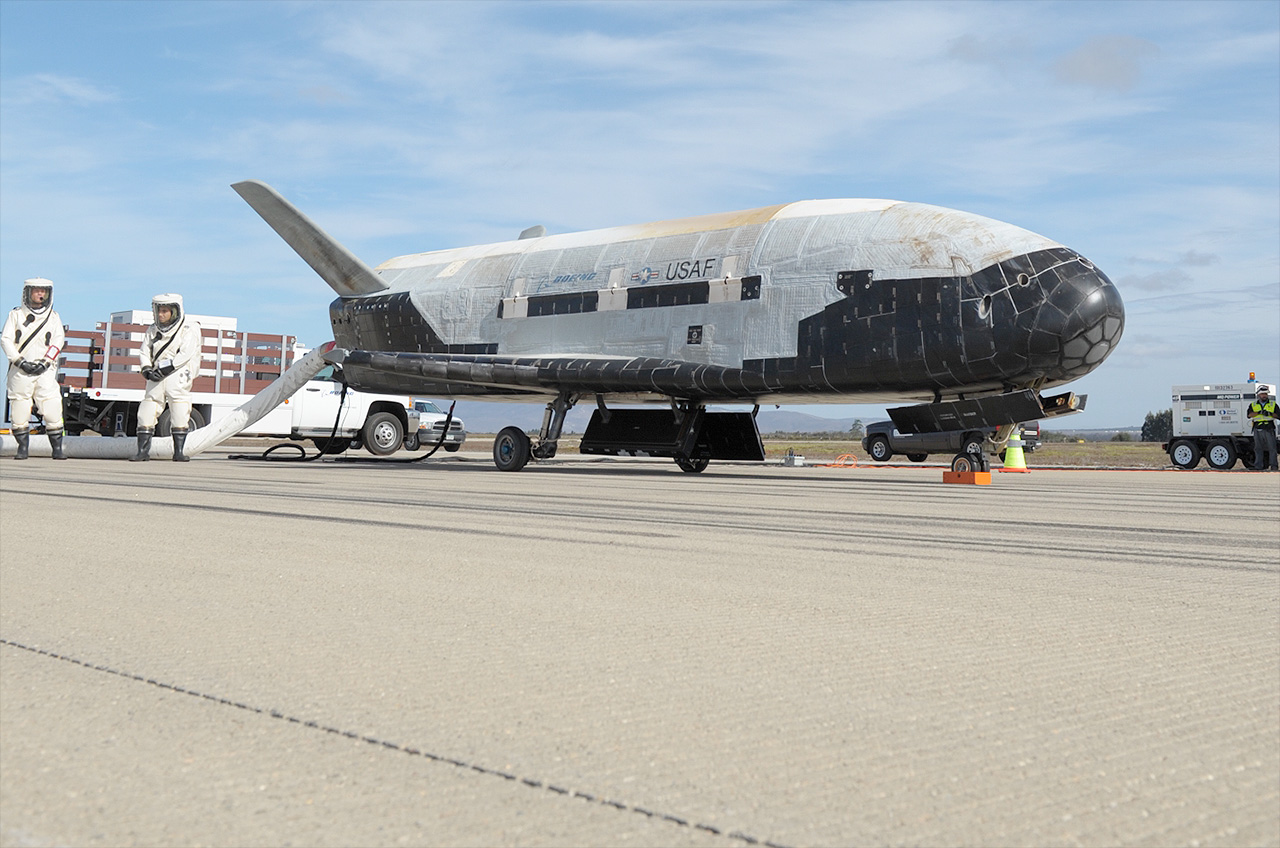
It seems that ESA dreams of their own re-useable spacecraft aren't as dead as some assumed, and who can blame them? The age of the mini-shuttle could truly be upon us: The U.S. airforce has even developed their own spaceplane - the X37-B - because they missed the Shuttle's capabilities. ESA is keeping it's plans close to its chest, however with them talking seriously about a manned lunar base it seems their ambitions for the coming decade have been awakened...
Right now the U.S.A is deep into deciding who'll run it for the next four years. Since there are only two parties with any kind of shot at winning (Republicans and Democrats), and they have very different outlooks, it's likely that the winner will have an impact on NASA's activities. Now, I'd love to say that NASA's just one space agency, let's not overreact, etc. And they are just one space agency. But they are by far the best funded and most active agency in the world, and in many respects a world leader in quality to. So, yes, who wins the U.S. power struggle is important to space exploration world wide.
Ben Carson doesn't seem overly fussed about space exploration, but does mention that he feels 'not being in the space race' is bad for America (The relevant bit is around 4 minutes 20 seconds):
Ted Cruz:
Ted Cruz is a known climate change denier, and would likely dismember NASA's Earth observation program. I don't understand how he has got to this position on the subject, but in other ways he seems quite pro NASA:
Donald Trump:
I feel I ought to say that Mr Trump seems a bit confused when it comes to space policy. Here he seems, well, indifferent (relevant bit about 38:40 in)...
.. and here he's passionately pledging to protect it...
However Mr Trump has often seemed to have only a vague idea of what his policies are in many areas - he often wins his debates on personality rather than anything substantial about running America (although he does win them, a lot, read into that what you will) - so perhaps hearing two different stories from him is not a surprise.
The Democrats:
It's only really Hilary Clinton and Bernie Sanders in the running still - and I'm afraid I haven't been able to find anything much on video.
Hillary Clinton:
However I did unearth this clip from Hilary explaining how she was once spoken to disrespectfully in a letter from NASA:
Even so, material from her 2008 presidential campaign suggests she has some policy ideas, including:
"...expanded robotic spaceflight probes of our solar system leading to
future human exploration, and enhanced space science activities." ....fully fund NASA's Earth Sciences program and initiate a Space- based
Climate Change Initiative to help us secure the scientific knowledge we
need to combat global warming and to prepare for extreme climate events."
However in 2016 it doesn't seem to be much of a talking point for her. What to read of her overall I'm not sure.... Vaguely friendly indifference?
Bernie Sanders:
Sanders is worrying because in 1996, 2000, and 2012 he helped to
decrease funding for NASA, and spending on space exploration. When asked about this at an during an Ask Me Anything (AMA) Reddit event in 2015 he said:
“Sometimes, and frankly I don’t remember all of those votes, one is
put in a position of having to make very, very difficult choices about
whether you vote to provide food for hungry kids or health care for
people who have none and other programs....But, in general, I do support increasing funding for NASA."
Again the overall impression is a sort of tolerant indifference, a 'space, yeah, sure, so long as it won't cost too much' sort of attitude. But that is the biggest worry of all - not one of them has any passion for the subject, or treats it as having much signifcance. It seems the best we can hope for from any of them is that NASA doesn't get it's budget cut for some PR friendly (but pointless - NASA's whole budget is less than 0.5% of the U.S. Governments discretionary budget*) 'cost cutting'.
Perhaps, I'm too pessimistic, and there is some hope ; Personally I am of the opinion, for each candidate, that actions speak louder than words...but we shall see...
*In simple terms the U.S government's budget comes in two parts: Mandatory spending (roughly 2.5 trillion dollars), on things like the social security and medicare, and discretionary spending (roughly 1.1 trillion dollars), which is what things like military spending, international affairs, and NASA comes under.
You probably know Tabby's star (licence plate: KIC 8462825), as the star that was reported as having 'alien megastructures' around it. The jury's still out on what the hell is gong on at this distant star, but Jose Solorzano, over at data science central, has been working to fit the shape of the mysterious objects obscuring the star to their observed light curves. His resultsare intriguing:"I do not believe it's possible to precisely match the day-792 light curve with a small number of entirely opaque objects," he writes. "What is likely required is a swarm or semi-transparent cloud". That also fits with the length of the observed transits, which take multiple days, rather than the hours more typical for a solid structure. The model he comes up with for one transit looks like this:
Actually quite hard to spot, isn't it? Scroll back and forth between 0:10 and 0:20. It is there, but it's a very diffuse cloud that dims the whole star, making it hard to spot - only the very densest central portion of the cloud shows up, as a weak silhouette. What does this rule out? Not much by itself - a swarm of dust or a swarm of small solar collectors would look about the same at this distance - but it adds to the growing pile of evidence that whatever's going on around Tabby's star is due to something diffuse but structured, rather than a few monolithic objects. So less this:
Above: The idea of a monolithic Dyson Sphere. Courtesy of popsci.com .
... and more this (perhaps):
Above: A swarm of solar powered nanosats. Image courtesy of Wired.com