Search This Blog

Thursday, 17 May 2012

Small steps to huge dreams


Hows my Blogging? Leave some feedback, I get better at this, you get a more interesting read!


The Arkyd series 101 minature space telescope, Space Resources Inc's first proposed step towards asteroid mining. Image courtesy of Space resources Inc.


Almost anyone with an interest in space exploration will have heard of Planetary Resources Inc [1] (formerly Arkyd Astronautix), the company that has announced plans to mine asteroids, and will have formed their own opinion on it.
Me? I'm over the moon that someone is trying this, but I don't quite see how the scheme is going to make money. True I have the same grasp of economics as a tazered chicken, and the founders of the company have admitted that this is more about developing their vision for humanities future than short term profit.
So I'm not going to talk much about the company directly. The Internet is abuzz about it, and you can learn far more from their website than you could from me.
What I will do is take a quick peek at some of the developing ideas for moving asteroids about, as pointers to how an asteroid resource extraction effort might eventually take shape:

Gravity power:

Image right: A gravity tractor hangs in space over an asteroid.Image courtesy of Dan Durda. 

Just to complicate things, many asteroids are piles of rubble, not solid rocks, and spin in all three axis at once. So firing bombs at them, or landing a big rocket on the surface, isn't as simple as it might appear.
But in the void of space there is no friction, and the few forces (such as the solar wind) acting on bodies are very slight. So diverting an asteroid doesn't need the colossal force you might imagine.

The gravity tractor [2] takes advantage of this fact: The space craft doing the towing hangs in space, not too far from the surface of the asteroid, and lets the small gravitational attraction between the asteroid and the craft move the asteroid towards it. The craft fires a low thrust engine to keep the distance between itself and the asteroid constant, and so the asteroid slowly follows it. It's a nice, elegant, idea but  it carries the drawback of taking quite a long time to take effect, as too much thrust would just send the towing ship off into space.

Solar power:


Video above: The Sun, the biggest power source in our solar system. Video courtesy of NASA/Solar Dynamics Observatory.

The Sun is the power house at the centre of our star system, and it'd be foolish to miss a trick that even plants manage: Take advantage of that energy. There are a variety of ways that the sun might be used to move an asteroid:

Image left: Solar panels, much like those you might install on your own roof, could power an engine to move an asteroid. Image courtesy of solarenergy.com.

Solar powered thrusters on the surface could move a solid object quite quickly, but encounter problems when moving loosely bound rubble piles, the same as regular thrusters. However the problem of carrying your fuel out there with you is at least avoided. The problems with rubble piles can be mitigated by applying a gentle thrust for a much longer time, such as from an ion engine, and by doing your homework on the asteroids spin and internal mass distribution, so this idea still holds some water. However with current ion engines we'd need a looong time to significantly change the path of a big asteroid.


Image right: A solar reflector kilometres across focuses the Suns energy onto the surface of an asteroid. Image courtesy of sciencephotolibray/Chris Butler.

Another solar powered approach could be to station a huge parabolic reflector near the asteroid. This would focus sunlight onto the surface, vapourising part of it to produce a plume that could push the rock onto a new course. The biggest problem with this idea is getting a large reflector out to the rock, although technologies like those behind the Ikaros solar sail could be useful there.

A solar sail [3] combined with the gravity tractor idea is yet another possible approach. We're still some way off being able to deploy solar sails of the size needed, although, as I blogged about earlier this week, there are people working on innovative sail designs.

Image above: The spaceship Ikaros, the first successful solar sail. Image courtesy of JAXA

Coating the rock in a reflective layer would let it gathered momentum from the pressure of sunlight, but without the high ratio of surface area to mass that an ordinary solar sail would have it needs a good long while to work, and steering with a 'dumb' reflective coating would be hard. Similarly, painting the asteroid white to change the way the YORP effect [4] pushes on it  would require a gigantic bucket of paint, and a long lead time as well.

Nuke it:


Video above: Los Alamos scientist Bob Weaver explains that YES, you could stop an asteroid with a well placed nuke. Courtesy of Los Alamos National laboratory.

Well, as Bob explains above, you could save the world by nuking an asteroid, but moving one for mining might be harder. Nuclear weapons could move an asteroid, although the effects of a nuke in space [5] are quite different than those of one on the ground, in a similar fashion to the Project Orion spacecraft [6]. But once again we run into the problems of the asteroid  breaking apart, and remember we're thinking of mining this thing, so making it radioactive probably isn't a good idea.

Kinetic Impactor:


Image above: Deep Impacts copper 'bullet' puts a big hole in comet Tempel 1. Image courtesy of JPL/NASA.

As NASA's Deep Impact mission [7] showed by blowing a hole in comet Tempel 1, we can crash a big lump of metal into an asteroid, perhaps changing its course. But, well, look at that picture: If you did that to a small or weakly built asteroid you'd just have lot of floating bits. That said, a Deep Impact style mission might be a very useful quick 'n dirty way of finding an asteroids composition.

Cloud power:

This is a relatively recent suggestion by researchers at the University of Strathclyde. Again it's a simple idea in principle: Launch a swarm of tiny space craft that will crash into the asteroid, each one imparting a small change in momentum. It has advantages over sending one big impactor or bomb: The smaller knocks would be unlikely to disrupt even a loose rubble pile, the swarm could still impart a good amount of energy fairly quickly, and such a swarm would be fairly simple to build and  launch. However we are still a way off having the satellite-on-a-chip style space craft needed, although prototypes are being tested on the ISS [8].

Lasers!

Bang! Mwahahahahaha!. Image courtesy of Lucasarts.

OK, we're not talking fielding a huge Death Star type laser. Such things are expensive, and look gaudy in the night sky.
Lasering an asteroid would move it by vapourising material off the surface to produce thrust [9]. The neat thing about using laser light is that you can spread the beam across the entire surface, allowing you to give the asteroid a meaningful nudge without risking it breaking up or absorbing our push by deforming.
Lasers fired from Earth would need to go through our atmosphere, which would absorb part of the power, and Earths rotation would limit the chances to hit the target. A large solar powered laser in orbit has been proposed, but the falling down point is that it would be hard to  build, need a lot of power, and probably maintenance. The University of Strathclyde, who have a bit of a thing for shoving asteroids about, have a new take on the laser power idea: Send up a swarm of smaller lasers, and have them bombard the rock in concert. The difficulty in building and launching such swarm is much lower, and the overall effort can survive a few units going down through extended use.

To view the abstracts for both the Univeristy of Strathclydes asteroid moving proposals, presented at the Astrobiology Science Conference. Pay the ASC website a visit, go to 'scientific program', and put 'Gibbings' into the search engine. No, I'm not him, I just like both the ideas he presented there. I'm John Freeman, and BTW, I just passed my PhD, so I'm going to go and get drunk. Stay tuned for physicist with five alarm bell hangover!
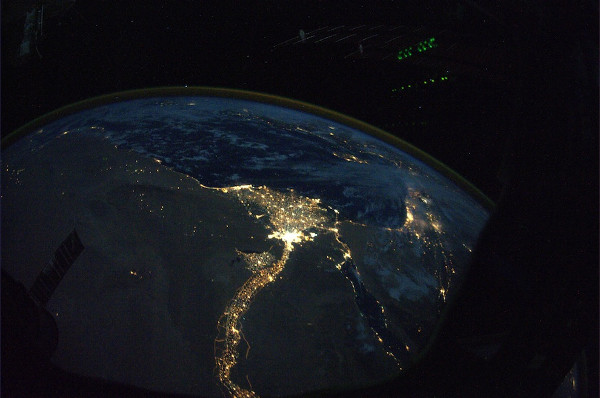
Earth from the International Space station. Will a worker or robot on an asteroid mine one day have a similar view? I hope not; ISS is only four hundred km up, thats too close for a big rock and my comfort. Still, it's pretty, which is why I put it there. Image courtesy of NASA

List of Links:
[1]http://www.planetaryresources.com/
[2]http://news.nationalgeographic.com/news/2005/11/1109_051109_asteroid_tug.html
[3]http://www.planetary.org/explore/projects/lightsail-solar-sailing/
[4]http://www.news.cornell.edu/stories/March07/margot.yorp.html
[5]http://history.nasa.gov/conghand/nuclear.htm
[6]http://www.islandone.org/Propulsion/ProjectOrion.html
[7]http://www.nasa.gov/mission_pages/deepimpact/main/
[8]http://news.discovery.com/space/satellite-on-a-chip-to-launch-with-space-shuttle-110516.html
[9}http://www.strath.ac.uk/space/research/missionsystems/asteroiddeflectiontechnologies/laserablationexperiments/ [10]http://abscicon2012.abstractcentral.com/s1aplanner/com.scholarone.s1aplanner.s1aplanner/S1APlanner.html?&CONFIG_ID=2390&USER_ID=1593989&ROLE_ID=14918&ROLE_TYPE_ID=17&PERSON2ROLE_ID=17696201&WORKFLOW_ID=17&CURRENT_PAGE=BROWSE_THE_PROGRAM&ALLOW_EDIT_INSTRUCTIONS_FL=N&SESSION_ADMIN_PERMISSION_FL=N&DIRECT_LOGIN_FL=Y&HASH_KEY=U3EUGrcX1xIcZLBnWyEoaTkPtRo&STUB_ROLE_ID=0&TIME=1337288817285&SOURCE_URL=http://abscicon2012.abstractcentral.com

Tuesday, 15 May 2012

Space is beautiful

Image above: The Cygnus X star forming region, where stars, planets comets, asteroids, whole solar systems are growing as we watch. On the right the filament structure of the cloud is particularly complex, dust and gas shepherded by stellar winds and light. The knots where the filaments meet are regions where the glowing gas and dust are collapsing, forming protostars and protoplanetary disks.
The white areas are where hot young stars are heating the gas and dust, and the central void is where cloud material  has been cleared by the fierce pressure of stellar winds and light from better established stars, less visible in this infra-red image. It's just...beautiful.

I've made it as big as I can, but I can't do it justice. Please follow the link to the original at ESA. Image courtesy of ESA/.

List of link:
http://www.esa.int/esaSC/SEMXKITWT1H_index_0.html

Sunday, 13 May 2012

Big things can have small beginnings

Firstly, if you're a Dr Who fan and haven't already seen this, I highly recommend it:


Video above: Eric Calderone. Metal time lorrrd man! No I'm not smoking anything illegal. Seriously.

Anything that opens space exploration to a greater section of the world is, frankly, brilliant. Hence I am a big fan of ideas like the cubesat [1], which has bought the cost of putting an experiment into orbit down to the level that a major university- not just a major government or corporation- can afford.

It has done this, at least in part, by providing a standardised, reliable, nano-sat kit in which experiments can be housed, and by piggybacking on larger launches. However there are limits on what such a small vehicle can do, and one of them is propel itself effectively.

Image left: A visualisation of the prototype for the cubesail idea, being deployed. Image courtesy of the University of Illinois and CU Aerospace. They look a bit like the fuzzy dice over your cars rear view mirror don't they? Except in space, doing orbital velocity not 70mph.

So I am over the moon to talk about the work being done by the University of Illinois Aerospace lab, on the cubesail [2]. Click that link people, it's an entire PhD thesis on the subject.
Inheriting ideas from a proposed sail design called Ultrasail, the cube sail is a development of the cubesat,  incorporating solar sailing technology as a 250 m long unrollable sail, as opposed to a folded square sail with its obvious problems of folding ultra thin delicate material. A company called CU Aerospace [3] is working in collaboration with the lab to develop the concept, and the work so far has been funded by a NASA grant. If funding could be found for a demonstration flight then the next step would be a series of cubesats unrolling solar sail 'vanes' from a central core.

OK, there is still a long way to go between here and deep space missions cheap enough for any major university to afford, but this is a great, innovative idea. I'm keeping everything crossed that this flight will become a reality.

Perhaps this is a small beginning.

List of links:
[1] http://www.cubesat.org/index.php
[2] http://www.ideals.illinois.edu/bitstream/handle/2142/18320/Pukniel_Andrzej.pdf
[3] http://cuaerospace.com/

Thursday, 10 May 2012

Vesta - last of its kind

How's my blogging? Leave some feedback, I get better at this, you get a better read!

I couldn't go to bed without including this:


Video above: Simulated flybys of Vesta 'tourist spots'. Courtesy of JPL/NASA

OK, my guess earlier today was well wide of the mark.
However the conference was fascinating all the same, and underscores just what a remarkable protoplanet Dawn [1] is exploring.
In particular I was pleased to see three things highlighted by the conference: That Vesta is indeed a protoplanet [2], just how much the HED meteorites [3]- now all but certain to have come from Vesta- have contributed to our exploration, and how much telescopic observations have contributed.

Sample return missions to an alien world that were no more expensive than bending to pick up a fallen space rock: Sometimes the universe does come to us. But first, some music for the occasion:


Video above: The music is Ironheart, by Two Steps From Hell. Image from the movie 'Your Highness' I think. It's Natalie Portman, which wasn't picked by me, but I do approve. I like Natalie Portman. I'm only human dammit.

So, what has Dawn found?
Firstly, the evidence strongly suggests that Vesta is indeed differentiated like a full grown planet, with a iron rich heart, a mantle, and an outer crust. Estimates for the size of the core put it at about 70 miles across. By comparison, Earths core is 2000 miles across and Mars core is thought to be about 1000 miles across.


Image left: A slice through one of the HED meteorites. Iage courtesy of saharamet.com.

The HED meteorites now look almost certain to have come from Vesta, from different depths in its crust and mantle, and allow the team to draw conclusions about Vesta they otherwise would not have been able to. They are probably the  result of the two massive impacts that have obliterated the Vestan South pole, excavating 250,000 cubic miles of rock. The HED's tell us things that Dawn couldn't easily see: There are small amounts of olivine present in the HEDs, which tells us that the blast punched right through the Vestan crust and into its mantle.

However it is hard for Dawn to spot olivine from orbit for two reasons; the amounts of olivine are fairly small, and, since the giant impacts, smaller blasts have mixed up the surface, grinding everything into smaller pieces.


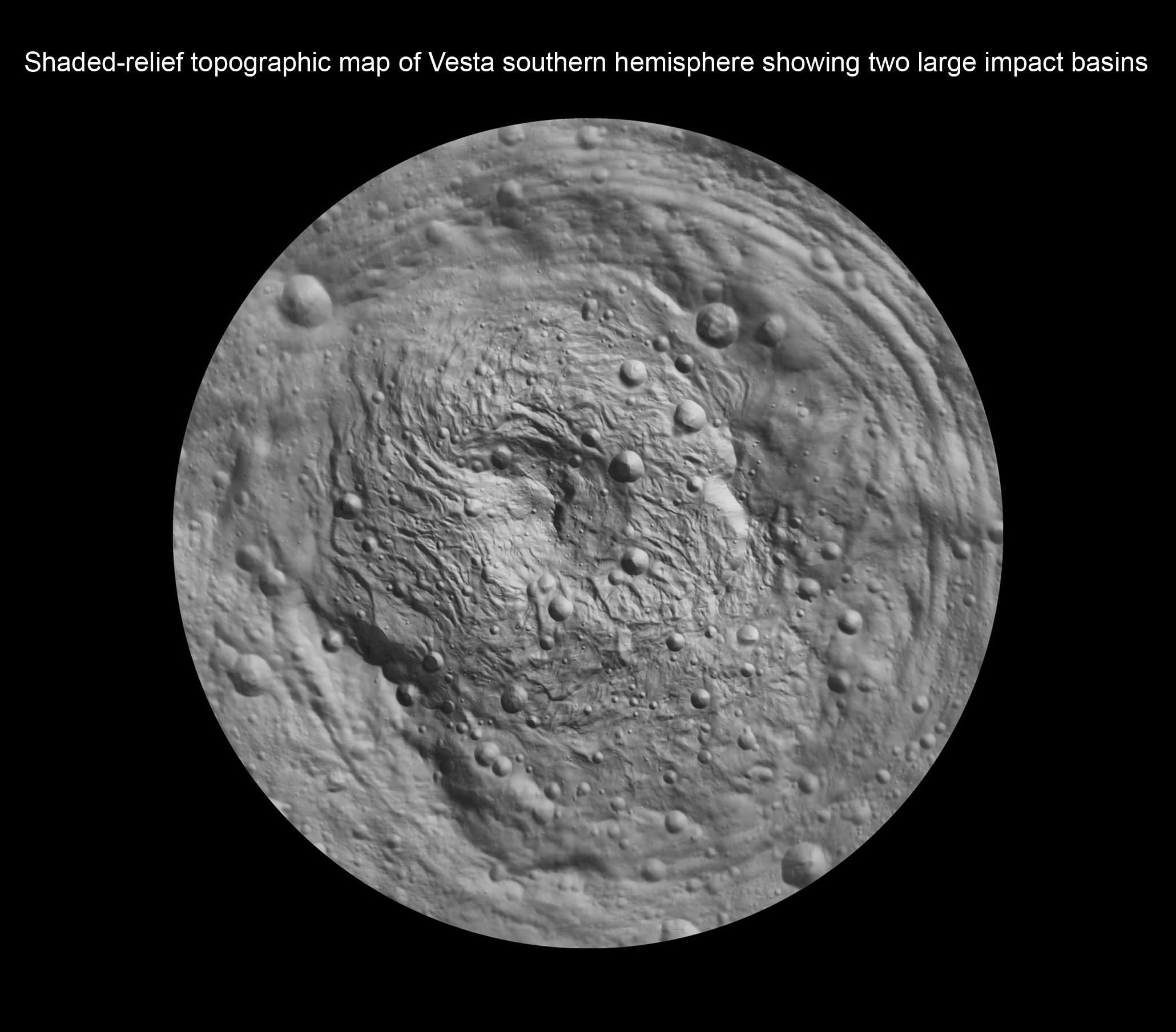
Image above: the Rheasilvia basin, and its predecessor Vanenia, have completely re-shaped the vestan surface. Image courtesy of JPL/NASA.
The two giant impacts, one on top of the other, have been dated by crater counting of the basins formed (on average impacts happen at a constant rate). The younger, Rheasilvia, is about a billion years old, which is a surprise as massive impacts are thought to have all but stopped around 3 billion years ago. The older crater, Veneneia, is harder to date because Rheasilvia is almost on top of it, but is at least 2 billion years old. The material thrown out by the last big impact sits as a layer of pulverised rock, 5km deep, around the basin.

Image right: This grey scale image of Rheasilvia shows the spiral pattern on its floor slightly better. Image courtesy of JPL/NASA.

The structure of Rheasilvia is unusual, the central peak is almost a third as big as the crater itself. This is because the crater is getting on for as big as Vesta itself, which changes the way the crater forms. And the impact has had another effect: It essentially rejuvenated the southern hemispheres geology, leaving Vesta ancient in the north, and younger in the south. There are massive spiral patterns on the craters floor, and grooves running around the protoplanet that seem to be centred on the impact - the blast literally re-arranged the whole world.

Image left: Massive grooves gives mute testimony to the violence done to Vesta by nature. Image courtesy of JPL/NASA.

Vesta has also surprised the science team with how varied the subtle colours of its surface are, again separating it from smaller asteroids that are relatively monotonous, and pointing to a complex surface. The crust seems to be a complex mix of diogenite [4]and eucrite [5] rocks, but the general dominance of diogenites supports the idea that most Vesta melted early in its history.
The surface is clear of any obvious lava flows or volcanoes, which is likely of a consequence of all the activity being shutdown a long time ago, and Vesta getting one hell of a pounding since then.

The data Dawn has collected, in conjunction with the HED meteorites, paints picture of Vesta as the last survivor of a type of rocky protoplanet. It's brothers and sisters were likely either pulverised by impacts with objects like the one that excavated Rheasilvia, or absorbed into the growing main planets.

So we now know that Vest is a baby planet, it  had geologic activity and a planet like structure, and has stood up to a spectacular beating from the debris in the asteroid belt. And, we have pieces of it here on Earth!

All this coincides with the latest batch of scientific papers released from the Dawn team, over at Science [6]. Be warned, it's a pay to view the whole paper deal.

The data Dawn has collected also contributes, along with data from infrared and optical telescopes, to helping planetary scientists decide where to send future mission to further unravel the history of the solar system.

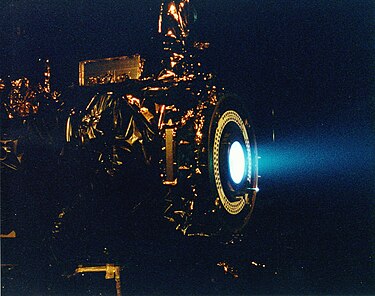
Image left: An ion engine being test-fired. Image courtesy of NASA/JPL.

A worthy legacy, but the show's not over at Vesta yet: The Vesta phase of the mission has been extended by 80 days, first when the team didn't need the forty days built into the plan to deal with anomalies (the spacecraft going wrong in non space speak), and secondly when they found Dawns ion engines [7] were performing above expectations. So the trip to Ceres [8] (the next target) will need less time. Because of the extensions Dawn will get a chance to image the ancient north polar region, which is currently in winter darkness.

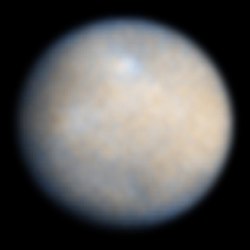
Image right: Ceres, to be visited in 2015 by DAWN, as imaged by the Hubble space telescope [9]. Image courtesy of NASA/JPL.

After that, it's on the Ceres, an even bigger protoplanet than Vesta, with a surface that suggests much less heating and volcanic activity, and possibly large reservoir of ice beneath the surface.

And no, that's not my WAG again, that's the official facts... at least until Dawn gets there and begins to surprise us all over again!

One last thing: The relevance of missions like Dawn to plans, now plans with a lot of cash and determination behind them [11], to extract resources from asteroids was raised, and I really ought to mention those:

It's just too big. I can't decide if its madness or genius, but I am sure it'll be interesting to watch how it all unfolds. More on that when I've got my head around it!

List of links:
[1] http://dawn.jpl.nasa.gov/
[2] http://www.universetoday.com/37053/protoplanets/
[3] http://planetary.brown.edu/pdfs/3446.pdf
[4] http://www.daviddarling.info/encyclopedia/D/diogenite.html
[5] http://www4.nau.edu/meteorite/Meteorite/Eucrite.html
[6] http://www.sciencemag.org/content/336/6082/684
[7] http://dawn.jpl.nasa.gov/mission/ion_engine_interactive/index.html
[8] http://en.wikipedia.org/wiki/Ceres_(dwarf_planet)
[9] http://hubblesite.org/
[10] http://www.planetaryresources.com/

What has Dawn found at Vesta? Could it be ice? (Update: No it's not)

Update: No, it's not ice, but it is an amazing glimpse into a world that records the earliest history of our solarsystem. More to come!

How's my blogging? Leave some feedback, I get better at this, you get a better read!
Video above: DAWNs Low Altitude Mapping Orbit of Vesta. Courtesy of NASA/JPL-Caltech

NASA has announced a press conference to talk about the Dawn [1] spacecrafts latest findings at the humongous, 400km, asteroid-slash-protoplanet Vesta [2].

Kick off is 2pm EDT, 7pm UK time.
So, guesses as to what it's about?
The list of panellists is:

• Carol Raymond, Dawn deputy principal investigator, NASA’s Jet Propulsion Laboratory, Pasadena, Calif.

• Harry McSween, chair, Dawn surface composition working group, University of Tennessee, Knoxville

• Vishnu Reddy, Dawn framing camera team member, Max Planck Institute for Solar System Research, Katlenburg-Lindau, Germany, and the University of North Dakota, Grand Forks

• David O’Brien, Dawn participating scientist, Planetary Science Institute, Tucson, Ariz.

• Maria Cristina De Sanctis, Dawn co-investigator and visible and infrared mapping spectrometer team lead, Italian National Institute for Astrophysics, Rome

The current phase of DAWNs mission, LAMO (Low Altitude Mapping Orbit), is all about mapping Vestan composition. We have mainly people involved in compositional mapping instruments on the panel, and David O'Brien.
Dr O'Brien lists his research interests as :

Planet formation and the dynamical and collisional evolution of the early Solar System

Collisional and dynamical evolution of asteroids and trans-Neptunian objects

Thermal modelling of geophysical phenomena

Icy satellite geophysics

I think 1 and 2 are the most relevant here. So we have a compositional finding probably relating to either thermal modelling of the Vestan surface, or its collision history. Or both. Hmmm. I recall a recent article on the possibility of water ice at high lattitudes on Vesta [3], I wonder if there’s a link (Composition, temperature, cratering, impact history -important factors in the formation of ice deposits). Ice at Vesta would be big news, as Vesta has been thought to be bone dry after massive basaltic lava eruptions covered its surface early in its history.

Let's see at 7pm! (go to the NASA website for the latest news)


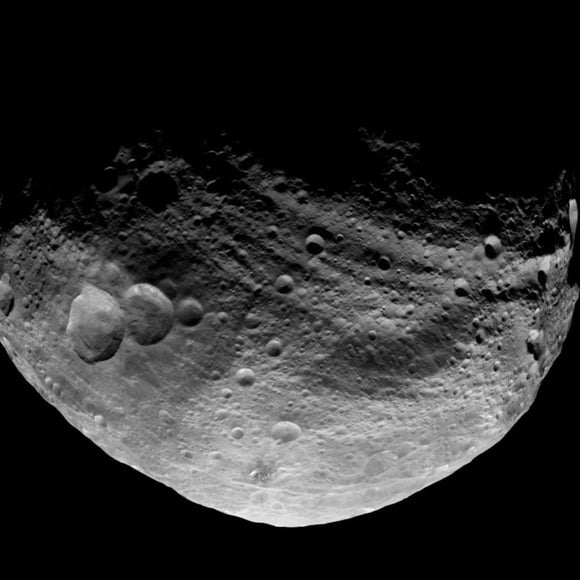
Image above: Vesta. Like a potato, but 400km across, 4.5 billion years old and covered in frozen lava. So not much like. Disagree? What kind of potatoes are you growing?
List of links:
[1] http://dawn.jpl.nasa.gov/
[2] http://www-ssc.igpp.ucla.edu/personnel/russell/papers/CeresVesta.pdf
[3] http://www.space.com/14361-hold-thu-1-26-huge-asteroid-vesta-packed-water-ice.html

Tuesday, 8 May 2012

How often does Earth get visitors?

Hows my Blogging? Feel free to leave a comment! I get constructive critisicm, I get better at this, you get a more interesting read!


Video above: A van sized chunk of primordial space rock rips into our atmosphere on April the 22nd. Courtesy of Júlio Cézar Soares.

A couple of weeks ago a 70 ton meteoroid - about the size of a minivan - blew up spectacularly in Earths atmosphere. Packed quite a punch in fact, around 5 kilotons. Meteorite tracking networks [1] (More on them soon!) used infrasonic sensors to pin point the rough location of the blast at 37.6N, 120.5W.

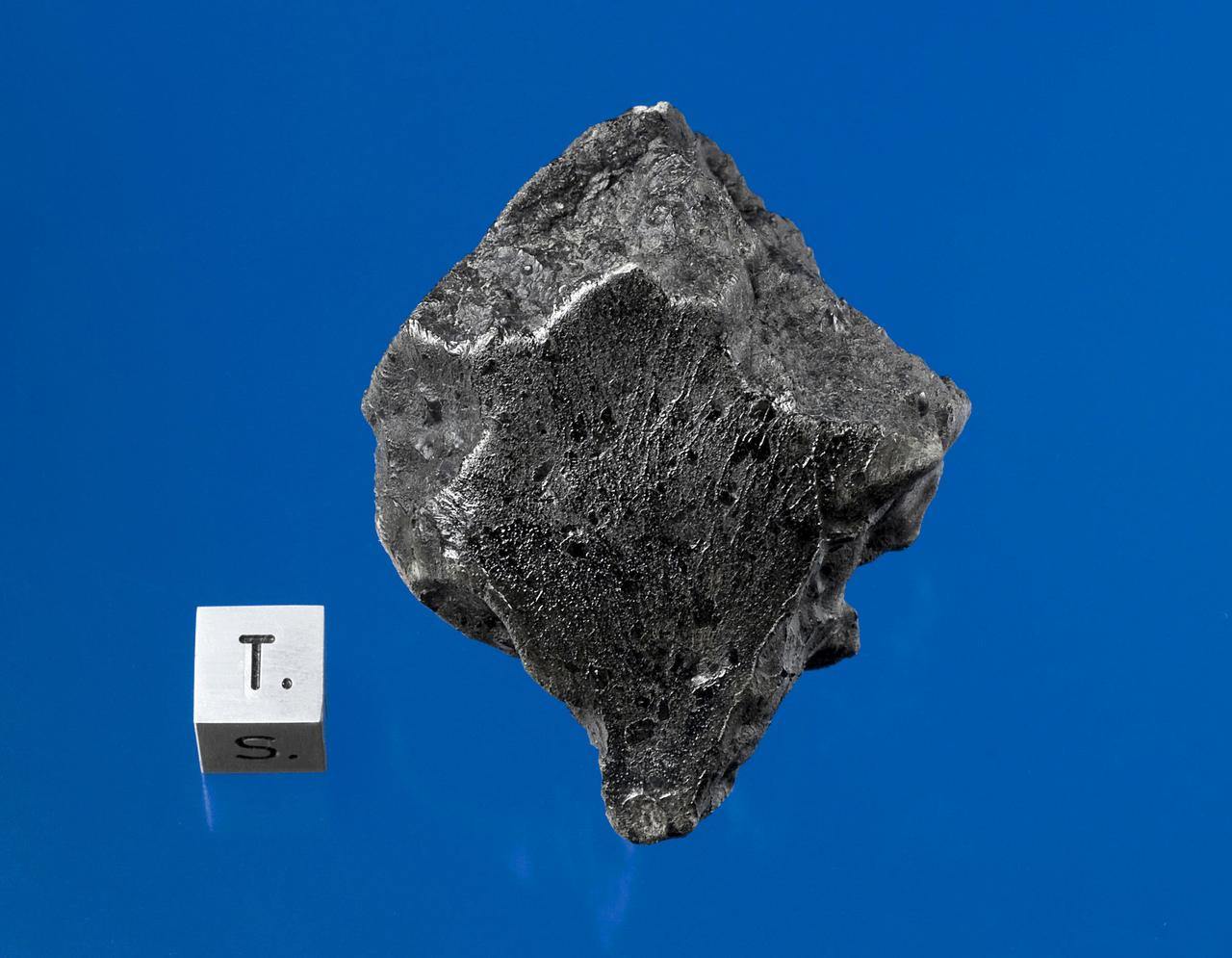
Image right: Fragments of the Sutters Mill Meteorite. Image courtesy of Greg Hupe.

It's being called the Sutter’s Mill Meteorite. Meteorite hunters have been able to recover fragments of it, and we now know that it was a CM class carbonaceous chondrite [2]. That's one of the really rare and groovy types that contain ancient material, show signs of having been altered by liquid water on their worlds of origin, and contain bio-molecules like amino acids.
NASA and SETI are looking for bits of it using a zeppelin! Follow this link [3] for news report.
The really strange thing is that things this size hit Earth on a regular basis, but often come in over unpopulated areas and don't get seen.  Earlier this year 2012 BX34 [4], a lorry sized asteroid, 'near missed' Earth - it was too small to have done any world ending if it hit, and in any case 'near miss' in this case means about ten times the distance from the Earth to the moon.
These events highlight a very interesting point: Fragments of lost worlds buzz by Earth all the time!

Image left: 2012 BX34 seen in January. Image courtesy of Alex Gibbs, Catalina Sky Survey/University of Arizona

The chart below, courtesy of the brilliant space weather.com [5], has bought home to me just how freaking often some piece of space debris passes by Earth. This  is just the encounters for the last half of January! Only one was big enough to be scary, and it passed us by a loooong way off. But it just goes to show that there are a lot of objects out there. Bear in mind I'm convinced we can find clues to the big questions of the universe in even the tiniest bit of space debris.....


Recent Earth-asteroid encounters:

Asteroid  'name' 
      Date(UT)
    Miss Distance
    Size


2012 BZ13
              Jan 18
          9.1 LD
             29 m


2012 BL14
              Jan 20
         1.2 LD
             10 m


2012 BV1
               Jan 20
           0.8 LD
             3 m


2012 BS1
               Jan 23
           3.1 LD
            10 m


2012 BY1
               Jan 24
           2 LD
                31 m


  1991 VK
                Jan 25
           25.3 LD
           1.9 km


2012 BW13 
         Jan 26
           1.7 LD
           16 m


2012 BD14
           Jan 30
           5.8 LD
           19 m


Notes: LD means "Lunar Distance." 1 LD = 384,401 km, the distance between Earth and the Moon. 1 LD also equals 0.00256 AU.


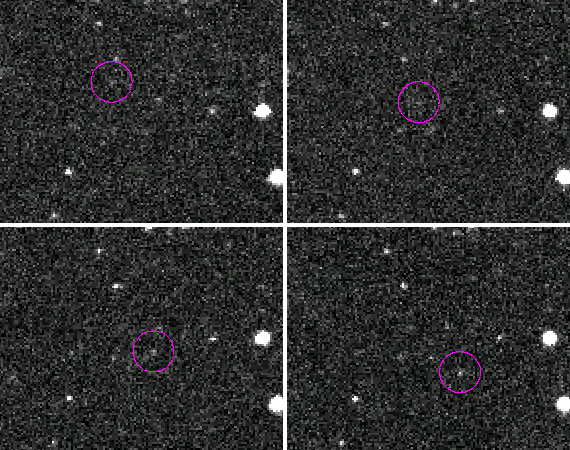
Image above: The simulated path of a mini-moon, following a temporary, chaotic orbit about Earth. Inset: A larger asteroid, showcasing the rough surface of small objects. The simulations suggest mini-moons could be a common occurrence, and these little critters could orbit Earth for a year or more. Image courtesy of K.Teramura.

In fact, things have recently been suggested to get even closer to home than that. We've known for some time that asteroids like 3751 Cruithne [6] can become co-orbital with Earth, making them 'quasi moons'. Now a joint study from the University of Helsinki [7], the University of Hawaii [8], and the Paris Observatory [9], suggests that small space rocks, meters to tens of meters across, frequently become mini-moons of Earth.
They are only weakly bound, and follow chaotic, temporary, orbits, but the simulations the teams have run show that there will be at least one object a meter across or bigger orbiting Earth at any one time.

Now for an asteroid hugger like me that is absolutely amazing: A sample return mission to such an asteroid could be done for next to nothing in space exploration terms.

OK, house sized bits of rock whizzing over our heads on an almost daily basis isn't any thing to get excited about......
......um actually, at the very least, I'd rate it a 6.5 on my list of things that make go 'huh?'. Seriously - house sized rocks are flying over my head right now, and this happens every day?

List of links:

[1]http://www.wired.co.uk/news/archive/2011-03/16/nasa-fireball-network
[2]http://www.meteoris.de/class/CM-Group.html
[3]http://youtu.be/NlcGLWtjdeo
[4]http://digitaljournal.com/article/318574
[5]http://www.spaceweather.com/
[6]http://en.wikipedia.org/wiki/3753_Cruithne
[7]http://www.helsinki.fi/university/
[8]http://www.uhm.hawaii.edu
[9]http://www.obspm.fr/presentation.en.shtml

Sunday, 22 January 2012

The Universe comes to us....

A lot of the time when space science gets into the mainstream media it is due to a mission to somewhere in space. But a big chunk of our knowledge, much bigger than many people imagine, is down to the universe coming to us. So here's my ode to the universe coming to us (certainly no offence meant to the 'boldly going' approach), and a few bits and pieces of news on the end:

Oh, but first: Some suitably epic music for this subject:


Composers: Two Steps From Hell Studios,
-Thomas J. Bergensen & Nick Pheonix


Fusing Boldness and Cunning: Going and getting the Universe, and getting the Universe to come to us.
There are two ways of exploring the cosmos: 1: Go out to it (or: ‘To Boldly Go’), and 2: Have it come to you (or: ‘To Cunningly Wait’).
It is little realised that 2 is in many ways easier than 1, though with its own weaknesses as well, because it happens naturally all the time.


Image above: The view from Earth: Image courtesy of Marylandweather.com

Look up at that huge, black and twinkle studded, expanse over your head on a clear night - the light reaching your eyes is a wealth of information about the universe, falling onto us for free. Over time we've learned to make the most of that light: At first by careful observation with our own eyes, then using telescopes, and eventually across the whole of the electromagnetic spectrum [1]. We have learned to use the information carried by particles, and fields as well: Projects like Ice Cube (studying neutrinos)[2], Compton (gamma rays)[3], and Cluster (magnetic fields)[4] have allowed us to sense realms of information from space that our unaided bodies cannot.


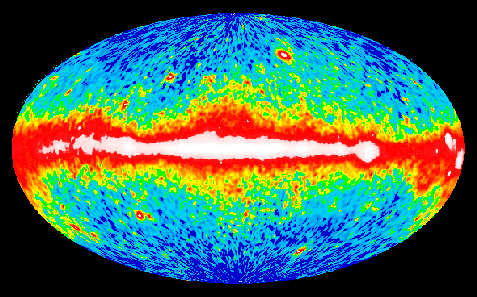
Image above: Sky seen in Gamma rays by the Compton Gamma Ray observatory. The bright bar across the middle is our Milky Way Galaxy. Image courtesy of APOD NASA.

The cool thing is this shows that science, and the universe it studies, are all one piece: the existence of neutrinos [5] was first inferred [6] from theories that plumbed into the subatomic realm. How ironic then that those theories about the smallest scales opened a new view onto cosmology, the largest.
Many of the instruments we use to sense the torrent of information streaming down on us are undersold by the word telescope : Just take the European Southern Observatory [7], a battery of scientific instruments, some bigger than a small house, high atop various mountaintops, to give us a window into a universe we could scarcely imagine. And we have many observatories like this - the hull of spaceship Earth is studded with sensors [8], and surrounded by a swarm of high tech eyes and ears piecing the deeps of space.


Image above: The European Southern Observatories Atacama Facility of frankly gigantic telescopes. Image Courtesy of ESO.

Other things than radiation carry their knowledge to Earth; pieces of matter, more familiar to us than hyper exotic neutrinos, come here every second of every day: Meteorites and space dust carry geologic information to us from all across the solar system, on worlds often long dead or totally destroyed. Some pieces of material we have recovered may even be from the black gaps between the stars, or remnants of the pre-solar nebula [9]that birthed our star system.
This to we have got better at exploiting; Meteor tracking networks [10] have been set up, and we know the best hunting grounds for well preserved space rocks – places like the Atacama desert, or the ice fields of Antarctica. And NASA has for a long time run high altitude flights to collect in falling space [11] dust.
Once these pieces of matter are here their advantages quickly come to light: We can do things with them that we can't do to a sample being examined by a small space craft millions of miles away:
  • We can subject them to the best possible tests using the most advanced and powerful equipment on the planet.
  • We can use multiple approaches and methods to get the most possible information from each micro gram.
  • Technologies like Secondary Ion Mass Spectrometry (SIMS [12]), Transmission Electron Microscopy (TEM [13]), and Gas Chromatography – Mass Spectrometry (GC-MS [14]), Atomic Force Microscopy (AFM [15]) can be bought into play with far greater ease than we could send these things into space (although we can, and do [16] if the pay-off in knowledge gained looks to be big enough).
Image above: Mars, showing off its biggest mountains and swirls of water ice clouds. Courtesy of NASA.

A staggering example of this is Mars exploration: Some of our best geological evidence for conditions on ancient Mars comes from actual samples of its crust – yet a sample return mission [17] is at best decades away still. These samples were shot into deep space by the shock waves from asteroids striking Mars. They wandered – preserved by the cold and vacuum of interplanetary space – until the landed here on Earth. As well as giving us evidence of warm and wet conditions on ancient Mars [18] these samples provide possible (highly controversial)  indicators of microbial life [19] there – some of which have been largely debunked, and some of which still have a question mark over them. The scientific process occasionally takes a detour down a blind alley but without these naturally travelling samples of the red planet we would not have even reached that junction yet! And, just to add to the mysteries, there have recently been more meteorites shown to have come from Mars [20].

Image left: The new visitor from Mars, which landed here on Earth in July 2011.

Another example is the giant asteroid Vesta [21]. Although the first space craft to visit it – the gob-smacking Dawn mission [22] – only arrived in 2010 we have had samples of it [23] to ponder for many years, courtesy of the giant impact that, thanks to Dawn we now know, tore apart the entire Vestan south pole. A great example of how approach 1 and approach 2 can compliment each other!
There are other scientifically profitable meetings between approach 1 and approach 2. One such approach is sending observatories a short way into space, where see more clearly above our atmospheres distortions, or in wavelengths that our atmosphere attenuates. These are instruments like the Compton observatory (mentioned above), the Planck observatory [24], or the venerable Hubble.


Image left: The Pillars Of Creation, one of the most famous images from the Hubble. To get anything like this view with the naked eye we would have to travel around a thousand light years.

By travelling only a few hundred miles into space we can explore for countless thousands of light-years. Even more, we can look back into the younger ages of our cosmos, even back to the first galaxies, and (completing the circle begun with the discovery of neutrinos) we can use what we see to learn about the most fundamental properties of matter. Black holes and neutron stars are great examples of this [25]: by studying these examples of matter under such improbably extreme conditions [26] we can infer things about its fundamental, sub atomic, make up.


Video above: The Crab nebula, seen an multiple wavelengths. Courtesy of NASA.

A new fusion of approach 1 and approach 2 may be in the offing: A team led by Mikael Granvik has shown [27] via computer simulation that many small asteroids – ranging from 10 cm to 1 meter across – may become temporary satellites of Earth [28]. These are too small and dim to be easily spotted, although a few suspicious examples may have been caught [29]. These objects, if we can pin down their paths and identify one that will wait a few years, could be a great resource: A space mission to study, and perhaps even retrieve, one of these visitors would be far easier and cheaper than travelling clear across the solar system to reach similar objects. Such a mission would need to travel less far, less fast and could carry more weight. It could bring back a significant portion of one of these objects (or just bring it intact back to home, period, and) combine the perfect preservation of deep space with the facilities available on Earth.
None of this is to say that we could do away with the ‘boldly going to look at things first hand’ approach: Without Viking we would not know our Mars samples we actually from Mars, without Dawn the geologic context of the rocks from Vesta would still be obscure, not to mention all the wonders that these missions have shown us that could not even be guessed from samples of rock, however well preserved (Vestas gigantic landslides and grooves, Mars buried glaciers and dust devils). But the best results come from finding ways to have ‘Boldly going’ and ‘Patiently waiting’ compliment each other, and the more we learn from both methods, the better at combining them we will undoubtedly become............

In other news:
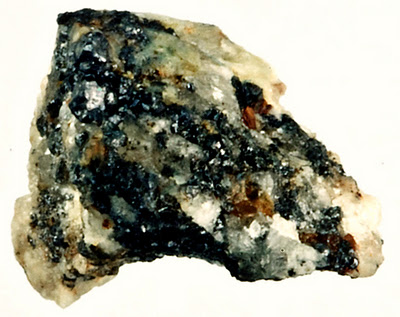
Quasi crystals: I will try to post a more detailed report on this soon, but a bizarre from of matter known as ‘quasicrystal’ has been found in rock believed to have come from space [30]. Quasi crystal crystal has regular but non-repeating molecular structure, and to date this is the only natural example of it.


Image right: A piece of rock, believed to be extraterrestrial, containing quasi crystal. Courtesy of Princeton University.

There are three lines of thought supporting its origin: Oxygen isotope ratios found in the rock show it to be from the early solar system, the composition of the rock is similar to carbonaceous chondrite meteorites, and the conditions for quasi crystal formation are more likely in space.  At first the very notion of such a material was far to outre for scientists, and fierce scientific battles were fought for years to have the notion accepted. Until recently it was thought to be created in the controlled conditions of the laboratory only.
Now it seems it may rain from the sky......

Finally: Please spare a thought for everyone who worked so hard, and persevered so much,on the Phobos-Grunt mission to the Martian moon Phobos, and the Yinghuo-1 orbiter to Mars itself. These two probes were launched in November of last year. The launch craft suffered some form of internal malfunction, which stopped it putting the probes on course to the red planet, despite making it into Earth orbit. There was a brief ray of hope late last year when some communications were temporarily restored, and early indications that the craft had some power and was holding its orientation with its own attitude thrusters. But attempts to reach and revive the mission failed, and it burned up over the Indian Ocean. Rest In Peace Phobos Grunt and Yinghuo-1, and my sympathies to everyone who worked on them and was hoping for data from them.

List of links:
[1] http://imagine.gsfc.nasa.gov/docs/science/know_l1/emspectrum.html
[2]http://icecube.wisc.edu/
[3]http://heasarc.gsfc.nasa.gov/docs/cgro/index.html
[4]http://sci.esa.int/science-e/www/area/index.cfm?fareaid=8
[5]http://www.ps.uci.edu/~superk/neutrino.html
[6]http://theta13.lbl.gov/neutrinos_universe/neutrinos_04.html
[7]http://www.eso.org/public/teles-instr.html
[8]http://www.eso.org/~ndelmott/ObsSites/obs_sites_zoom.html
[9]http://www.sciencedaily.com/releases/2009/04/090421080504.htm
[10]http://www.rcktmom.com/njlworks/MeteorTrackingPpr.html
[11]http://www.nasa.gov/centers/dryden/Features/ER-2_cosmic_dust.html
[12]http://www.chem.qmul.ac.uk/surfaces/scc/scat5_5.htm
[13]http://www.nobelprize.org/educational/physics/microscopes/tem/index.html
[14]http://www.scientific.org/tutorials/articles/gcms.html
[15]http://www.nanoscience.com/education/afm.html
[16]http://www3.imperial.ac.uk/opticalandsemidev/microsystems/sensors/phoenix
[17]http://www.esa.int/esaMI/Aurora/SEM1PM808BE_0.html
[18]http://www.psrd.hawaii.edu/May00/wetMars.html
[19]http://nssdc.gsfc.nasa.gov/planetary/marslife.html
[20]http://www.universetoday.com/92807/rocks-from-mars/#more-92807
[21]http://www.solarviews.com/eng/vesta.htm
[22]http://dawn.jpl.nasa.gov/
[23]http://www.saharamet.com/meteorite/gallery/HED/index.html
[24]http://www.esa.int/SPECIALS/Planck/index.html
[25]http://books.google.co.uk/books?id=APD5UiG-VJQC&pg=PA241&lpg=PA241&dq=neutron+stars+and+pulsars+particle+physics&source=bl&ots=D93QIpeBOt&sig=Ug_Xvef18pZSGI-TQuAkEPGXFKs&hl=en&sa=X&ei=okwcT8H6EoygOpb6tJgI&ved=0CFkQ6AEwBg#v=onepage&q=neutron%20stars%20and%20pulsars%20particle%20physics&f=false
[26]http://www.sciencemag.org/content/304/5670/536.short
[27]http://arxiv.org/abs/1112.3781
[28]http://www.scientificamerican.com/podcast/episode.cfm?id=earth-usually-has-second-tiny-tempo-11-12-27
[29]http://www.lpi.usra.edu/meetings/acm2008/pdf/8297.pdf
[30]href="http://www.space.com/14122-ancient-russian-meteorite-quasicrystal.htmlCached