Search This Blog

Tuesday, 29 May 2012

Man weighs asteroid with radio waves

How's my blogging? Leave some feedback, I get better at this, you get a better read!

It's late, so just a deep space quirky (Edit, I added a few pictures):

Astronomer Steve Chesley has managed, using data from the Goldstone Solar System Radar [1], the Spitzer Space Telescope [2], and the Arecibo radio observatory [3], to make the most accurate estimate yet as to the mass of asteroid 1999 RQ36 [4].

 Image left: The titanic Arecibo radio dish, an eye on the universe fit for spaceship Earth. Image courtesy of the National Astronomy and Ionosphere Centre.

The 600 meter wide space rock weighs in at sixty million tons [5], and is set to be visited by the OSIRIS-REx mission, which should begin in 2016. Chesley presented the finding at the Asteroids, Comets and Meteors 2012 meeting in Niigata, Japan. 

He has also measured the effects of the Yarkovsky force [6], where an asteroid absorbs sunlight and re-emits it as heat causing a small propulsive effect, on this big tiddler of an asteroid: The tiny but real force has moved the rock about one hundred and sixty kilometres off course.

Pinning down the mass of 1999 RQ36, and the size of the Yarkovsky force it feels, will make it easier to determine if this Earth crossing asteroid will ever hit us. There are eight possible impacts in the last thirty years of the 22nd century, although the total chance of any of them happening is less than a tenth of a percent.

OSIRIS-REx [7] is aimed at uncovering our solar systems origins, and how the molecules that pre-cursored life formed. 1999RQ36 is a carbonaceous asteroid [8], potentially rich in these.

Here's a very atmospheric run down on the mission courtesy of the University of Arizona:


List of links:
[1]http://deepspace.jpl.nasa.gov/technology/95_20/gold.htm
[2]http://www.spitzer.caltech.edu/
[3]http://www.naic.edu/
[4]http://www.space.com/11802-nasa-asteroid-mission-dangerous-1999-rq36.html
[5]http://www.nasa.gov/mission_pages/asteroids/news/asteroid20120524.html
[6]http://en.wikipedia.org/wiki/Yarkovsky_effect
[7]http://osiris-rex.lpl.arizona.edu/
[8]http://www.psrd.hawaii.edu/April11/amino_acids.html

Sunday, 27 May 2012

Music of the Spheres...

Hows my blogging? Leave some feedback, I get better at this, you get a better read!

A very quick post today, (I spent hours on a long one, realised it was midnight and decided you can wait until tomorrow for the long one - work in the morning. 5.30. Ouch) but one that shows art and astronomy colliding. I don't know if I've posted this before, but it deserves re-posting at least once: Music made from pulsar beats:


Video courtesy of Reimhaus.

List of link:
http://www.jb.man.ac.uk/pulsar/Education/Sounds/sounds.html

Friday, 25 May 2012

The Dragon roars, and how the Moon got its scars...

Hows my blogging? Leave some feedback, I get better at this, you get a more interesting read!

As you will probably have heard, SpaceX [1] have become the first private organisation to reach the ISS. The Dragon capsule, with its cargo of supplies, reached the orbiting laboratory and successfully docked there at 16:02 UTC. My heartfelt congratulations to the SpaceX team!


Video above: The capture of a Dragon, courtesy of SpaceX. Note the purple dragon taking part in events at mission control.

The ship first manoeuvred to within ten meters of the space stations hull, and was then captured using the 58 foot long robotic arm. It was carrying scientific equipment, computer hardware, food and sundries. Hopes are high across the world that this represents the dawn of a new era of private transport to LEO, freeing up NASA to push further into the solar system. Hopefully with visits to, just for example, asteroids!

Asteroids, and the ancient Moon, are also the subject of another piece of intriguing news: A re-examination [2] of rock samples, bought back from the moon by the Apollo missions, have found fragments of chondritic asteroids [3] - asteroids made of (nearly) unaltered early solar system materials - embedded in them.


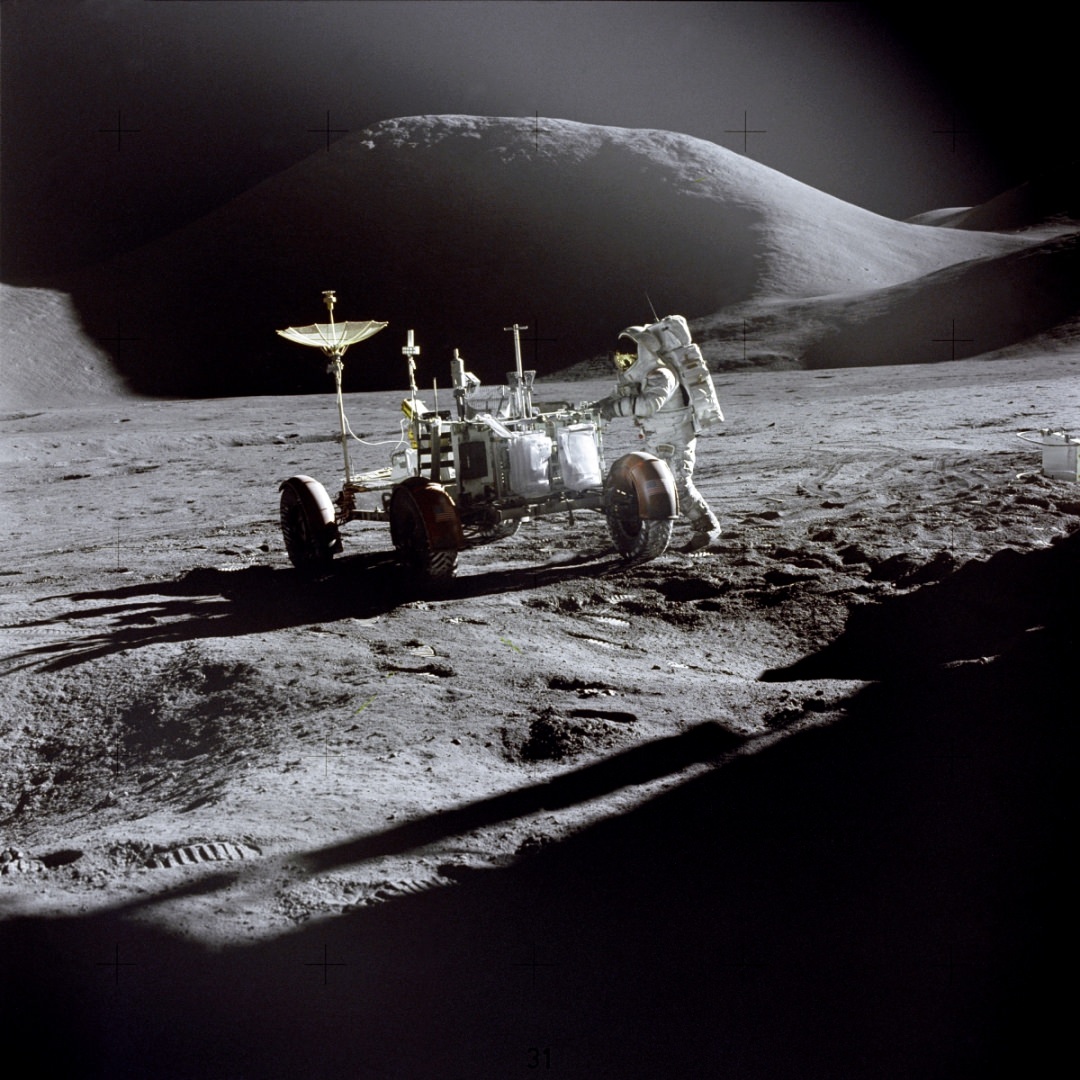
Image above: Astronaut James Irwin fiddling with his lunar rover. Oh, and the desolate majesty of the Moon providing background. Image courtesy of NASA. 

There is a marked contrast between the lunar breccia [4] (rock made of broken up bits of other rocks) samples older than 3.4 billion years, and those that are younger: The older samples show fragments that are almost universally from chondritic asteroids, whereas the younger samples show a much wider diversity of asteroid fragments. The younger samples are also more in line with the current overall composition of the space rocks hitting the Earth today.
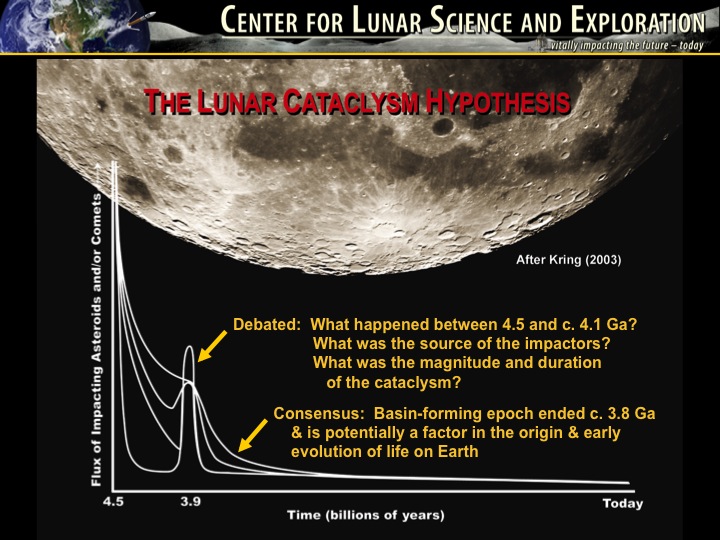
This adds weight to the 'Lunar catclysm' [5] idea, which says that the Moon, and probably the Earth to, underwent a 'blip' of very intense bombardment, ending about 3.4 billion years ago. The evidence of the hammering has been removed from Earths surface by billions of years of weathering and plate tectonics, but the Moon has preserved a pristine record. Based on the number of big craters the Moon has from that time the Earth would have been hit by nearly twenty thousand objects, leaving craters up to a thousand kilometres across.

Image right: A map of the 180 Km wide Chicxulub crater. Imagine that, happening 17,000 time over, some smaller, some a lot bigger. Bad hair day for ancient Earth? I think so.

This would have made Earth, with its bigger gravity and larger target, a poor place to stand at that time.

The impacts would have altered the surfaces of both worlds totally. It was that destructive that mountains, seas, whole continents, would have risen and fallen like bedsheets after a bad curry.
Interestingly the earliest evidence of simple life on Earth dates from just after this time, suggesting that life got started (again, perhaps!) quickly after it was all over. Since chondritic asteroids can be rich in carbon compounds, including biologically relevant ones such as nucelobases [6] and amino acids, the bombardment may even have set the stage for the emergence of life.


Image above: The 'blip' in the rate of asteroids hitting the Moon, called the Lunar Cataclysm. As blips go it's fairly big. Image courtesy of NASA/ LPI-JSC.

But, as with all good science, this find leaves us with more questions. The obvious one being: What caused the Earth-Moon system to suddenly become a shooting gallery?

Although there is absolutely no sign of a swarm of massive asteroids on its way here anytime soon, the answer to that question will help determine the answer to the next, which could be - one day long from now - of life and death importance: Will it happen again?

List of links:
[1]http://www.spacex.com/
[2]http://lunarscience.nasa.gov/articles/nlsi-team-detects-actual-remnants-of-ancient-asteroids-on-the-moon/
[3]http://dawn.jpl.nasa.gov/meteorite/explore_meteorites_chondrites.asp
[4]http://curator.jsc.nasa.gov/lunar/letss/breccias.pdf
[5]http://www.lpi.usra.edu/nlsi/publications/InnerSolarSystemCataclysm.pdf
[6]http://www.nasa.gov/topics/solarsystem/features/dna-meteorites.html

Wednesday, 23 May 2012

Worlds on the edge of knowledge: Pluto, Charon, Nix, Hydra, and, um.... S/2011 P1

Hows my blogging? Leave some feedback, I get better at this, you get a more interesting read!

Image above: The Pluto system, as seen by Hubbles Wide Field Camera 3 ultraviolet visible instrument, showing the motion of tiny little moon S/2011 P1 (labelled 'P4' on the image). Image courtesy of NASA/JPL.

OK, so the last one doesn't even have a real name yet. But that's the point: Our knowledge of the Pluto [1] system is still expanding, and when the New Horizons [2] probe reaches it in 2015 it's going to get a whole lot bigger. 
Pluto first cropped up in  1930, when Clyde Tombaugh [3] was searching for the planet believed to be responsible for unexplained perturbations in the orbit of Neptune. As it turned out Pluto, at just over a fifth the mass of our Moon and about two thousand km across, was much to small to cause the observed changes in the orbit of Neptune. But Clyde had struck it lucky, and for many decades Pluto was regarded as the ninth planet despite its small size.
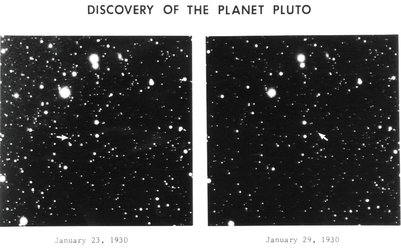
Image above: The original photographic plates that led to the discovery of Pluto. See it? Well it's got an arrow pointing to it. Which helps. But imagine trying to spot that tiny moving blip without an arrow to point it out. Image courtesy of the Lowell Observatory.

Oh, the name? Suggested by an eleven year old schoolgirl, Venetia Burney, who got £5 for coming up with the winner. That's about £230 in todays terms- who says Astronomy and Greek mythology don't pay off?
Image Left: The negative images that led to the discovery of Charon. The lump on the top of the left hand image is the water ice moon. Image courtesy of the US Naval Observatory.

In 1978 James Christy noticed a lump on the images of Pluto, that moved periodically. This lump turned out to be Charon [4], the largest moon of Pluto. Charon is so large, compared to Pluto, that the two worlds orbit each other, moving around a point in space (called the barycentre [5]) between the two of them. In 1985 evidence of a thin, thin, thin atmosphere [6] was found, and confirmed in 1988.

Then, in 1990 the Hubble space telescope [7] was launched. It had some (coff) 'teething problems' at first, then it opened up a whole new sky for us.
Images left: Top: Hubble, hanging over Earth.
Bottom: A map of the Kuiper belt of icy objects, showing the trajectory of New Horizons. Pluto is definitely not alone out there. Image courtesy of JHU/APL.

Hubble found other objects in the Kuiper belt - the vast torus of icy objects beyond Neptune - as big as, or bigger, than Pluto. So Pluto got downgraded from Planet to Dwarf Planet, under the new IAU definitions [8]...

...Although, being a 2000 km wide world of ice and rock, I don't think it much cared...
At the same time, under the gaze of Hubble, the Pluto system began to flower into a very complex place: In 2005 two much smaller moons, Nix and Hydra were found, and in 2011 S/2011 P1 was found while astronomers were looking for evidence of Plutonian rings.
The discovery of these little moons is an astonishing feat: Pluto is nine light hours away, or about 5 billion kilometers,and while Nix and Hydra are somewhere between 100km and 200km across each, S/2001 P1 is much less than 50 km across.

So, Pluto has gone from being a tiny spot of light on one of Clyde Tombaugh's photographic plates to just one of a the massive family of Kupier belt objects, to a strange, cold, complex place of multiple moons, and perhaps even rings.

Which begs the question: What are these worlds like?

Well, that's why we're sending New Horizons there! But there are some things we already know:

Pluto is a frigid but constantly changing place: The surface varies between white, charcoal black, and vivid orange. It is covered in frozen methane, and has polar caps of solid nitrogen. The atmosphere of methane, nitrogen, and carbon monoxide, freezes and falls as snow as the winter sets in, and may stream away from the planet in a tail, like a giant comet. There may even be clouds of hydrocarbon haze [9], formed by methane breaking down and re-forming into more complex molecules, under the suns distant UV light. Such molecules are thought to have been instrumental in beginning life on Earth.

Video above: Hubbles best resolution images of Pluto, merged into a video map of the whole dwarf planet. Courtesy of NASA/JPL.

Charon, the biggest moon, has a solid water ice surface,  a low density suggesting it is more ice than rock and  is more odd even than Pluto: There are patches of crystalline water ice, and ammonia hydrates, on its surface [10]. Crystalline water ice breaks down into amorphous ice under space radiation, which, bizarrely, suggests that Charon has some form of internal activity. That means heat which is.... surprising to say the least, for a world well under a fifteen hundred km across. But we have seen tiny little worlds with cryo-vulcanism (ice volcanoes erupting ice and cold gas) before, at Enceladus, and at Triton. The ammonia hydrates are, perhaps, a clue: Ammonia is a potent antifreeze, perhaps keeping a very little water/ammonia mix slushy deep beneath the surface, where it might find it's way out to the surface from time to time.


Image above: A reconstructed black and white image of Charon. Image courtesy of the Lowell Observatory.

Which begs a certain question about Charon, given how adaptable we know terrestrial extremophile life to be....

Nix...well that is a real unknown. Perhaps grey, or red in colour, with estimates of size ranging from 45 km to 140 km. Hydra is more or less an unknown to, probably grey-ish in colour, and between 60 and 160km across. S/2011 P1 is truly tiny, only tens of km across.


Video above: A NASA science cast on the /new Horizons mission to Pluto. Courtesy of NASA.

The presence of the the three small moons might imply a system filled with debris, from which the idea of a ring system for Pluto comes. This has caused some headaches for the New Horizons team [11], since they have to navigate their spaceship through the Pluto system - and it may be filled with unknown chunks of rock and ice. When it arrives in 2015, New Horizons is set to reveal this strange system of double-planet and moons in even greater detail than Hubble could. Who knows what Pluto could become to us then?
But one thing is already clear:  Pluto isn't a distant ball of ice and rock. Pluto is a complex, alien, changing planetary system, sitting on the edge of the interstellar dark.

Image above: New Horizons sets out for Pluto, on the dark frontier. Clyde Tombaugh's ashes are aboard. When asked by NASA scientists if they could pay a visit to the planet he discovered he said: "You're welcome to it!". Image courtesy of NASA/JPL. 
List of links:
[1]http://nineplanets.org/pluto.html
[2]http://www.nasa.gov/mission_pages/newhorizons/main/index.html
[3]http://starchild.gsfc.nasa.gov/docs/StarChild/whos_who_level2/tombaugh.html
[4]http://solarsystem.nasa.gov/planets/profile.cfm?Object=Plu_Charon
[5]http://en.wikipedia.org/wiki/Barycentric_coordinates_(astronomy)
[6]http://news.discovery.com/space/pluto-has-a-strange-atmosphere-110420.html
[7]http://hubblesite.org/
[8]http://www.iau.org/public_press/news/detail/iau0603/
[9]http://www.dailymail.co.uk/sciencetech/article-2077674/Building-blocks-life-Plutos-surface.html
[10]http://www.sciencedaily.com/releases/2007/07/070719011140.htm
[11]http://www.boulder.swri.edu/~throop/files/nh_rings_whitepaper.pdf

Tuesday, 22 May 2012

Per Ardua Ad Astra.....

Hows my blogging? Leave some feedback, I get better at this, you get a more enteraining read!

.....But when all that 'ardua' pays off it is sweet. Space eXploration Technologies Corporation [1] has done it, launching the first fully private mission to the ISS [2]. More on this to come, of course, but as I have my driving test at 8 am tomorrow (Yes, I'm 29, have you seen the cost of car insurance these days? I'll need to be manageing director of spmething before I can afford it) I'll content myself, for now, to show you the launch. Enjoy!


Video above: The May 22nd 2012 launch of the private Dragon space vessel to the ISS. Video courtesy of SpaceX. 

List of Links:
[1]http://www.spacex.com/
[2]http://www.nasa.gov/mission_pages/station/main/index.html

Monday, 21 May 2012

Amateur astronomers invited to save the planet........

How's my blogging? Leave some feedback, I get better at this, you get a more interesting read!


Image above: The Dinosaurs. They're all dead. 'Nuff said about why astronomy is important.
Actually it's not quite as cut and dried as 'the asteroid did it'. But the asteroid certainly didn't help things.

The phrase 'planetary defense' always conjures up images of superheroes to my mind, but this is about preventing a more real, and hence more serious, threat than marauding space aliens:
ESA's Space Situational Awareness Office [1] -  the bit of ESA that worries about space hazards like satellite damaging solar flares and asteroid impacts -  is asking teams of amateur astronomers to help it spot, track, and confirm the paths of Near Earth Objects (NEO).

Just in case you don't know what I'm talking about: Go outside and look at the Moon with a pair of binoculars. You see all those holes in the Moon, the holes that hundreds of kilometers across? I'm talking about the things that made them.

Impacts that big are rare, millions of years apart in fact. But even a space rock a hundredth of that size, coming down over a major city, and making it through our atmosphere....unfortunately, on very rare occasions, the universe comes to us hard.

The latest collaboration is with the Faulkes Telescope Project [2], at the University of Glamorgan, to help with observations that were begun with ESA's Tenerife telescope. Spains La Sagra Sky survey [3], who are able to detect hundreds of new NEO's a month, have also joined the operation.

The possibility of something like the Tunguska event [4] happening over a populated area is one that deserves to be taken seriously. But tracking down every chunk of rock - and bear in mind that that includes things as small as fifty meters across - requires a lot of time, and luck, and then confirming and pinning down an objects path is equally challenging.
Few kinds of asteroid have the courtesy to be bright white and on an easy to spot path. Many are pitch black and can come at us from out of the sun, or from unexpected directions most telescopes don't watch. So the more eyes on the sky we have, the better the odds of finding anything potentially dangerous in time to do something about it.

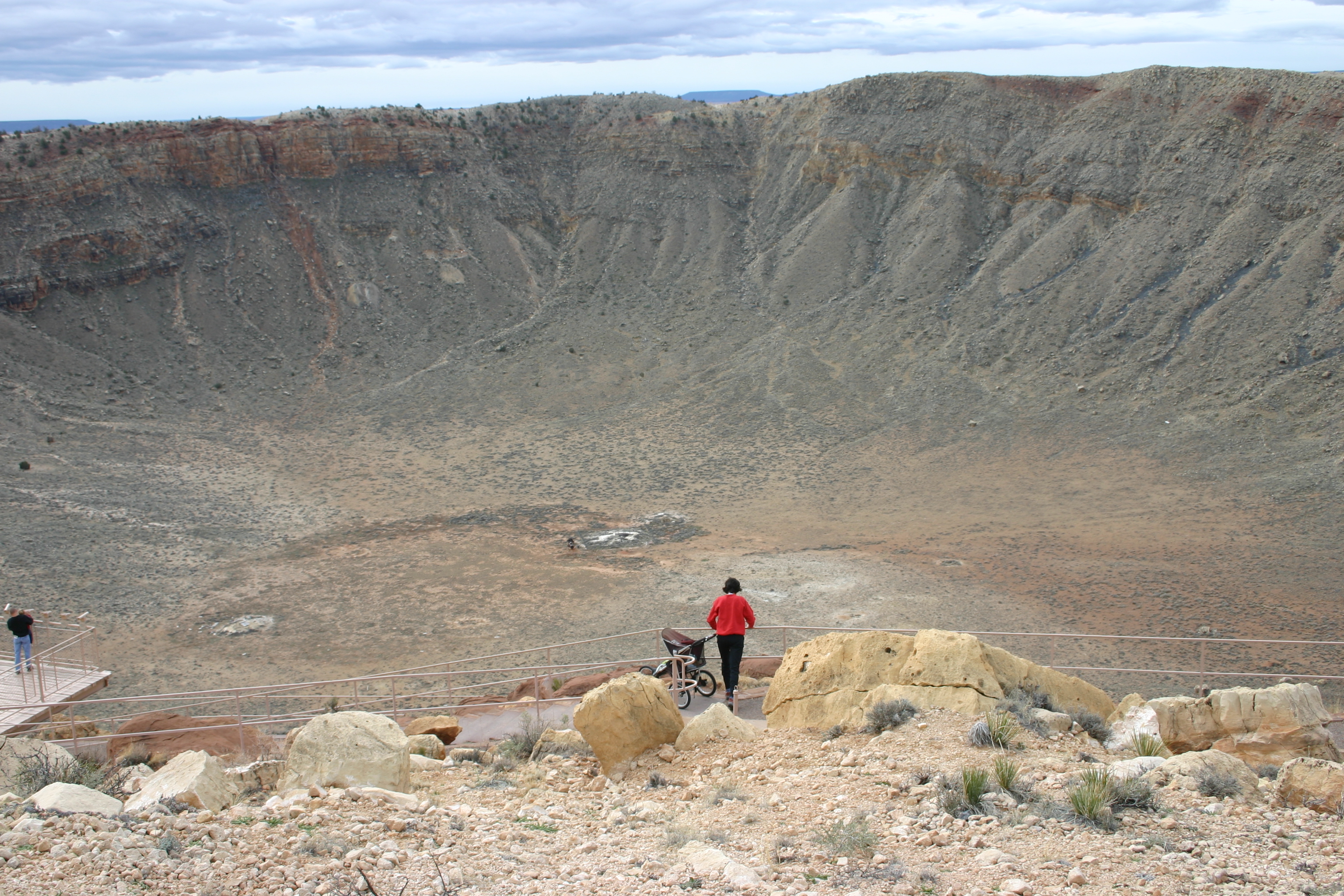
Image above: Barringer (Meteor) crater, in Arizona, created by the impact of the 50 meter wide Canyon Diablo Meteorite. It's amazing how, given enough time, a 10 Megaton explosion can be good for tourism! Image courtesy of Kevin Walsh.

What's more these efforts could also help us identify targets of opportunity, low hanging fruit for space exploration. For example, confirming the recent computer simulations [5] suggesting that (very) small asteroids frequently enter orbit [6] around the Earth could open up literal low hanging fruit for asteroid sample return missions.

Faulkes run both research and educational programs, where UK (and some European) students can get observing time on the telescopes. So if you're teaching science, and fancy having people who work to protect the Earth talking to your students.... go on, the links just there......

Hey, who was in a position to catch Sundays annular eclipse of the Sun? So far the most spectacular image of it I've seen is this one:
Image above: Sundays eclipse, as seen from Japan. Image courtesy of 'Japan - A Foreigners view' [7] 

But ESA's Proba-2 micro-satellite also got a spectacular view:

Video above: Sundays solar eclipse seen from the Proba-2 micro-satellite. Video Courtesy of ESA.

And lastly: Good luck to SpaceX [8] on their first mission to the International Space Station. The last attempt to launch was scuppered at literally the last instant by a faulty turbo pump. Here's hoping this one goes all the way to the ISS!

List of links:
[1]http://www.esa.int/esaMI/SSA/SEMYTICKP6G_0.html
[2]http://www.faulkes-telescope.com/
[3]http://www.minorplanets.org/OLS/
[4]http://science.nasa.gov/science-news/science-at-nasa/2008/30jun_tunguska/
[5]http://www.newscientist.com/article/mg21328464.600-hundreds-of-tiny-moons-may-be-orbiting-earth.html
[6]http://www.sciencedirect.com/science/article/pii/S0019103511004684
[7]http://gaijininkansai.com/2012/05/21/the-annular-eclipse-may-2012/
[8]http://www.spacex.com/

Friday, 18 May 2012

Lyrid meteor shower: Sprinkles of comet Thatcher

Hows my blogging? Leave some feedback, I get better at this, you get a better read! Never follow Absinthe with warm Sake. The green fairies get hammered.

Image above: A Lyrid meteor slams into Earths atmosphere - photographed from above, by one of the crew of the International Space Station. Do yourself a favour, check out the original here [1]. Then do yourself a bigger favour and watch the video [2]. Image courtesy of NASA.

Meteor showers are streams of tiny particles left behind by passing comets -  so when you see one you are literally seeing parts of a comet raining down from the sky. We've just passed through the Lyrid meteor shower, a stream of particles from comet Thatcher [3], a 2600 year old trail of debris with a history of surprising humanity: In 687 BC it was described as being so intense that 'the fixed stars were invisible, and stars fell like rain'. Although the shower usually peaks at around 20 meteors an hour, in 1803 it peaked at 700, and in 1982 at 90. Bigger Lyrid meteors, known as Lyrid fireballs, can throw shadows and leave behind visible trails of smoke.
And this year the van sized Sutters Mill meteorite [5] came down while the shower was on - and blew up rather spectacularly, leaving people seeing spots [4], spraying the ground with pieces of space rock, and with an estimated force of 4 kilotons (Hiroshima's 'Little boy' was about 15 kilotons). It's arrival was probably just a coincidence, but mentioning it gives me an excuse to post a stunning picture its arrival, so there:

Image above: The 70 ton Sutter's Mill Meteorite blows up over Nevada with the force of a small nuke. Pretty, isn't it! Image courtesy of JPL/NASA.

Comets are cryogenic time capsule from the earliest times of our solar systems existence, and Thatcher hails from far reaches of the Kuiper belt [6], so you'd think that the Lyrids would be an excellent opportunity to do some Laz-y-boy deep space exploration.

Well I did, anyway.
And it turns out, I was right!


Video above: NASAs efforts in studying the Lyrid meteor shower. Courtesy of NASA/JPL.

As well as a world wide campaign of ground based observations and the observations from the ISS, Tony Phillips from spaceweather.com [7] has led a team of high school and middle school students in an edge-of-space balloon mission [8], to try and capture images of the Lyrids from 100,000 feet, using an experimental NASA camera. Studying how the brightness and intensity of a meteor shower changes with time tells us about the size and evolution of the swarm of particles, which in turn tells us about the comet that produced it.


Video above: Students launch a near space balloon mission to capture images of the Lyrid meteor shower. Video courtesy of Tony Phillips.

All the above efforts are contributing to producing a 3D image of the Lyrids, as described in this 'NASA chat' transcript [9].

Image right: Three NASA ER2 high altitude research aircraft fly in formation over the golden gate bridge. Image courtesy of the National Oceanic & Atmospheric Administration.

NASA also often fly a high altitude ER2 aircraft around this time of the year, hoping to pick up cosmic dust [10] from the shower using a large, cooled, collector mounted on the wing. The dust is relatively intact, as it's small size lets it float down to Earth rather than streaking in as a meteor, which makes it a great way to get material from space - although a lot of sorting is needed to separate the cosmic dust [11]from the various kinds of Earth dust. The increase in the amount of dust entering the atmosphere during a shower is actually fairly slight, but since any piece of interplanetary material found is a sample from deep space it pays to maximise the chances!


Video above: The Lyrid meteor shower: Real comet dust, falling to Earth. Time lapse video by Mark Zebo.

Incidentally, it's just a small thing but: SpaceX will be attempting to launch it's Dragon space capsule tomorrow! 
The mission is to the ISS, hauling supplies, and hopefully becoming the first commercial entity to fly there.
If they succeed I will attempt to do a back flip with joy, and probably sprain something. If something goes wrong, I hope they will be able to push through - Elon Musk certainly has the drive and ambition to ride out a few mishaps. To SpaceX [12]: Good luck!

Image above: A CGI impression of the Dragon spacecraft docking at the ISS, as it hopefully will later this week. Image courtesy of Discover magazine.
List of links:

[1]http://www.nasa.gov/topics/solarsystem/features/watchtheskies/lyrids1.html
[2]http://www.nasa.gov/multimedia/videogallery/index.html?media_id=143997541
[3]http://ssd.jpl.nasa.gov/sbdb.cgi?sstr=C/1861+G1
[4]http://www.rgj.com/article/20120423/NEWS/304230031/1459/news?nclick_check=1
[5]http://apod.nasa.gov/apod/ap120428.html
[6]http://solarsystem.nasa.gov/planets/profile.cfm?Object=KBOs&Display=OverviewLong
[7]http://www.spaceweather.com/
[8]http://www.nasa.gov/topics/solarsystem/features/watchtheskies/balloon_lyrids_update1.html
[9]http://www.nasa.gov/pdf/642909main_LyridsChat.pdf
[10]http://www.nasa.gov/centers/dryden/Features/ER-2_cosmic_dust.html
[11]http://curator.jsc.nasa.gov/dust/
[12]http://www.spacex.com/