Search This Blog

Tuesday, 12 June 2012

Opening an X-ray eye....

How's my blogging? Leave some feedback, I get better at this, you get a more interesting read!

EDIT: I'm a numpty, yet again, the press conference begins at 11.30 eastern daylight time . D'oh.
A quick note, on a small but very interesting space mission:

Nu-STAR ready to take to space!


Image above: The Nu-STAR spacecraft, with its unfoldable boom and X-ray optics deployed. Artists impression, courtesy of NASA/JPL/Caltech.

X-rays astronomy [1] has always been a bit of a bugger to do, as X-rays from space don't go through Earths atmosphere very well  - yes, I know that seems odd, since we use them to look inside ourselves. We use them for that because they will go through some kinds of biological tissue (muscle) and won't go through others (bone for example). However a hundred kilometres of air, like the hundred kilometres of air sitting on top of you right now, stops them rather nicely. Which is good because lots of X-rays would be bad for us, in the sense that they would kill us all.
The other problem with X-ray astronomy is that focusing X-rays isn't easy [2]: Most materials that they don't go straight through absorb them, instead of reflecting them. The highest energy X-rays, which would let us observe some of the most powerful events in the sky, are especially hard to handle. But it can be done [3], using technologies like the Wolter telescope [4]. Getting one of these into space could open up a whole new universe for us!

Image Left: The Pegasus rocket, with Nu-STAR aboard. It's one of those microsat launchers that launches from beneath the belly of a big aeroplane, which means the Nu-STAR is actually quite dinky when it's all folded up. Image courtesy of NASA/JPL/Caltech.

So NASA has built the Nu-STAR [5] (Nuclear Spectroscopic Telescope Array) spacecraft, based on the Wolter telescope, and which is being launched tomorrow on an Orbital Sciences [6] Pegasus rocket.
Once in space it will deploy a ten meter long boom, with a set of X-ray optics on the end. The long boom is needed because the X-ray optics have a long focal length [7], so the optics need to be held away from the X-ray detectors.
The satellite should totally change the field of X-ray astronomy, allowing us to do things like mapping the newly forged heavy elements in the debris of supernova. Since all the elements heavier than iron formed that way [8], learning more about how the gigantic supernova explosions distribute them across space helps us understand our solar systems birth. Nu-STAR will also be a very sharp eyed black hole hunter. Which isn't ancient solar system related, but just about anything to do with black holes is cool in my book.
Image above: To show how much Nu-STAR will improve X-ray astronomy, here's a comparison between an image taken by ESA's INTEGRAL spacecraft (Top left), and the kind of image expected from the Nu guy (bottom right). See what I did there? Make you laugh? Groan? Throw something at the screen? Well, at least that's a reaction. Image courtesy of NASA/JPL/Caltech.

The Nu-STAR team will have a news conference tomorrow, at 11.30 British time, with the following panelists:

-- Omar Baez, NASA launch director, Kennedy Space Center, Fla.

-- Fiona Harrison, NuSTAR principal investigator, California Institute of Technology, Pasadena, Calif.

-- William Craig, NuSTAR instrument manager, University of California at Berkeley (UC Berkeley)

-- Grace Baird, NuSTAR bus chief engineer, Orbital Sciences Corporation, Dulles, Va.

And you can get a live audio stream of it here [9].
I'll be at work then, cussing at the machines. That's not how I usually work, it's just missing the launch. Ahem.

List of links:
[1]http://www-xray.ast.cam.ac.uk/xray_introduction/
[2]http://imagine.gsfc.nasa.gov/docs/science/how_l2/xtelescopes_systems.html
[3]http://www.astro.umd.edu/~richard/ASTR680/Aschenback_mirrors.pdf
[4]http://en.wikipedia.org/wiki/Wolter_telescope
[5]http://www.nustar.caltech.edu/about-nustar
[6]http://www.orbital.com/
[7]http://hyperphysics.phy-astr.gsu.edu/hbase/geoopt/mirray.html
[8]http://hyperphysics.phy-astr.gsu.edu/hbase/astro/nucsyn.html
[9]http://www.nasa.gov/news/media/newsaudio/index.html

Monday, 11 June 2012

Absent Dwarves, and a big black rock....

How's my blogging? Leave some feedback, I get better at this, and you get a more interesting read!

Just a couple of quick bits of news, because it's late, and because the 'a' on my keyboard is playing up which makes typing a lot like hard work:

The Dwarfs aren't out there:
NASA has released results [1] from the infra-red WISE [2] space telescope, and they have a surprise: Theories predict that there should be one Brown Dwarf [3] - an object partway between a Jupiter like planet and a small star - for every regular star. But there aren't! The number is more like one for every six regular stars.


Image above: Our local bit of the Milky way, with the positions of newly found brown dwarfs circled in red. basically, there should be more of them. The image is a view from about 30 light years away. Presumably a simulated view. If it's an actual view then my mission to keep you up do date with space related news has suffered something of a ......hiccup.
Image courtesy of NASA/JPL

Brown dwarfs are thought to form by the same process as regular stars [4] -  the collapse of a huge, sparse cloud of gas. That there are fewer in our local neighbourhood may be telling us something about the history of our corner of the Galaxy, or pointing to a gap in our theories of star formation.
But WISE is still looking, and there may be further surprises. Brown dwarfs are hard to spot: They're too small to sustain hydrogen fusion [5]. Instead they briefly fuse deuterium [6], and then slowly fade and cool-  in fact the coldest one found by WISE is only 25 degrees Celsius at it's surface, a record breaking cold 'star'.

Son of the Falcon to visit black rock:

JAXA [7] is looking to visit asteroid 1999 JU3 [8].... and their ship is already under construction.

Image Above: The asteroid 1999 JU3. Um. Ok, you've got me, that asteroid's Itokawa, the target of Hayabusa 1. But it's still a spectacular chunk of space rock! Go on give it chance...... fine, it looks like a 500 meter long potato. Or worse. But 1999 JU3 itself is pitch black, due to its high carbon content - the 'lead' in a pencil is actually made of carbon -which makes it very difficult to image from Earth. But while most asteroids look like huge potatoes, they make up for it by holding clues to how planet Earth, and life here, started. Image courtesy of JAXA.

Their Hyabusa 2 space ship is, according to the Japanese Asahi Shimbun newspaper, already under construction. It's based on the ion drive [10] propelled Hayabusa (which means 'peregrin falcon') probe, that had a 'very eventful' mission to the asteroid Itokawa.

Which is science speak for: Things went wrong. A lot of things.

But to be fair, it was a totally new design of spaceship. The JAXA engineers are inventive, determined, and they bought the little bird home with its cargo of asteroid samples. The probe -  aside from the sample return capsule, which landed safely - was then incinerated in Earths atmosphere which was a pity, but always part of the plan.

Although the probe itself might have objected to that plan

The story of triumph over adversity [11] has gone down well in Japan, probably as it shows just how much engineering talent and tenacity JAXA have. So JAXA are doing a sequel, although in cash strapped times they've had to fight for the money


Video above: Hayabusa slams into Earths upper atmosphere at very, very, high speed. The shower of huge sparks is the main probe breaking up, the little spark on the lower right is the sample return capsule, which made it back to Earth with it's cargo of asteroid bits intact. Video courtesy of NASA.

The new probe is intended to visit asteroid 1999 JU3 in mid 2018, and stay in orbit for a year and a half, It will spend it's time studying the asteroid, collecting samples for return to Earth, and possibly deploying a small lander. 1999 JU3 is getting this attention because it holds carbon chemistry, and shows signs of being altered by liquid water [12], presumably while part of a larger body like a protoplanet. Ground based observations also suggest that there may be two types of material on its surface, so perhaps we have a rubble pile of two asteroids, smooshed into one by a collision.

After all the things we've found in carbon rich meteorites [13] that relate to the origins of life - nucleobases, nucleobase analogues, amino acids -  this kilometre long piece of black rock could provide us with some important clues as to how we all came to be.

List of links:
[1]http://www.jpl.nasa.gov/news/news.cfm?release=2012-164&cid=release_2012-164&msource=12164
[2]http://www.nasa.gov/mission_pages/WISE/main/index.html
[3]http://astro.berkeley.edu/~basri/bdwarfs/SciAm-book.pdf
[4]http://www.cfa.harvard.edu/news/2008/pr200824.html
[5]http://www.astrophysicsspectator.com/topics/stars/FusionHydrogen.html
[6]http://www.astrophysicsspectator.com/topics/degeneracy/BrownDwarfStructure.html
[7]http://www.jaxa.jp/index_e.html [8]http://en.wikipedia.org/wiki/(162173)_1999_JU3
[10]http://www.jaxa.jp/article/special/hayabusa/kuninaka_e.html
[11]http://www.bbc.co.uk/news/10285973
[12]http://iopscience.iop.org/1538-3881/135/4/1101/
[13]http://www.pnas.org/content/early/2011/08/10/1106493108

Thursday, 7 June 2012

Venus (an extreme world) and Vesta (an extremely battered world):

Hows my blogging? Leave some feedback, I get better at this, you get a better read!

The transit of Venus was as spectacular as promised, although not from my house, as we've had our allocated five sunny days of summer here in Manchester What's up with that? [1]

However, other parts of the world were luckier, and spacecraft don't suffer from such things, so here are some truly amazing snaps from:

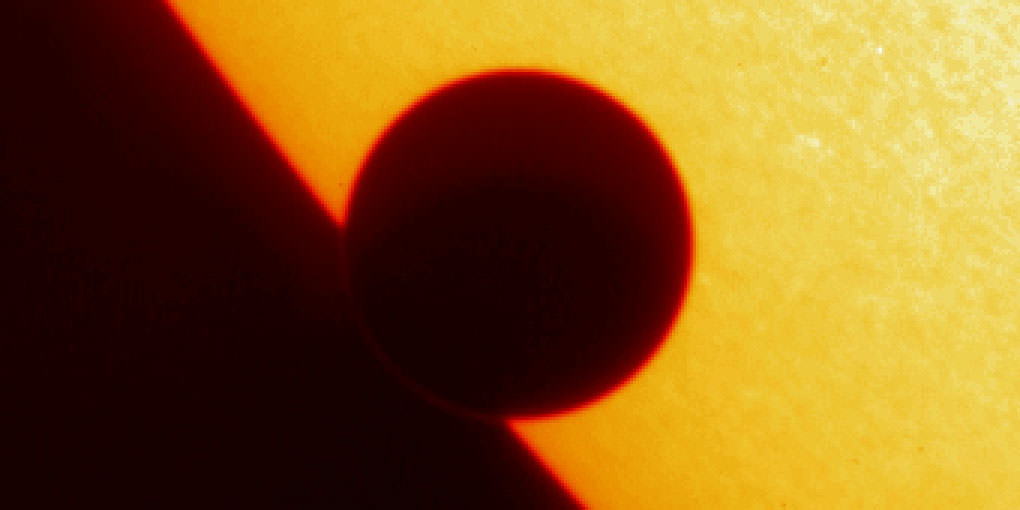
The NASA/JAXA Hinode [2] spacecraft....


Image above: The planet Venus begins its passage across the face of the Sun. Image courtesy of NASA/JAXA.

....the Arctic island of Spitsbergen....


Image above: The transit of Venus from the Arctic. Where the weather was, apparently, better for it than in England. Image courtesy of Michel Breitfellner and Miguel Perez Ayucar/ESAC.

 ....Canberra, Australia....


The Venus transit as seen from down-under. Please forgive this pom for calling it that, I realise it is in fact on the top of all the world. Don't make me play Australian rules football, please. I wouldn't survive. Image courtesy of Michel Breitfellner and Miguel Perez Ayucar/ESAC

As well as videos from ESA's Proba 2 micro-satellite [3]...


Video above:  The transit of Venus, as seen from the ESA Proba 2 spacecraft. The wobble is due to the satellite wobbling, not Venus. Venus does enough strange stuff already. Video courtesy of ESA.

...and NASA's Solar Dynamics Observatory [4].


Video above: The transit of Venus, as seen from the Solar Dynamics Observatory spacecraft. The roiling plasma on the surface of the Sun is complex and beautiful enough for me to watch by itself. And then it's got Venus in there to! Courtesy of NASA/JPL.

Image left: NASA has built the Extreme Environment Chamber. It's a beast, like a pressure cooker designed to dissolve, incinerate and pulverise the food in a split second. They plan to build machines that can live in it for a week. Image courtesy of NASA/Glenn.

In other Venus related news: NASA's Glenn research centre have built an Extreme Environment Chamber [5], to recreate the brutal conditions of the Venusian surface. The chamber is much too serious a machine for me to do something silly, like call it an Xtreme Environment Chamber.
Ooops. Anyway, each bolt to hold the lid in place weighs 45 kg, or as much as a... well I can't think of anything that weighs exactly that much. But that's a lot for one bolt. The engineering has to be that hardcore: Having a simulated Venus inside makes the chamber a huge explosion, waiting to happen.

The main purpose of all this is to work out how to build electronics, machinery, and sensors, that will operate under the crushing  Venusian pressure and heat [6]. Initially the aim is to build something that would last for five days there. For example: The Glenn team are developing a seismometer that would provide insights into Venus' extreme geological processes [7]. Others are working on measuring how sound, light, and the Venusian soil would behave under those conditions.

The applications for the chamber go beyond testing for Venus. According to Rodger Dyson, the principle investigator for the project, if you can work on the surface of Venus you can work anywhere in the solar system - except the depths of the atmosphere of Jupiter, which has all of Venus' charm with massive radiation levels added on top.

Geoffry Landis, who works as an aerospace engineer at Glenn, has been involved in several proposed robotic missions to Venus [8]: "Venus is the planet that is closest to the Earth, both in distance and in composition," Landis has said. "It's very much Earth's twin, but in some ways it's Earth's evil twin."

Elsewhere in the solar system:

The Dawn [9] team have published a 3D map of Vesta [10], in both real and enhanced colour, to bring out the differences in the composition of its surface areas.


Video above: A 3D map of Vesta, made using the thousands of hours of data the Dawn spacecraft has collected. Video courtesy of NASA/JPL.

Two things about this make me swoon with space nerdyness: You can see how nearly spherical Vesta is, how it might well have been planet shaped in the past. And we can see how hugely varied the surface composition is, showing just how complex and tumultuous Vestan geological history was. For example: Iron abundance is shown in green in this image, and we can see how iron has been bought to the surface, in patches, inside the huge gap where the south pole of this protoplanet used to be.

Image right: The best guess we have to date on he internal structure of Ceres, based on its mass, signs of materials that have interacted with water on is surface, how warm we think it might have gotten, and computer models. It's not been ruled out that there might be a tiny hint of geological activity, and perhaps a little liquid water, deep down near its core. Image courtesy of NASA.

Dawn is currently moving from its low altitude mapping orbit to its final science orbit, averaging 420 km above the Vestan surface. Then, in August, Dawn will break orbit of Vesta and head out to it's next target: The enigmatic and (probably) ice laden dwarf planet Ceres [11]. The ion drive powered spacecraft will reach the king of the asteroid belt in Febuary 2015, spending longer at Vesta than planned because the mission has so far gone almost flawlessly. As it departs Dawn will still be taking images and readings of Vesta, particularly its north pole, which has been in winter darkness for much of its visit so far.
Image above: The Hubble Space Telescopes best shot of Ceres. Can't think of a good comparison for it, but it looks tantalising. Image courtesy of NASA/JPL.

List of links:
[1]http://uk.answers.yahoo.com/question/index?qid=20091017061019AAhtlye
[2]http://solarb.msfc.nasa.gov/
[3]http://www.esa.int/esaMI/Proba/SEMJJ5ZVNUF_0.html
[4]http://sdo.gsfc.nasa.gov/
[5]http://www.nasa.gov/centers/glenn/technology/venus_chamber.html
[6]http://www.grc.nasa.gov/WWW/TECB/extreme.htm
[7]http://www.lpi.usra.edu/meetings/lpsc2012/pdf/1961.pdf
[8]http://www.lpi.usra.edu/vexag/may2008/presentations/18Landis.pdf
[9]http://dawn.jpl.nasa.gov/
[10]http://en.wikipedia.org/wiki/4_Vesta
[11]http://en.wikipedia.org/wiki/Ceres_(dwarf_planet

Tuesday, 5 June 2012

In which I'm a numpty....

I hang my head in shame: The transit of Venus is tomorrow from the UK, at about 5am [1], and I should be taken outside and slowly minced, feet first, for having the date settings on my computer wrong.

I'm very sorry.

Everything else I said about it still applies though.

OK, less embarrassing, and more interesting stuff:

A quick video of Venus starting to align with the sun to produce the coming transit, as seen from the SOHO spacecraft [2]:


Video above: Venus approaching the Sun, as seen by SOHO. Video courtesy of NASA Goddard space centre.


What I really love about this: You can see Mercury as well, giving a nice sense of looking into a spinning inner solar system.
The sun itself is blanked out, as the usual purpose of the LASCO C3 coronograph, the instrument taking this picture, is to observe the Suns corona (outer atmosphere), which is much fainter than the solar surface. The instrument is so sensitive that both Mercury and Venus are bright enough to overpower the pixels on the coronographs detector - causing the huge death-ray-spikes of light on either side of them.

Image above: A stunning image of Venus as it approaches the transit, showing the ring of scattered sunlight from high altitude particles in its atmosphere. Image courtesy of Lorenzo Comolli, and spaceweather.com.

Remember in my last, erroneous, blog post I pointed out that the suns light refracts about Venus, producing a 'ring of fire' around it, even before it has fully entered the Suns disk?
No?
OK, I only mentioned it briefly. But it turns out that this is important, because it allows astronomers here on Earth to probe the venusian atmosphere [3]. And the Venusian atmosphere is a dozen mysteries, wrapped in a conundrum, and hidden beneath sulphuric acid clouds.....

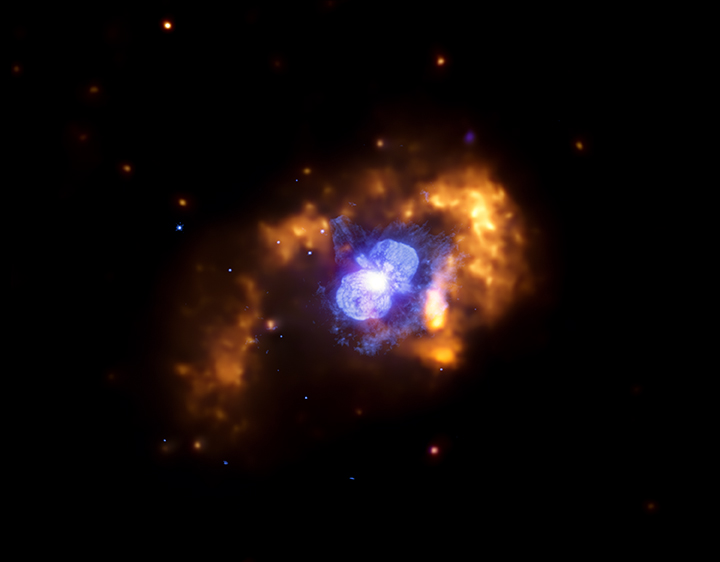
Image left: A combined X-Ray and optical image of the Homunculus nebula, home to the Eta-Carinae double star. The X-ray segment was taken by the Chandra space telescope, the optical part by the Hubble Space Telescope [4].The outer horseshoe shaped cloud is about two light years across, only visible in x-rays, and is evidence of a massive stellar tantrum about a thousand years ago. Image courtesy of NASA/JPL

ESA's Herschel space telescope [5] has produced another stunning picture, this time of the Carina nebula, which is home to several open clusters of young stars, star spawning regions of filaments and Bok globules [6], and the monstrous Eta Carinae double star. One of the stars in the system is thought to be a wolf rayet star [7], the other a huge ultra heavy luminous blue variable [8], weighing in at over a hundred times our suns mass. The pair are so unstable that they blast the bizarre Homunculus Nebula into the space around them.
Eta Carina has, at times, been almost as bright as Sirius [9] (itself a fascinating double star). Considering that Sirius is about eight and a half light-years away, and Eta Carinae is over seven thousand, the unstable double star must have been putting out a titanic amount of power at the time. And it spat our two lobes of super hot material, each weighing as much as our Sun or more, travelling at seven hundred km per second, making the Homunculus Nebula [10] we see today.
As Dr. Kris Davidson, from the University of Minnesota puts it: "If Eta Carina becomes a Supernova next Thursday, we shouldn't be surprised."


Image above: The massive Carina nebula, home to almost every kind of stellar beast you could imagine. It's even bigger and brighter than the Orion Nebula, but less well known because it's only visible in the southern hemisphere. Which seems a bit unfair to me, but never mind. We can see the voids carved into the nebula by the stellar winds of new born stars. The is picture was taken in the infra red by the ESA Herschel spacecraft. Image courtesy of ESA.

We get three fairly close NEO flybys in June: 2002 AC [11] and 1999 BJ8 [12] on June 16th, both passing by 60 to 70 times as far away as the Moon, both just over kilometre big. The third, on June 21st, is 2005 GO21  [13], which will be observed [14] by the Goldstone [15] and Arecibo [16] deep space radars. Arecibo expect to resolve the object to within a thousand pixels, and get a measurement of it's rate of rotation.

Finally: This week sees the Scorpid and Aretid meteor showers peak, with expected fall rates of twenty per hour and thirty per hour respectively. Watch out for the Scorpids Tuesday night, and the Aretids just after sundown Thursday.

The weather here in Manchester doesn't look promising for tomorrow. Still I'm going to go to bed with at least the hope that the sun might break through before I head for work. For long enough, perhaps, for me to use my telescope as a projector and catch a tiny piece of this never to be seen again (unless I wind up as a Futurama style head in a jar) event.
Tom Hanks. In a jar. Image courtesy of Matt Groening.

Cup of tea and then bed methinks.....

List of links:
[1]http://sunearthday.nasa.gov/2012/transit/viewing_locations.php
[2]http://sohowww.nascom.nasa.gov/
[3]http://science.nasa.gov/science-news/science-at-nasa/2012/04jun_arcofvenus/
[4]http://hubblesite.org/
[5]http://herschel.esac.esa.int/
[6]http://www.universetoday.com/24499/journey-inside-a-bok-globule/
[7]http://imagine.gsfc.nasa.gov/docs/ask_astro/answers/980603a.html
[8]https://www.cfa.harvard.edu/~pberlind/atlas/htmls/lbvstars.html
[9]http://en.wikipedia.org/wiki/Sirius
[10]http://en.wikipedia.org/wiki/Homunculus_Nebula
[11]http://ssd.jpl.nasa.gov/sbdb.cgi?sstr=2002 AC&orb=1
[12]http://ssd.jpl.nasa.gov/sbdb.cgi?sstr=1999 BJ8&orb=1
[13]http://ssd.jpl.nasa.gov/sbdb.cgi?sstr=2005 GO21&orb=1
[14]http://ssd.jpl.nasa.gov/sbdb.cgi?sstr=2005 GO21&orb=1
[15]http://deepspace.jpl.nasa.gov/technology/TMOT_News/FEB97/gldstone.html
[16]http://www.naic.edu/

Sunday, 3 June 2012

Venus, dark twin of Earth, in the light.... and behind the clouds

Hows my blogging? Leave some feedback, I get better at this, you get a better read!


Image above: The last transit of Venus, as seen by the TRACE spacecraft [1]. You can just about make out the light refracted through the edge of the Venusian atmosphere, completing the circle of light around the planet. Image courtesy of NASA/JPL.

The problem with last-chance-to-see-this-lifetime astronomical events, is that space ship Earth sometimes won't co-operate.Or put another way: Tomorrow is the beginning of the transit of Venus [2] across the Sun. It's the last time this will happen for over a hundred years. Work wouldn't give me Tuesday off, and the weather here in Manchester is.... well, it sucks at the moment.

So, since it doesn't look like I'll get a chance to see the transit myself, I'll content myself  by offering a piece of advice you'll hear from every good astronomy website:

DON'T  look directly at the unfiltered sun. And DON'T EVER look at the sun through a telescope or binoculars. It's a thermonuclear fireball three light seconds wide, don't forget that.

If you need any further convincing of its power to burn your eyeball out of your head (I'm not exaggerating in the slightest) when focused to a point, watch this video:


Video above: This is what sunlight can do. A small telescope won't have quite this much power. That doesn't matter, as it won't need a thousandth of it to blind you for life. Be very bloody warned. Video courtesy of the BBC.

The other star of the show isn't a star, it's Venus. Which is a planet. Although you probably knew that.
A quick internet trawl will provide you with all sorts of delightful facts about Venus:
The surface is a four hundred degrees Celsius, 90 atmosphere, pressure cooker of a hellscape. It spins backwards. The clouds are made of sulphuric acid and form what looks like a planet wide hurricane centred on the south pole. It's a fascinating world, although no garden spot. What makes it fascinating are the mysteries and questions still surrounding it, which are far to many to list completely at gone midnight.
So, to get you started on finding out about them for yourself -  the best way to find things out - here are few less well known facts about Venus:

Image left: The change in temperature and pressure with height above the surface on Venus. Temperature is given in degrees Kelvin, which means water freezes at  273 degrees on this scale. Image courtesy of Pearson Prentice Hall, Inc

1: About 55 Km above the surface the temperature and pressure are the most Earth like anywhere in the solar system.

2: It has been theorised that the planet formed from a head on collision [3]between two protoplanets.

3: There are signs of active volcanoes on the surface [4].

4: The entire planet seems to have resurfaced itself [5], in a titanic outpouring of lava, three to six hundred million years ago

5: There are mysterious bright clouds [6] that appear in its atmosphere, sometimes spreading to cover most of a hemisphere.

6: Having no magnetic field [7], the solar wind crashes straight into the upper atmosphere.

7: Billions of years ago, Venus is thought to have been an ocean bearing planet [8].

Image right: Venus in UV light, as seen by the Venus Express spacecraft. Image courtesy of ESA.

8: The clouds are threaded with streaks of an unknown compound that absorbs UV light [9].

9: It wasn't confirmed that the Venusian clouds produced lightening [10] until 2007, proving that lightening doesn't need atmospheric water vapour to happen.

10: The Akatuski space craft [11], launched by JAXA to study the planets atmosphere and climate, suffered an engine malfunction as it tried to pull into Venusian orbit in 2010. But JAXA engineers are both inventive and determined: The probe is making another attempt to enter orbit in 2016, using only it's manoeuvring thrusters.

Go one, do some more reading on Venus! It may be a bad, baaaad, spot to visit in person, but it's a constantly changing, incredibly complex, active planet. Give this acid soaked, lead melting, incredible planet a chance to enthral you. From a distance.

Good luck watching the transit of Venus tomorrow and Tuesday, let me know how it goes, and what you're able to see!

List of links:
[1]http://www.nasa.gov/topics/solarsystem/sunearthsystem/main/trace-retires.html
[2]http://www.transitofvenus.org/
[3]http://www.space.com/5025-venus-mysteries-blamed-colossal-collision.html
[4]http://solarsystem.nasa.gov/news/display.cfm?News_ID=33735
[5]http://es.ucsc.edu/~fnimmo/website/paper5.pdf
[6]http://venus.wisc.edu/news_features.html
[7]http://www-ssc.igpp.ucla.edu/personnel/russell/papers/venus_mag/
[8]http://www.astrobio.net/pressrelease/3185/earth-like-venus
[9]://sci.esa.int/science-e/www/object/index.cfm?fobjectid=43792
[10]http://www.sciencedaily.com/releases/2007/11/071128155513.htm
[11]http://www.jaxa.jp/projects/sat/planet_c/index_e.html

Saturday, 2 June 2012

Planets of Time...

Hows my blogging? Leave some feedback, I get better at this, you get a better read!

375 light years away some very, very, ancient planets have been discovered [1], around a relic of star called HIP 11952 [2].

This yellow-white star is on its last stellar legs: It's about to leave the main sequence [3] stage, the part of a stars life where it fuses hydrogen to shine, and bloat out into a huge red giant. Then it will throw off its outer layers, and becoming a planetary nebula with a tiny, heavy, white dwarf [4] in the centre.

Image right: The ancient HIP11952 system as compared to our own solar system. Image courtesy of exoplanet.hanno-rein.de

But the two planets discovered going around it...... they shouldn't be there. The age of their sun makes them much too old!
More ancient than our own 4.75 billion year old solar system, which obviously I think is pretty impressive.
These are impossibly ancient worlds, according to the leading theories of planet formation:
HIP 11952 can be dated by how much 'metal' it has (in astrophysics terms 'metals' are any element heavier than helium, which shows you that brilliant minds should still look in a dictionary sometimes, but anyway....), and the heavier 'metal' elements grew later, in the runaway nuclear reactions of supernova explosions [5].

The planets should be the same age as the star, which is (drum roll): 13 billion years old. So the whole star system formed at a time when the universe was too 'metal' poor to form planets - or so we thought:

Image above: The relative sizes of our local planets, and the two incredibly ancient planets orbiting HIP 11952. Don't you wanna tell them: 'Hey, stop hogging all the old' ? No? Oh dear, it's just me then.... Image courtesy of exoplanet.hanno-rein.de

The key idea behind those long odds is the 'core accretion model' [6] of giant planet growth: When planets are forming, from a protoplanetary disk around their star, the 'metals' condense to form solids at a much lower temperature than hydrogen and helium. The metals are thought to form massive solid cores, which have enough gravity to suck down gas  from the surrounding protoplanetary disk and form gas giants.

But theories change.

Our exoplanet observations (we live in a time when it's possible to detect, and even see, planets around other stars - how cool is that?) show us that statistically it is much more likely to find planets around a metal rich sun. Yet the existence of these fossil worlds might point in a different direction for giant planet formation, a theory called the 'disk instability model' [7]. In this version the giant planets spontaneously grow out of the swirling gas of the protoplanetary disk.
In fact we have a spaceship on its way to our own gas giant, Jupiter (the JUNO [8] mission), that is heavily outfitted to investigated the inner working of Jupiter, via gravity measurements, and determine if Jupiter does have such a dense core.

Video above: A hugely informative rundown of the huge JUNO mission to the huge planet Jupiter. The video itself isn't hugely long though. And it's computer screen sized, which isn't huge unless you're desperately trying to compensate for something with your PC..... Video courtesy of NASA.

These two aren't the only  unexpectedly ancient worlds to have been found.
In 2003 a candidate for a giant planet, in a system 5,600 light years away, was identified by the Hubble.
The locale for this one is pretty weird corner of space: The giant planet orbits a pair of ancient stellar corpses, one a 'skinned' helium white dwarf [9], the other a spinning neutron star -  a pulsar [10].

Yes, I said the white dwarf has been skinned by something. M4's a rough neighbourhood, no joking.

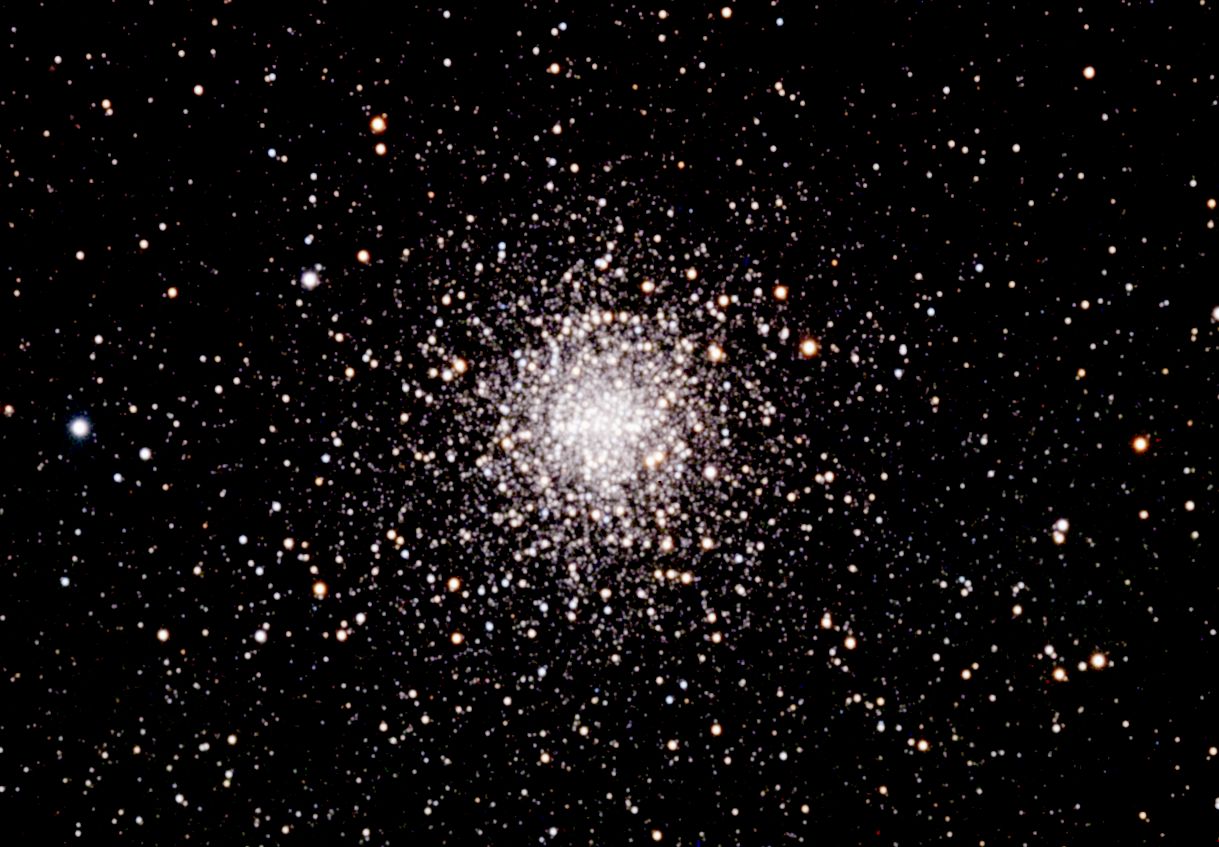
Astronomers worked out the effect of the white dwarf on the pulsars rotation, and then backtracked from that to show that something was affecting the motions of both of them. That something was shown to have the mass of bout two and a half Jupiters, definitely in the planet, as opposed to brown dwarf [13], range. The whole system is part of the nearby globular cluster [11] 'M4', a hive of a hundred thousand ancient suns.


Video above: The Hubble Space Telescope observations of the M4 globular cluster, followed by a CGI impression of the strange, cthonic, star system it has found lurking there. Image courtesy of  NASA, Lynn Barranger (STScI), and Greg Bacon (STScI)

The scenario put forward to explain this planet is that it probably formed around some star a bit tamer than the pulsar, and was stolen via a massive game of gravitational billiards. That's pretty rare in our part of the galaxy, but amongst the teeming red giants and stellar copses of M4 such thievery is probably quite common.
Even though the planet is probably an interloper in its current home, the chances are very good that it still formed within M4. That means around a metal poor, ancient, sun. So, once again, its existence is hard to explain with the core accretion theory.

The M4 globular cluster of ancient stars. Image courtesy of Sid Leach


The teeming suns near the core of  M4. Unseen in there, but definitely having an influence on the motion of the visible stars, are black holes, neutron stars, white dwarfs, and blue stragglers [12]. Credit: NASA/STScI/WikiSky

Our current theories of planet formation have a lot going for them, and so probably aren't totally wrong. But science is an ongoing thing, and theories are supposed to get revised, and improved, as more evidence comes in. It's a never ending effort to reach a goal that may well be forever just beyond our reach; the absolute truth. Which is something that I wish more people, inside and outside the scientific community, would wrap their heads around.
These, utterly old, planets are pointing us towards improving our theory of how our own solar system came to be.
We just need to be smart enough to follow the signposts.

List of links:
[1]http://news.discovery.com/space/most-ancient-impossible-alien-worlds-discovered-120327.
[2]http://en.wikipedia.org/wiki/HIP_11952
[3]http://outreach.atnf.csiro.au/education/senior/astrophysics/stellarevolution_mainsequence.html
[4]http://imagine.gsfc.nasa.gov/docs/science/know_l1/dwarfs.html
[5]http://www.stanford.edu/~sehlert/Supernovae.pdf
[6]http://faculty.ucr.edu/~krice/coreacc.h
[7]http://nai.arc.nasa.gov/news_stories/news_detail.cfm?ID=160
[8]http://www.nasa.gov/mission_pages/juno/main/index.html
[9]http://www.sciencedaily.com/releases/2009/04/090423100808.htm
[10]http://en.wikipedia.org/wiki/Pulsar
[11]http://www.astro.keele.ac.uk/workx/globulars/globulars.html
[12]http://hubblesite.org/newscenter/archive/releases/2011/16/text

Thursday, 31 May 2012

Fire, Darkness, and Starbirth: A whistle stop tour of Cygnus X

Hows my blogging? Leave some feedback, I get better at this, you get a more interesting read!

A little while ago I posted this image of the Cygnus X star-spawning region:


Image above: A grand view of Cygnus-X, a massive complex of star spawning gas and dust, as seen by the ESA Herschel space observatory, in infrared light. Image courtesy of ESA. Yes I know it goes over the border a bit (Edit: It doesn't now!). I couldn't bear to show it any smaller.

It made my brain explode, although not literally. If it had done that I wouldn't have been terribly, terribly, tempted to set it as my desktop background - and I've had to put a moratorium on changing the desktop. I was making a new one every time another jaw dropping space image came down, which meant twice a day some weeks.

It wasn't until a few days ago that this occurred to me: As well as being stunning to look at - in fact one of the things that makes it so stunning - you can tell with a glance that this is a vast, complex, alien realm.
With a lot going on in there that has bearing of our own star systems deep past I ought to talk about some of the things that we know, or strongly suspect, might be hiding in that amazing picture.

So, here is the tour of Cygnus X:

The Milky Way galaxy as imaged by DIRBE (Diffuse Infrared Background Experiment). Cygnus X is circled in green. Image courtesy of NASA.

All good tours start with some background:
The Cygnus X region, located 4,500 light years away in the direction of the Cygnus constellation, was first identified as unusual by two radio astronomers: J. H. Piddington and H. C. Minnett.
They were 'listening' to radio signals from space, and found a diffuse but powerful region of radio emissions in the constellation of Cygnus. Believing the source to be a vast cloud of ionised interstellar gas [1], they christened it Cygnus-X to separate it from the radio emitting galaxy Cygnus-A, which lies in the same part of the sky.

As it turned out, the cloud is one of the biggest and most active in the local galaxy, weighing in at something like three million times the mass of our sun. It is a birthplace for giant blue stars [2], and so the huge complex of gas and dust hums with cosmic rays [3], and electromagnetic radiation [4] on almost every frequency.
As such its a prime target for astronomers, and some of the greatest observatories on Earth, and in space, have devoted time to it. Infra red observations by space observatories like Spitzer [5] and Herschel [6] - using frequencies of infra red light that are blocked by Earths atmosphere - can image otherwise invisible objects behind veils of dust.

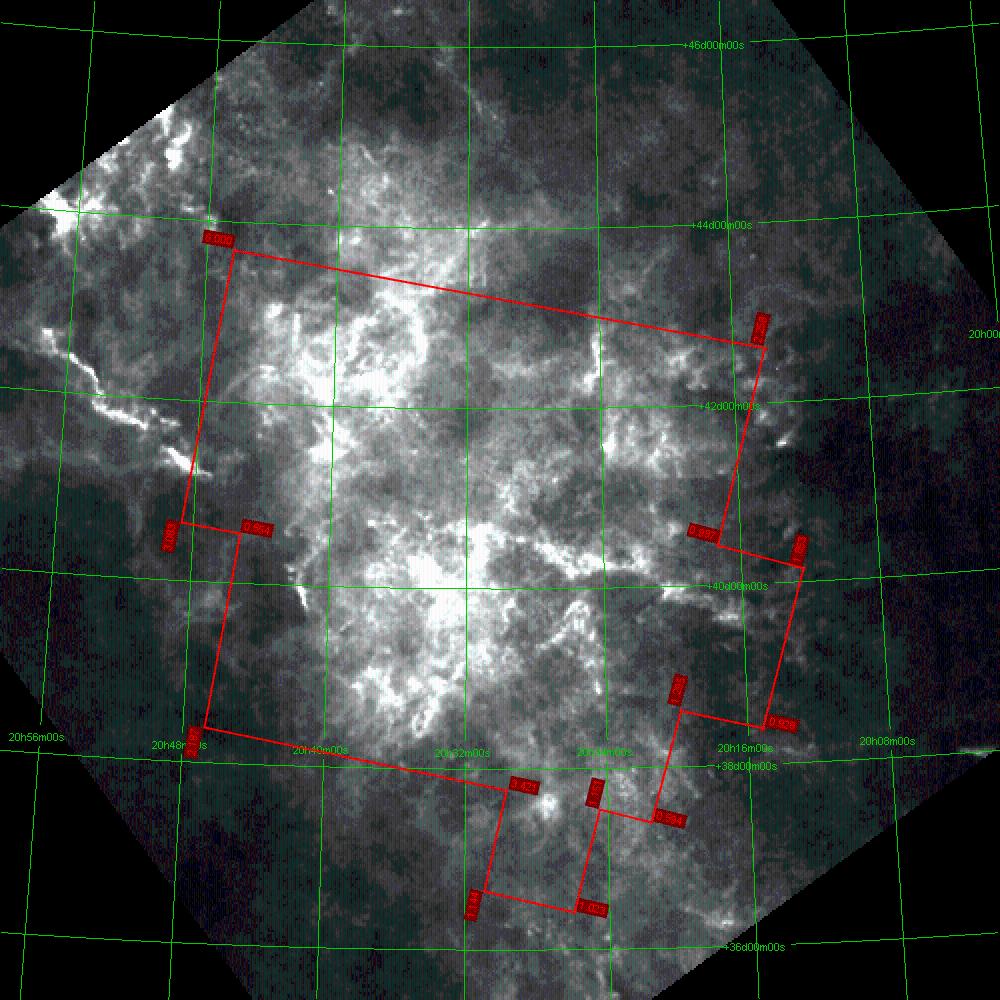
The section of Cygnus X studied by the Spitzer infra-red space telescope. Image courtesy of NASA/JPL.

The titanic blue suns shape the cloud around them, bullying the clouds hither and thither by high power stellar winds and high energy radiation. Some of these stars are right on the edge of exploding [7], as gravity and their over grown fusion hearts teeter along a knife edge balance, known as hydrostatic equilibrium. The huge suns determine which of the growing younger stars make it, and which die young, as they push the cloud material about, feeding some stellar embryos and starving others.

Image above: A false colour, infra-red, Spitzer Space Telescope image of Cygnus X. Hugely overpowered stellar winds from blue giants  and angry young protostars have blown voids into the clouds, giving them a foamy texture. Image courtesy of NASA/JPL.

But what else is there? I can't zoomify the image enough to show all the things that are, or could very well be, in there. But here are some examples of the things we know lurk in such chaotic and seething parts of the galaxy:

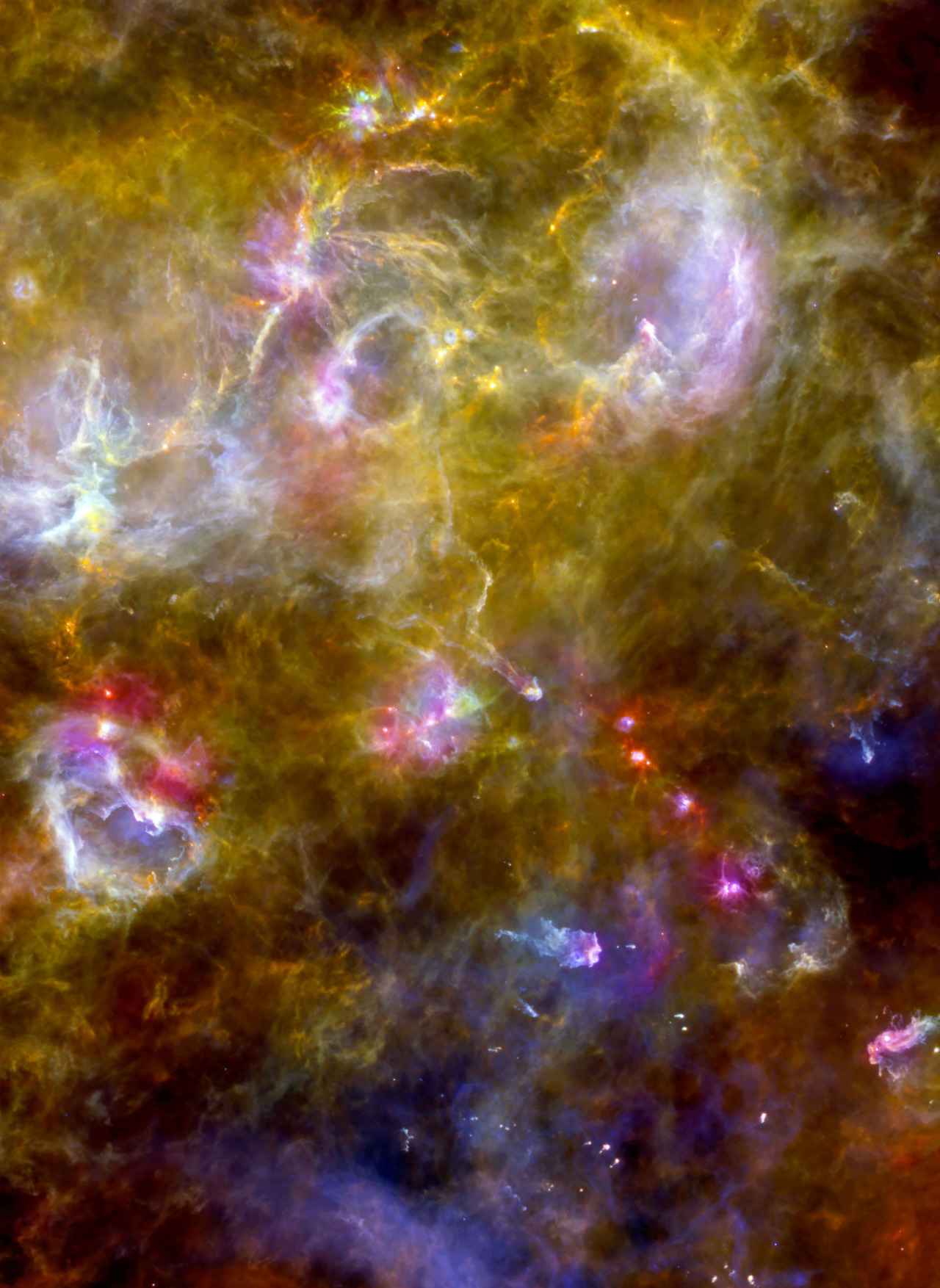
On the right hand side of the image at the very top of this post we see strings and filaments of gas, where the cloud is collapsing to firm new stars. Some of the young stars are forming inside long tendrils of cloud material - like the famous 'pillars of creation' in the Orion Nebula - and some are forming along huge filaments of cloud, like berries on a vine.


Image above: A close up on the most complex region of filaments in the newest Cygnus-X image. Image courtesy of ESA.

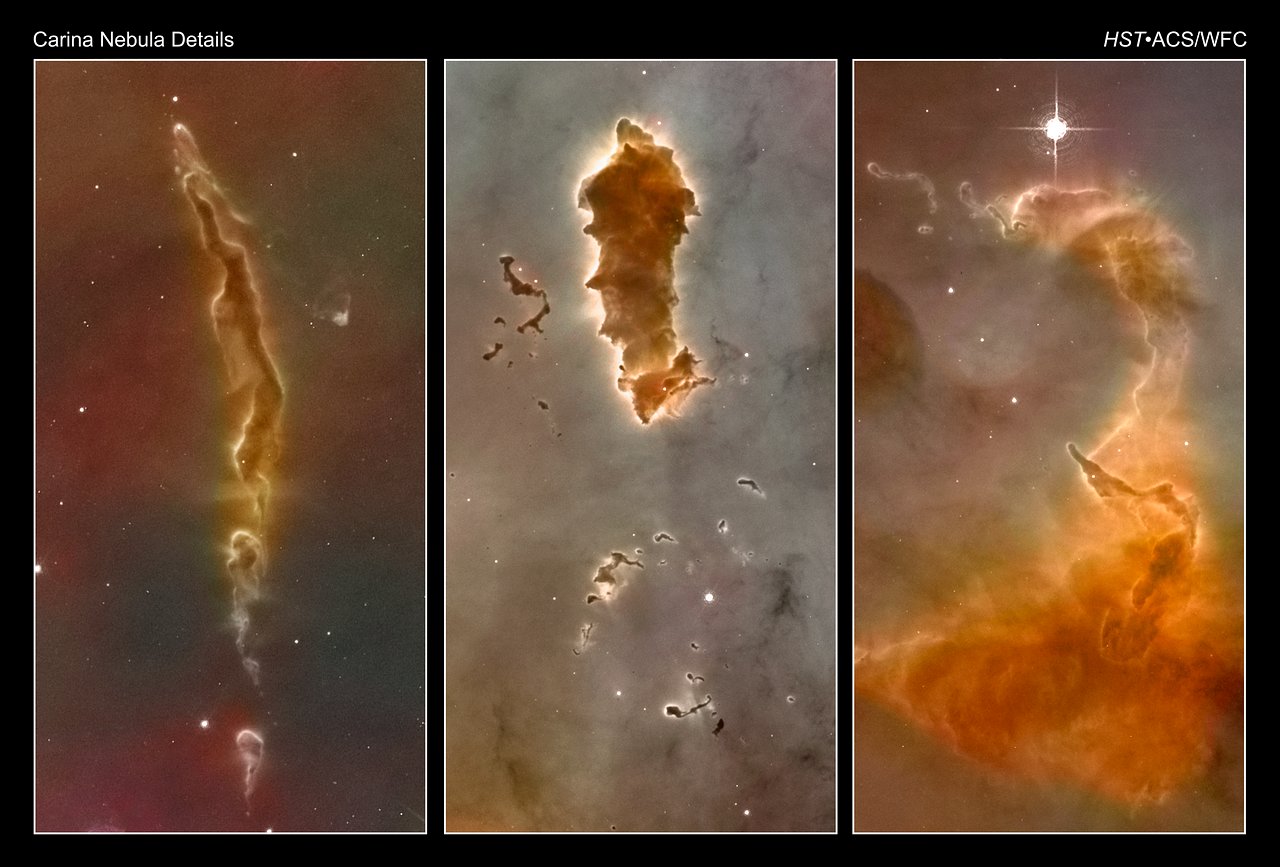
In time the filaments will collapse further, into Bok globules [8], which block out the visible light of the growing stars but can still be pierced - up to a point - by sensitive infra red telescopes like Spitzer:


Image above: Bok globules in the Carina Nebula, as seen by the Hubble Space Telescope . Image courtesy of NASA/JPL/ESA.

Herbig-Haro objects [9] are jets of ultra-hot gas, as much as twenty Earth masses worth, spat out of the poles of new-born stars at hundreds of kilometres per second. Where this blast ploughs into the surrounding gas it excites the gas molecules, causing the green-blue glow. These are more common from growing binary star systems:  

Video above: Hubblecast on Herbig - Haro stars. Video courtesy of ESA.

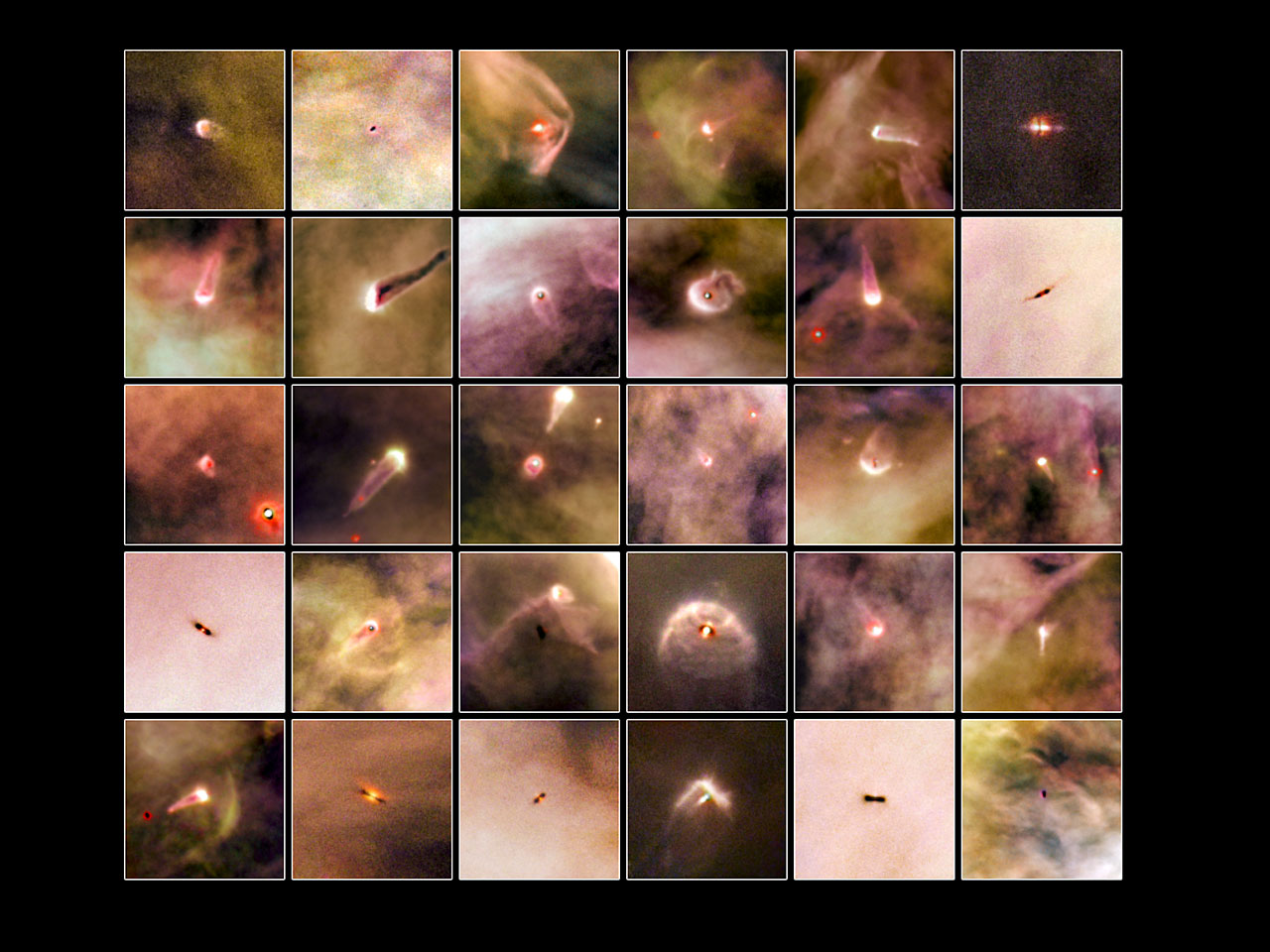
Propylyds [10] are protoplanetary discs orbiting the infant stars, where the building blocks of new solar systems are growing, even as matter from the inner edge of the disc is gulped down onto the young stars surface by its magnetic field and vapourised:

Hubble images of propylyds in the Orion nebula. Image courtesy of NASA/JPL.

Cygnus OB2-12 is a blue hypergiant star [11], 92 times more massive that the sun, millions of time brighter than our sun, and over 18,000 degrees kelvin at the surface, that may be blowing itself apart as we watch.


Artist impression of a Hypergiant rising over a nearby planet.Image courtesy of Supportstorm

The open cluster [12] NGC 6910, a family of young stars still surrounded by the remnants of the clouds that gave birth to them:

Image above: The open cluster NGC 6910, a gaggle of young stars. Image courtesy of Dr. Franz Gruber.


Image right: The Gamma Cygni supernova, or to be more precise, the still expanding remains of the giant star that caused it.                                                                 The 7000 year old gamma Cygni supernova remnant, a vast zones of destruction almost a hundred light years across, with the stellar core still 'living' in the centre as a pulsar [13]. Pulsars are balls of superdense matter with an iron crust and an interior of neutron super fluid [14], a pinhead of which would outweigh a supertanker. The dead star is still spinning hundreds of times a second, giving off twin lighthouse beams of radiation, and powering a magnetic field up to 1000,000,000,000 Gauss. By comparison the whole of Earths iron core manages a field strength of 0.3 Gauss. Even weirder, its electric field is so strong that it spontaneously decays [15] into matter and antimatter, electrons and positrons 'just' appearing out of the intense electric field.

And where you have lots of unstable stars, and at least one confirmed supernova, you will almost certainly find others, and their 'undead' stellar leftovers: Neutrons stars [16], black holes [17], perhaps even stranger things like quark stars [18].....

Finally, just because space explorers are great, here are a selection of amazing views of Cygnus X, in frequencies across  the electromagnetic spectrum:


Video above: Cygnus X, from a wide variety of instruments. Video courtesy of NASA.

There may be even stranger things in such regions of space. To really push the speculative boat out: A mix of dust and plasma - such as clouds like Cygnus-X are made of -  is known to form 'crystals' where the dust forms a regular repeating pattern in the plasma. Computer simulations have suggested that plasma crystal structures not unlike DNA [19], with some  ability to evolve and replicate, may be possible.

All the above is just a slice of the things at play in Cygnus X, and similar, wilder regions like the Tarantula Nebula [20] . And it amazes me still further to think that our Sun and solar system was probably born in a not dissimilar place, almost five billion years ago...

And ,in other news much, much closer to home: A video of the Sutter's Mill meteorite [21] -a real relic from the solar systems earliest times - has surfaced. I looked for hours for one when I posted on the subject a while back, and I'm thrilled that someone has managed to take a video of the minivan sized space rock hitting our atmosphere. And exploding with the force of small nuclear weapon. Only a small one though. Enjoy!


Video above: Big rock smashes into Earths atmosphere. And you've gotta love that soundrack. Video courtesy of Shon Bollock.
List of links:
[1]http://www-ssg.sr.unh.edu/ism/what1.html
[2]http://www.sciencedaily.com/articles/b/blue_supergiant.htm
[3]http://helios.gsfc.nasa.gov/qa_cr.html
[4]http://imagine.gsfc.nasa.gov/docs/science/know_l1/emspectrum.html
[5]http://www.spitzer.caltech.edu/
[6]http://herschel.esac.esa.int/
[7]http://www.astronomynotes.com/starsun/s7.htm
[8]http://www.universetoday.com/24499/journey-inside-a-bok-globule/
[9]http://www.stsci.edu/stsci/meetings/shst2/ballyj.html
[10]http://campus.pari.edu/mwc/html/proplyds.html
[11]http://cronodon.com/SpaceTech/Hypergiant.html
[12]http://messier.seds.org/open.html
[13]http://imagine.gsfc.nasa.gov/docs/science/know_l2/pulsars.html
[14]http://physicsworld.com/cws/article/news/2011/mar/02/neutron-star-has-superfluid-core
[15]http://adsabs.harvard.edu/full/1972ApJ...178..809P
[16]http://imagine.gsfc.nasa.gov/docs/science/know_l1/neutron_stars.html
[17]http://www.nasa.gov/audience/forstudents/k-4/stories/what-is-a-black-hole-k4.html
[18]http://news.discovery.com/space/why-are-quark-stars-so-strange.html
[19]http://physicsworld.com/cws/article/news/2007/aug/15/helices-swirl-in-space-dust-simulations
[20]http://apod.nasa.gov/apod/ap051212.html [21]http://apod.nasa.gov/apod/ap120428.html